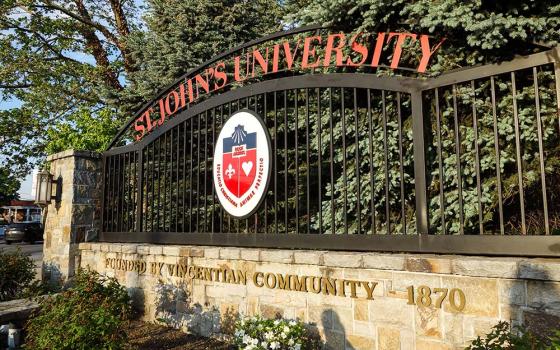

Signage at St. John's University in the Queens borough of New York City (Wikimedia Commons/StJohnHall, CC BY-SA 4.0)

by Brian Fraga
Staff Reporter
In recent years, a handful of Catholic universities and colleges across the country have used a similar playbook to undermine unionization efforts and to halt recognition of faculty unions on campus.
Those institutions claimed a religious exemption from the jurisdiction of the National Labor Relations Board, an independent federal agency that investigates unfair labor practices and that safeguards employees' rights to organize and collectively bargain.
Emboldened by the NLRB's 2020 decision that it does not have jurisdiction over religious schools, Catholic colleges and universities have cited the exemption in a manner that labor organizers have said amounts to union busting on their campuses. Faculty union leaders say that violates a tenet of Catholic social teaching: the right of workers to organize and collectively bargain.
Institutions that have claimed the religious exemption include Boston College, Duquesne University, St. Leo University, Marquette University, and most recently, Loyola Marymount University.
And now, faculty union leaders at St. John's University in Queens, New York, are sounding the alarm that they believe the 155-year-old Vincentian institution is laying the groundwork to follow the same path as other Catholic colleges.
"The university is beginning, it hasn't formally made that move yet, but it's beginning the process of trying to decertify us on First Amendment grounds," said Christopher Denny, a theology and religious studies professor who serves as president of the university's faculty association.
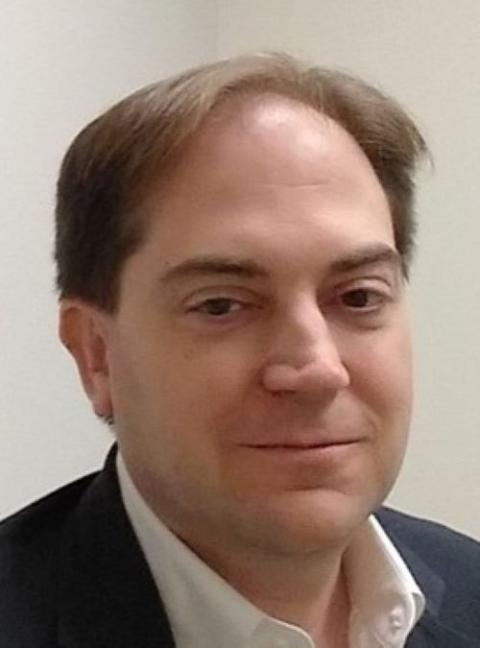
Christopher Denny, a theology and religious studies professor at St. John's University (Courtesy of Christopher Denny)
Fred Cocozzelli, president of the St. John's University chapter of the American Association of University Professors, shares Denny's concern that the university's recent legal filing before a state agency that mediates labor relations disputes poses a direct threat to the unions on campus.
"I think there's no way around it," Cocozzelli said. "Once the framework of that argument is made, it's hard to avoid where it can go. It doesn't mean that they are going to do it, but it certainly primes their position in a way that they haven't previously."
In a statement provided to the National Catholic Reporter, a spokesman for St. John's University did not directly address the union leaders' concerns that the university plans to bust the two unions that have represented faculty members on campus in collective bargaining since 1970.
"As has long been our practice, St. John's University is committed to respectful, good-faith negotiations regarding our dedicated faculty and to an outcome that benefits all parties. We are, however, deeply disappointed by the actions and false statements from union leaders, which question their seriousness in this protracted process," said Brian Browne, the university spokesman.
'Accepting organized labor as legitimate is a core ideal of Catholic social thought.'
—Fred Cocozzelli
The flashpoint in the simmering controversy at St. John's University is an unfair labor practice complaint that the faculty unions filed on Oct. 6 against the university with New York's Public Employment Relations Board.
In their complaint, the unions alleged that the university's administration had not been forthcoming with how it calculates health insurance premiums for most of the unions' 1,266 full-time and part-time faculty members.
"We contend the administration has not been sharing information about its health care insurance calculations that they are required by law to share with us," Denny said.
The unions and the university have been negotiating since February on a new contract to replace the collective bargaining agreement, which expired on June 30. Among their contract demands, the unions are seeking 3.85% annual raises for full-time faculty, a 25-30% pay increase for part-time faculty and a reduction in health insurance premiums.
The university offered full-time and part-time faculty a 3% raise, according to the St. John's University chapter of the AAUP.
Browne, the university spokesman, told NCR that the union's contributions to health care costs are lower than those paid by their university colleagues.
"Our latest offer to the union representatives, in the context of declining enrollment and increasingly challenging market conditions, is already a more generous pay increase than what their administrative and staff colleagues received this year," Browne said.
In its official response to the unfair labor practice complaint, St. John's University denied the unions' accusation that it withheld information regarding health insurance premiums. Rather, the university said it provided the information requested.
But the university's Nov. 14 response went beyond addressing routine contract negotiations.
Asserting its identity as a religious institution of higher education, St. John's University argued that PERB lacks jurisdiction over the university on First Amendment grounds.
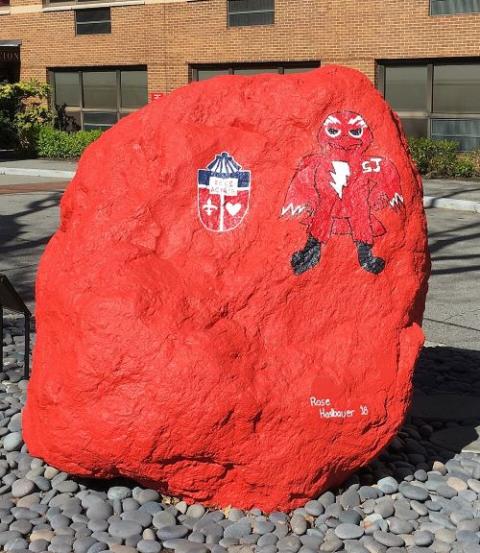
A drawing on a rock at St. Johns University depicts Johnny Thunderbird, the school's mascot. (Wikimedia Commons/CC BY-SA 4.0/Pete Unseth)
The university also argued that faculty members are "managerial employees" of the university and "therefore must be excluded from any bargaining unit." The university's response further argued that the state board was "preempted" from asserting jurisdiction under the federal National Labor Relations Act.
The university's attorney reiterated that position in a Nov. 19 letter to PERB. Attorney Howard Robbins, from the high-powered New York City law firm Proskauer Rose LLP, wrote that St. John's University did not consent to the board's jurisdiction in the unfair labor practice dispute, or in any other matter.
The university's legal arguments have rattled union leaders.
"Rather than dealing with the particular financial and contractual issues at play, they're just sort of going for the jugular," Denny said. "It's been 55 years since our collective bargaining unit came into existence and we to my knowledge have never had a situation where the St. John's administration has formally, in a legal filing, said that their religious mission precludes recognition of this collective bargaining unit."
Cocozzelli, who is a politics and government professor at St. John's University, said he hopes the administration will not do anything to put the faculty in an untenable position.
"We've been bargaining for a very long time, over 50 years of collective bargaining at St John's campus," Cocozzelli said. "It's been the kind of thing that faculty have come to expect from the university, for good reason. We're a part of life at the university. That there would be a change would be highly disruptive to the culture of the university, if not destructive in general."
The PERB held an initial conference hearing on the unfair labor practice complaint on Nov. 20, and has scheduled a follow-up appointment on Dec. 22, Denny said, adding that the two sides are also set to meet for an arbitration hearing on Dec. 8.
Advertisement
The university's arguments notwithstanding, there is a legal precedent in New York state law that indicates religious educational institutions are covered by the state statute that created PERB. A 1997 ruling by the New York State Appeals Court rejected a Catholic secondary school's argument that the First Amendment shielded it from the state's Labor Relations Act.
William Herbert, a public policy professor who is the executive director of the National Center for the Study of Collective Bargaining in Higher Education and the Professions at Hunter College in New York City, said that the New York State Constitution has a provision protecting the right to unionize and to engage in collective bargaining.
While adding that St. John's University had offered the unions a generous pay increase, Browne, the university spokesman, said in his prepared statement: "As the collective bargaining sessions are ongoing, we have nothing further to add currently and prefer to continue these discussions at the bargaining table."
Cocozzelli said he welcomed the spokesman's statement committing to continue bargaining in good faith.
"I would be glad to hear that they have no intention of challenging the faculty's right to a union and would hope that they make that position clear," Cocozzelli said. "Accepting organized labor as legitimate is a core ideal of Catholic social thought and it would be an act of good faith for the administration to say definitively and publicly that they accept the unions as negotiation partners."