
Sunlight cuts through smoke from the Pickett wildfire on Aug. 22, 2025, in Napa County, Calif. (AP/Godofredo A. Vásquez)

The Trump administration's erasure of the scientific finding that emissions driving climate change endanger public health drew swift condemnation from Catholic leaders, who characterized the move as morally indefensible.
The decision, finalized Feb. 12 by the U.S. Environmental Protection Agency, sets the stage for a high-stakes legal battle that many see ultimately leading to the U.S. Supreme Court.
In 2009, EPA issued the "endangerment finding," a scientific determination that six greenhouse gases, including carbon dioxide and methane, pose a danger to human health and welfare. It stemmed from a directive by the Supreme Court in its landmark 2007 decision in Massachusetts v. EPA, which ruled greenhouse gas emissions are air pollutants subject to EPA regulation under the Clean Air Act.
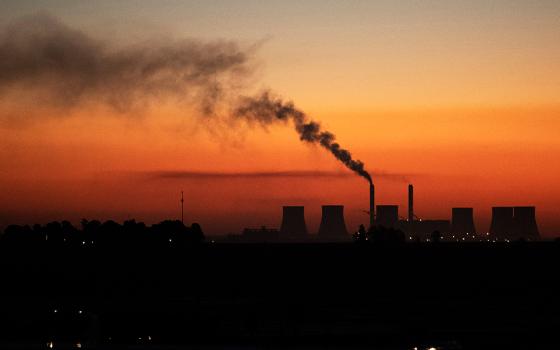
Greenhouse gases are primarily released from burning coal, oil and gas. An overwhelming preponderance of scientific evidence has shown that increasing rates of greenhouse gases in the atmosphere are rapidly heating the planet and with it altering climates across the map with more intense heat waves, extreme storms, droughts, wildfires and flooding.
The last 11 years have been the hottest on record, and climate scientists project the rise in average temperatures will eclipse 1.5 degrees Celsius (2.7 degrees Fahrenheit) sometime in the next decade, a point at which hundreds of millions more people worldwide would be at risk of climate impacts.
The endangerment finding has been the bedrock of nearly all federal climate-related regulations and policies in the past 16 years, including limits on emissions from vehicles, coal-fired power plants and other polluting industrial sources. Environmental groups and several states have said they will challenge the EPA move in court.
Eliminating the endangerment finding "places our country and our planet on a dangerous path," the Catholic Climate Covenant and the North American chapter of the Laudato Si' Movement said in a joint statement.
Advertisement
"Today's decision is more than a setback — it is unconscionable," the leading U.S. Catholic environmental organizations said.
"The Endangerment Finding should have stood. But our moral obligation to care for our common home remains unchanged."
Calling climate change "one of the greatest environmental threats we face," Chieko Noguchi, spokeswoman for the U.S. Conference of Catholic Bishops, said in a statement that EPA rescinding greenhouse gas regulations "flies in the face of efforts that have been put in place to protect and care for the earth now and for future generations, and we strongly urge the Administration to reconsider this consequential decision."
Bishop Joseph Tyson of Yakima, Washington, the episcopal liaison to the Catholic Climate Covenant, said in an interview that the endangerment finding repeal runs counter to church teaching on the environment and dignity of the human person.
"The science is pretty clear on this and it hasn't changed. It's only gotten stronger over time," he said.
Susan Gunn, director of the Maryknoll Office for Global Concerns, said in a statement that revoking the endangerment finding "demonstrates again that the climate crisis is a moral crisis."
"As people of faith, we know the 'cry of the earth' and the 'cry of the poor' are one," she said, citing a passage from Pope Francis' 2015 encyclical, Laudato Si'. "By dismantling these protections, the United States abdicates its duty to the most vulnerable. We must return to science-based policy to protect our common home."
EPA Administrator Lee Zeldin announced his agency's elimination of the endangerment finding inside the White House's Roosevelt Room alongside President Donald Trump. They referred to the step as the single largest deregulatory action in U.S. history, while Zeldin repeated a past critique of "the climate change religion" that had drawn the ire of faith leaders.
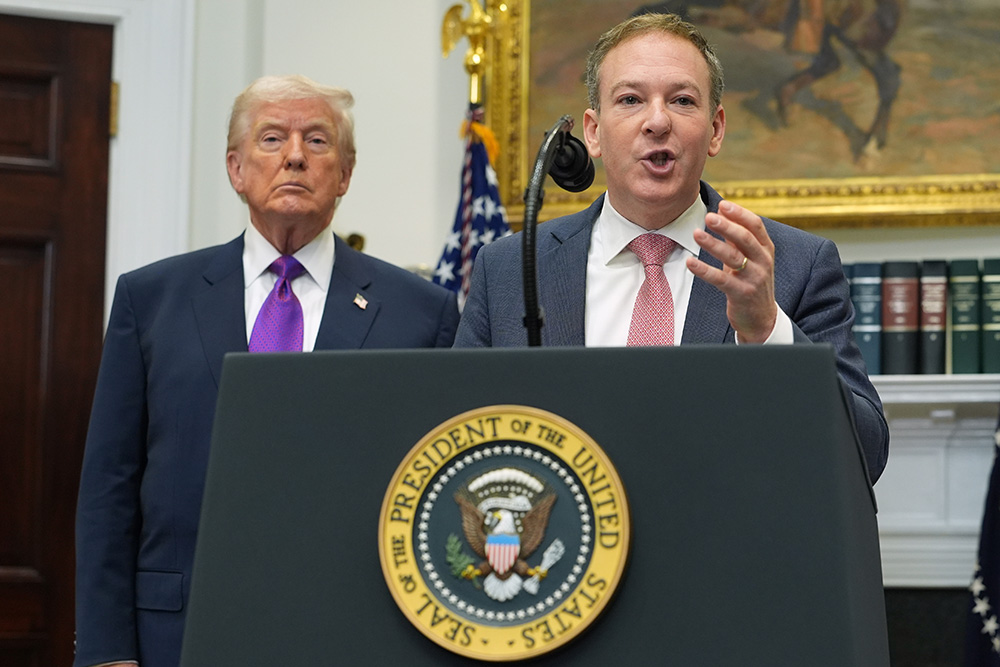
President Donald Trump listens as Environmental Protection Agency Administrator Lee Zeldin announces his agency's elimination of the endangerment finding Feb. 12, 2026, in the Roosevelt Room at the White House in Washington, D.C. (AP/Evan Vucci)
When asked by a reporter about how revoking the endangerment finding would impact health and the environment, Trump said, "It has nothing to do with public health. This is all a scam, a giant scam."
Numerous studies have linked climate change to harming health, whether increased heart disease and lung cancer tied to exposure to fossil fuel pollution, expanding vector-borne diseases or respiratory issues from smoke from more extreme wildfires. A 137-page report by the nation's top science and medical academies last September concluded the evidence of greenhouse gases harming human health "is beyond scientific dispute."
Revoking the endangerment finding and related regulations could lead to as many as 58,000 more premature deaths by 2055, according to an analysis by the Environmental Defense Fund, which has vowed to sue the Trump administration.
Catholic and faith organizations have championed the endangerment finding since it was issued in 2009. Catholic Climate Covenant and other faith organizations helped mobilize nearly 10,000 comments — including a 15-page comment from the U.S. bishops' conference — in support of keeping the endangerment finding during the public commenting period last summer.
"This will go down in history as an act of immoral cowardice," said Rabbi Jennie Rosenn, founder of the Jewish climate group Dayenu. "The moment when the Trump administration sold our future to the fossil fuel industry, condemning us to a world that will be hotter, drier, and more dangerous."
Conservatives, the fossil fuel industry and regulation opponents have long sought to revoke the endangerment finding. It was included in Project 2025, the Heritage Foundation blueprint for a second Trump administration.
"This EPA would rather spend its time in court working for the fossil fuel industry than protecting us from pollution and the escalating impacts of climate change," said Gina McCarthy, a Catholic who was EPA administrator during the Obama administration and is current chair of the America Is All In climate action coalition.
The repeal of the endangerment finding eliminates emissions standards on vehicles, the nation's largest source of greenhouse gas emissions and the focus of the Supreme Court case Massachusetts v. EPA.
In that 5-4 ruling, the high court ruled that "without a doubt" carbon dioxide, methane and other greenhouse gases fall under the definition of an air pollutant under the Clean Air Act.
That determination is likely to be challenged by the Trump administration as lawsuits against its repeal of the endangerment finding make their way through the courts, said Tseming Yang, head of the Environmental Justice Law & Advocacy Project at Santa Clara University.
In relitigating the air pollutant definition and whether Congress explicitly considered greenhouse gases when it passed the Clean Air Act, the Trump administration is hoping to find a Supreme Court more open to those arguments, Yang said. Three justices who dissented in Massachusetts remain on the court: Chief Justice John Roberts, Samuel Alito and Clarence Thomas, all of whom are Catholic.
"This entire rulemaking is really designed to appeal to those conservative members of the Supreme Court, hoping that they will, essentially, overturn that 2007 Massachusetts v. EPA decision," he said.
Should legal challenges to EPA's revoking of the endangerment finding reach the Supreme Court, Tyson said, it's possible the bishops' conference could file an amicus brief in support of maintaining the 2009 decision. "All of the options would be on the table," he said.
In the meantime, he encouraged Catholics not to become discouraged by the Trump administration's unraveling of federal environmental regulations and instead seek actions, both locally and nationally, to care for creation, including at the ballot box.
"We want to continue to be involved in public policy and find ways to enhance democracy, to not allow for the erosion of the democratic process in these kinds of rule changes," Tyson said, "and to be very, very attentive when we vote, to weigh heavily these questions of justice. The cry of the poor is the cry of the Earth, and that really has to be at the center of our public policy advocacy."