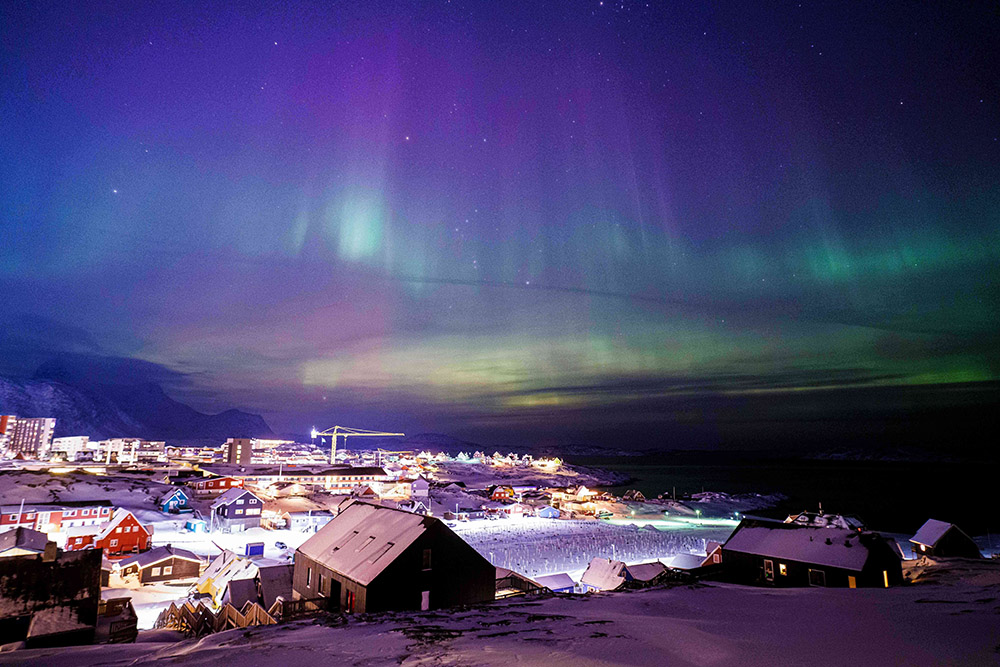
Aurora borealis, also known as the northern lights, is seen in the sky above Nuuk, Greenland, Jan. 20, 2026. (AP/Evgeniy Maloletka)

In Nuuk, Greenland's capital, a Catholic community of about 300 people is following renewed international debate over the island's future with a mix of concern, detachment and quiet attention. As global headlines once again frame Greenland in strategic terms, local Catholics — many of them Filipino immigrants — are processing the debate at a distance.
"When Greenland suddenly appears again in global headlines, people feel exposed," said Franciscan Conventual Fr. Tomaž Majcen, pastor of Christ the King Parish in Nuuk and the only Catholic priest responsible for pastoral care in Greenland.
"It is strange to see your home discussed far away, often by people who have never been here," he told the National Catholic Reporter on Jan. 19.
The renewed international attention — sparked by President Donald Trump's repeated claims that the United States should buy or annex Greenland — has stirred unease in a place unaccustomed to being spoken about as a strategic prize. For Greenlanders, including the small Catholic minority, they are concerned about their dignity and identity as well as a fear of being reduced to a negotiating tool.
"Greenland is still navigating its path toward greater independence from Denmark, and hearing ourselves discussed like a bargaining chip was disheartening for many," Majcen said. "But it also brought us closer together."
Majcen, 50, began serving Greenland in 2023 after years of pastoral visits to Catholics there while living in Denmark. Currently, his life is divided between Copenhagen and Nuuk, a reality shaped by harsh weather and uncertain travel. Flights are often delayed or canceled. Presence here is fragile, never guaranteed, he said, adding that this fragility mirrors the experience of many local parishioners.
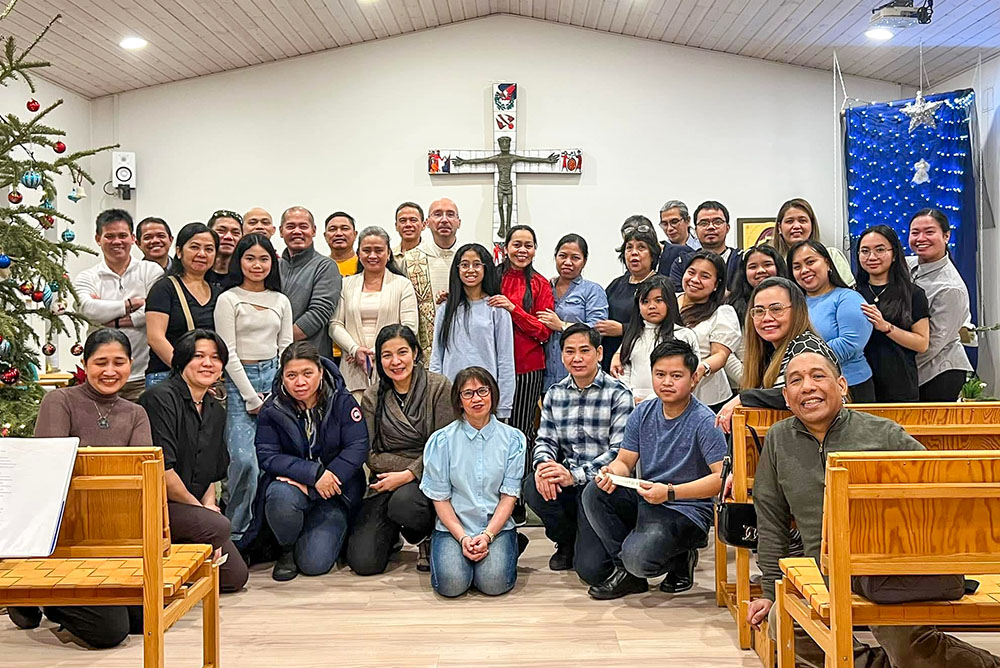
The Catholic community in Nuuk, Greenland, gathers with Franciscan Conventual Fr. Tomaž Majcen, pastor of Christ the King Parish, during Christmas 2024. (Courtesy of Tomaž Majcen)
One parishioner is Josephine Baquit, a 40-year-old from the Philippines who has lived in Nuuk for years. She runs a cleaning business with her sister and is raising two daughters born in Greenland. For her, the first news of Trump's interest in this region landed as a shock.
"I was very surprised," she said in a Zoom interview with NCR. "I was surprised, worried, because he might get in the country and it's not OK for me, in my own personal opinion."
Baquit's concerns are shaped by personal and historical memory. She mentioned the Philippines, where American military presence has left scars on land and communities, she said. Greenland, to her, is different — a place defined by calm, space and trust.
"What worries me is that this quiet land, or for me, this is like a peaceful place," she said. "My worries are that it might be exploited."
"Also the hearsay that Trump is against some immigrants or some foreigners, that's also one of my worries, that when he takes over Greenland, it might be the end of Asians or some foreigners here, or he might start some new rules about staying and working here."
Advertisement
On Jan. 16, Bishop Czeslaw Kozon of Copenhagen sent a letter to Majcen and the parishioners of Christ the King in Nuuk addressing the recent international spotlight on Greenland. In the opening lines of his letter, the bishop acknowledged: "In the last weeks and especially during the recent days Greenland has been on everybody's mind. A lot of concern and anxiety has filled many people worldwide, but especially in Greenland and Denmark, ordinary citizens and politicians alike."
The letter placed the current tensions in a broader context, pointing to wider global instability while urging confidence in spiritual resilience. Kozon wrote, "Many things are challenged and turned upside down in today's world. Peace and stability are at stake." He encouraged the community to remain rooted in faith and hope, stating that they should "be confident in God's mercy and providence that he may guide the governors of the world and make them open to his wisdom."
For migrant Catholics in Nuuk — many from the Philippines, Poland and other parts of Europe and Latin America — Greenland represents stability. Health care is free. Social protections are strong. Work is demanding but predictable. The idea that global power struggles could disrupt that balance creates a quiet anxiety, said Maria Jacobsen, a 68-year-old Catholic woman from the Philippines who has lived in Greenland since 1996 and works as a sales assistant in a large retail company.
"I felt sad and insecure," she said. "We pray that [Trump] cannot buy Greenland, because, you know, the social help in Greenland is very good."
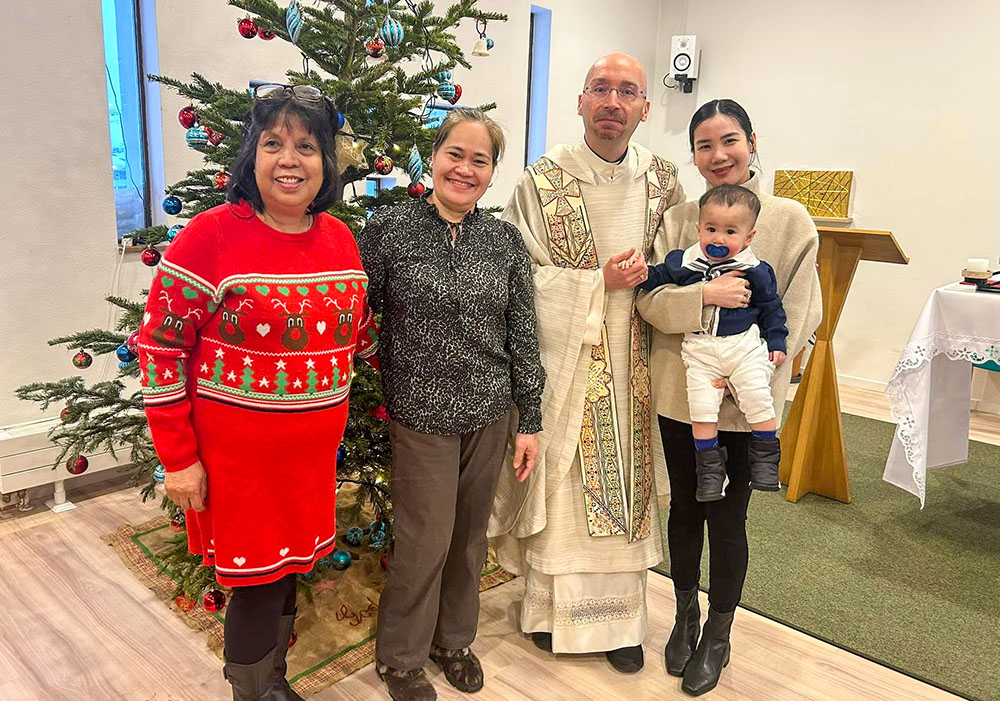
Maria Jacobsen, left, with three fellow Catholic parishioners and Franciscan Conventual Fr. Tomaž Majcen, pastor of Christ the King Parish in Nuuk, Greenland, during Christmas 2024 (Courtesy of Tomaž Majcen)
Jacobsen explains the worry in practical terms: free hospital care, long maternity leave, tax refunds — things that feel fragile when political uncertainty enters the picture. For her and others, fear peaked during moments of intense media coverage.
"We're all worried and afraid."
Yet fear here rarely turns into protest. The Catholic community tends to respond inwardly, gathering after Mass for coffee, exchanging concerns quietly, often choosing not to dwell on the news.
"After Mass, we normally have some coffee," Baquit said. "The mood is like, we are all talking about it and thinking, will it be?"
Majcen said he notices the same restraint.
"Most Greenlandic Catholics are not interested in political drama," he said. "But they are deeply connected to their homeland and community. So when President Trump speaks about buying Greenland, it likely feels disrespectful, as if their home, heritage and humanity were up for negotiation."
'Faith here is not loud or spectacular; it is humble and steady, like a small light in the Arctic night.'
—Franciscan Conventual Fr. Tomaž Majcen
When demonstrations took place in Nuuk, Majcen followed them from a distance. He did not march. Instead, he said, he prayed. "I believe that prayer is also a form of presence," he said. "As a priest, my role is not always to stand in the front with a banner, but to stand with the people before God."
For this community, faith offers grounding and politics is acknowledged, but rarely debated inside the church. At one recent interfaith prayer gathering, Jacobsen recalled, participants explicitly chose not to pray about politics at all.
Still, prayer has changed.
"I noticed that people have been praying more personally and simply," Majcen said. "There are more intentions for peace, for families back home and for the future of Greenland."
"Faith here is not loud or spectacular; it is humble and steady, like a small light in the Arctic night," Majcen said.
That light is sustained by lay Catholics like Baquit, who organizes children's religious dance, prays the rosary and novenas and passes on Catholic traditions far from her homeland.
"Being a Catholic here in Greenland, it's the same as anywhere else, but the faith is more," she said. "Because we are far, far away from our family."
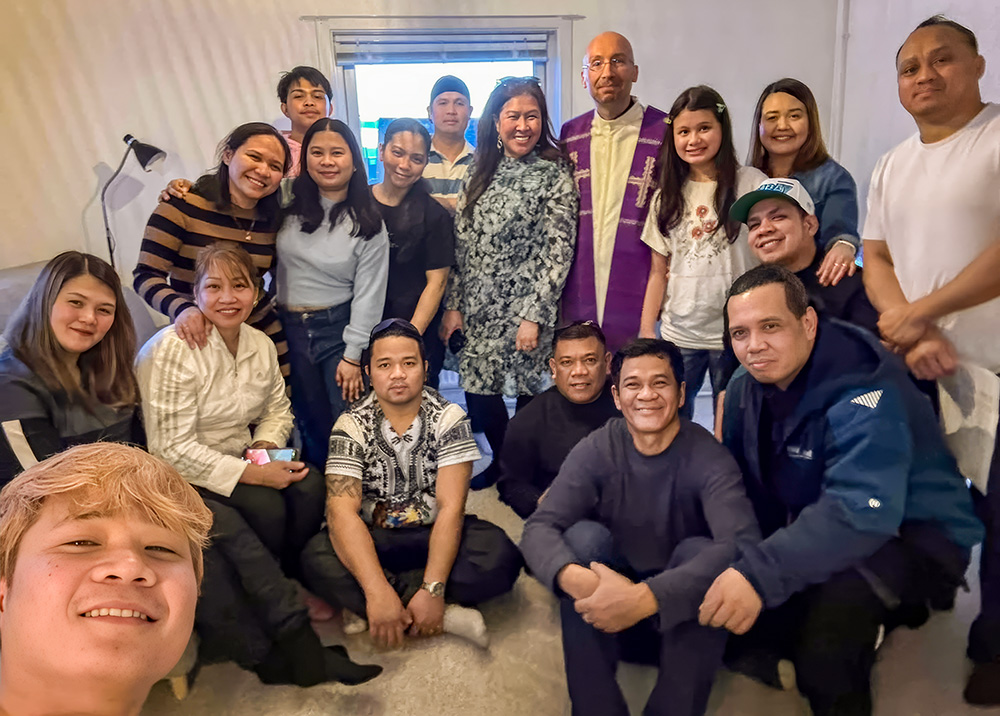
The Catholic community in Ilulissat, Greenland, gathers in a private home for a Mass with Franciscan Conventual Fr. Tomaž Majcen, the only Catholic priest in Greenland, in April 2025. (Courtesy of Tomaž Majcen)
And that sense of connection matters more now, as Greenland's future is debated elsewhere.
"Yes, there is worry — but it is not panic," Majcen said. "It is a quiet concern." What worries people most, he explains, is "invisibility" — the fear that Greenlandic voices will be ignored.
"People worry about stability, about respect for Greenlandic voices, and about whether ordinary people will once again be overlooked."
"We cannot control world politics," Majcen says. "But we can control how we respond — with dignity, calm and prayer."
Asked about what he thinks Catholics in the United States and worldwide should know about Greenlandic Catholics, Majcen said that he would like them "to know that Greenland is not an idea or a strategy — it is a home."
"We do not ask for attention; we ask for respect and prayer."