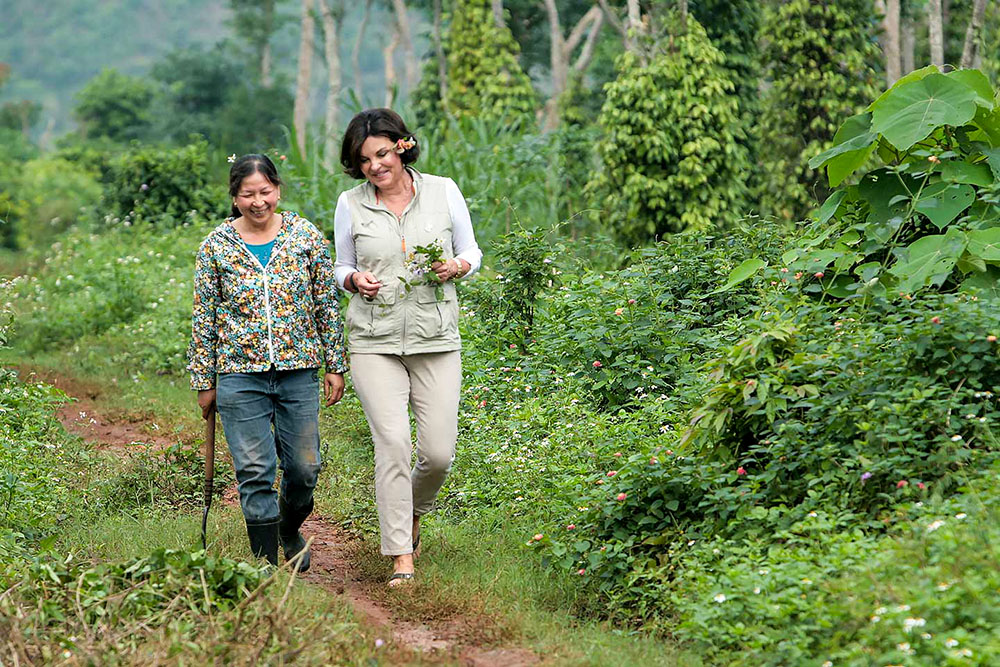
Heidi Kühn (right), founder of Roots of Peace, with a local farmer in Quang Tri, Vietnam, in 2020 (Courtesy of Thi Binh)

When Heidi Kühn arrives in a former war zone, the fighting has usually ended. What remains are landscapes that cannot be safely walked, cultivated or inhabited. Antipersonnel land mines and unexploded bombs lie beneath the soil, turning fields into hazards and preventing displaced communities from returning home.
For nearly three decades, Kühn has built an organization around a straightforward proposition: remove lethal land mines and replace them with agriculture. Clear contaminated land, then plant orchards, vineyards and high-value crops that can support families and local economies. The phrase she uses to describe this model — "turning mines into vines" — has become synonymous with her work and mission.
Kühn is the founder of Roots of Peace, a U.S.-based humanitarian organization that partners with professional demining groups and agricultural specialists to rehabilitate post-conflict land. Since its founding in 1997, Roots of Peace has worked in more than a dozen countries, including Afghanistan, Croatia, Vietnam, Cambodia, Angola, Iraq and Yemen.
The organization reports helping plant millions of fruit trees, supporting hundreds of thousands of farmers and managing more than $200 million in development programs funded by governments, multilateral institutions and private donors.
The approach is deliberately practical. Demining restores physical safety and agriculture restores livelihoods. Together, they aim to reduce the conditions that allow violence to reemerge.
Kühn does not present herself as a technical expert. She describes the work as something that emerged from personal experience, her Catholic faith and deeply personal circumstance rather than from professional design.
Advertisement
"My grandmother always taught me a beautiful saying, 'Coincidence is a miracle in which God prefers to remain anonymous,' and there are no accidents," she said.
The moment Kühn identifies as the beginning of Roots of Peace occurred on Sept. 21, 1997, in the living room of her family home in San Rafael, California. Three weeks earlier, Princess Diana had died after drawing international attention to land mine victims in Angola. Kühn was asked to host a reception. Nearly 100 people attended. Music was played. Kühn had not prepared remarks. When she raised a glass, she spoke a single sentence: "May the world go from mines to vines."
She was holding her youngest son, Christian, who had been born two years earlier after Kühn had survived cervical cancer. Years before, facing surgery, she had made a private prayer: "Dear God, grant me the gift of life, and I will do something special with it."
She began to view land mines as a parallel to illness — random, hidden and destructive.
"Cancer is a land mine ... and land mines are a cancer to the earth, and it just made such sense to me that the solution is removal," she said.
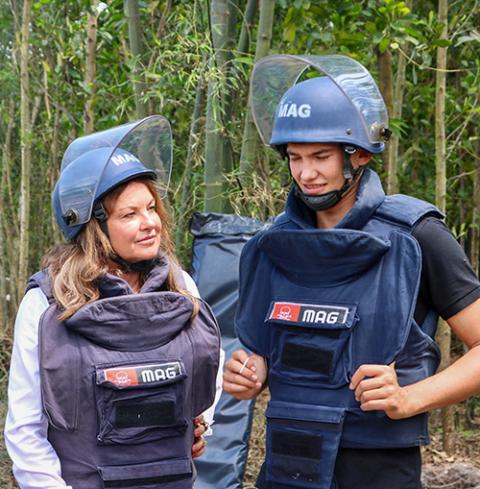
Heidi Kühn in Quang Tri, Vietnam, with her son Christian Kühn in 2018 (Courtesy of Vo Thi Lien)
Within weeks of the gathering, Kühn began telling people she intended to focus her life on removing land mines. The response, she recalled, was largely skeptical. She had no background in explosives, international development or large-scale agriculture. She was a former journalist and a mother of four living near San Francisco.
What she did have, she said, was a childhood shaped by Catholic education and religious experience.
In her interview with the National Catholic Reporter, she often returned to a memory from 1963, when she was 5 years old and attending Catholic kindergarten on the day President John F. Kennedy was assassinated. Sent home early from school, she asked her teacher how to make parents stop crying. The teacher told her to pray for peace. That night, Kühn said, she saw the Virgin Mary in a dream or a vision, and Mary gave her a single message: "Peace, peace and only peace."
She has interpreted much of her adult life through that vision, she said.
Roots of Peace began in the basement of her home. Kühn cold-called potential donors and foundations. Rejections were frequent. The first major financial support came from Napa Valley vintners, including Robert Mondavi, who organized a fundraiser in 1999 that raised $30,000. The U.S. State Department and the International Trust Fund later matched the amount.
In January 2000, Kühn traveled to Croatia, where she would walk a minefield for the first time. "They asked your blood type before you walked into a minefield," she said.
What she saw there solidified her commitment: children missing limbs, families unable to farm ancestral land, and communities paralyzed by hidden explosives. A boy asked her whether children in California could walk freely without fear.
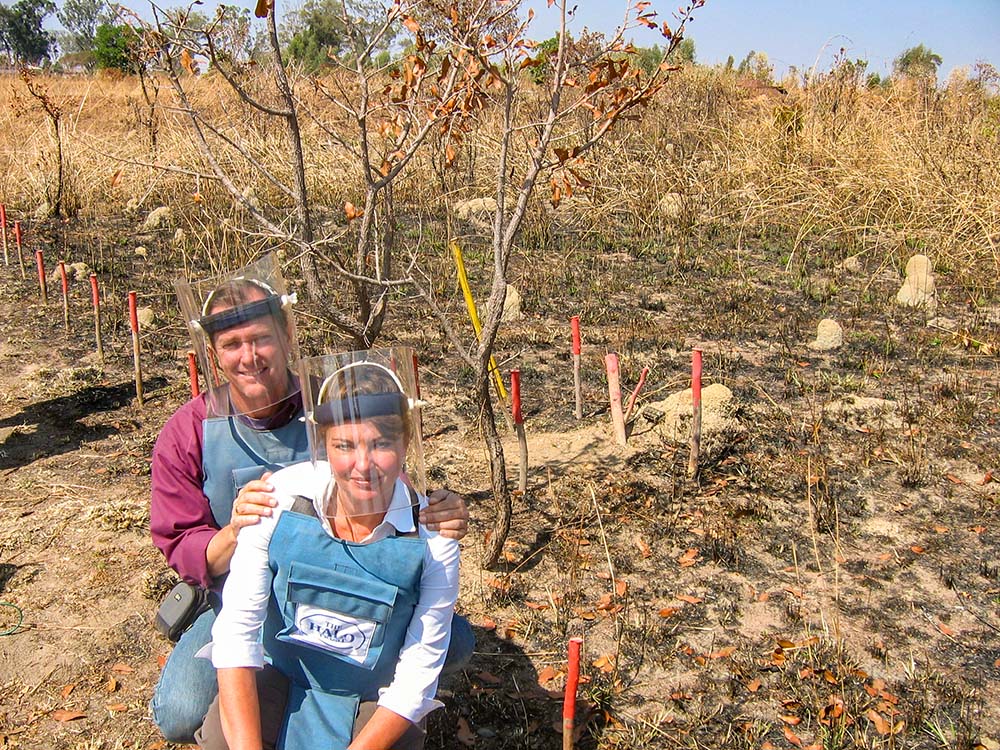
Heidi Kühn in Huambo, Angola, with her husband, Gary Kühn, in 2004 (Courtesy of Halo Trust)
From Croatia, Roots of Peace expanded into other post-conflict regions. After Sept. 11, 2001, Kühn turned to Afghanistan, where she learned that the country had a long history of grape cultivation. The organization began establishing trellised vineyards and orchards on cleared land. According to Kühn, Roots of Peace has helped plant approximately 8 million fruit trees in Afghanistan.
The work increasingly became a family effort. Kühn's husband, Gary, left a successful technology career at Adobe and traveled repeatedly to conflict zones. Their son Tucker is now CEO of Roots of Peace and previously served as country director in Vietnam. Their daughter Kyleigh, after visiting a minefield as a teenager, launched a penny campaign that raised 50 million pennies to build schools for girls in Afghanistan.
In different parts of the world, the organization's work is carried out by local professionals whose lives have been shaped by both war and by agriculture.
In Vietnam, Lien Vo grew up in the country's central region, one of the areas most heavily contaminated by unexploded bombs after decades of conflict. In a WhatsApp interview with NCR, she said more than 80% of the land around her childhood home was affected. Long before she met Kühn, the danger was a daily reality.
Vo has worked with Roots of Peace in Quang Tri province, along the former Demilitarized Zone between North and South Vietnam. When Kühn arrived in Vietnam, Vo said, the objective was clear: clear land and rebuild farms. The first focus was black pepper, a high-value crop well suited to local conditions.
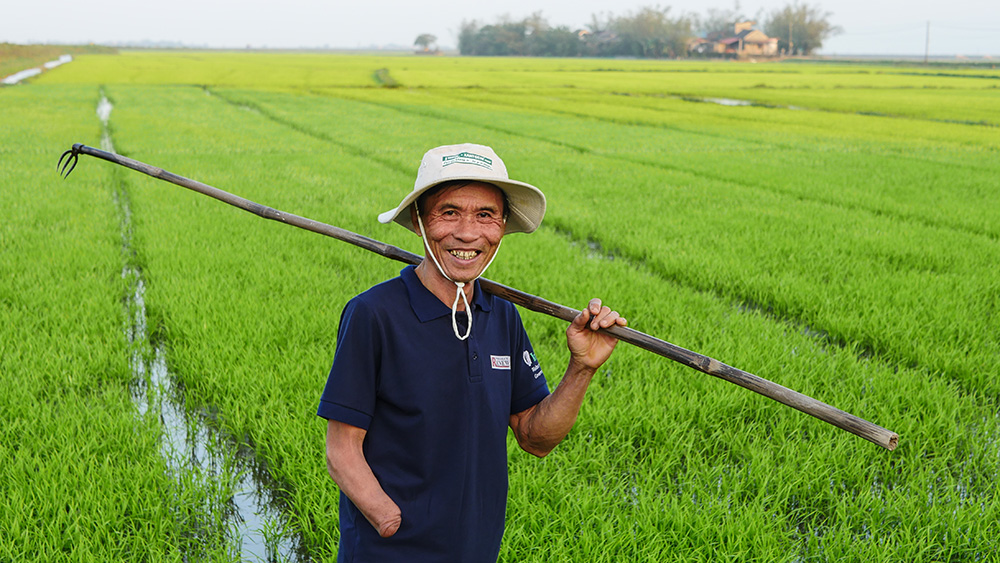
A Vietnamese farmer of the Quang Tri province goes back to his work — after being affected by a land mine — thanks to Roots of Peace in 2015. (Courtesy of Heward Jue)
The early work was shaped by risk. Farmers routinely encountered unexploded bombs buried deep in the soil. Some were killed while plowing or digging.
Roots of Peace connected with demining organizations to make land safe before planting. At the same time, Vo provided technical support, teaching farmers how to establish pepper vines, apply fertilizer, and manage crops as small businesses.
"Black pepper has the highest value in this area, and brings good enough income for the children to go to school and have a new education," she said.
One case remains particularly vivid for her. A man in his 40s lost both hands when a bomb exploded in his field. He survived, learned to farm without hands, married and had two children. Roots of Peace later helped clear and replant his land. But he eventually died after falling from a motorbike because he could not grip the handlebars.
Vo estimates that more than 60 hectares of land were cleared and converted to farms through the projects she supported. Although she is not an employee of Roots of Peace anymore, she continues working with Kühn as a business partner, helping farmers sell spices while Kühn's family helps export local Vietnamese products to the U.S.
In Guatemala, Roots of Peace operates in a different context. There are no active minefields, but the legacy of civil war, hunger and displacement remains visible across the western highlands.
Daniel Sandoval had previously worked in Guatemala's national planning secretariat, overseeing monitoring and evaluation of government programs. With Roots of Peace since 2021, his work shifted from policy analysis to field-based research and implementation, focusing on agricultural value chains in impoverished rural areas.
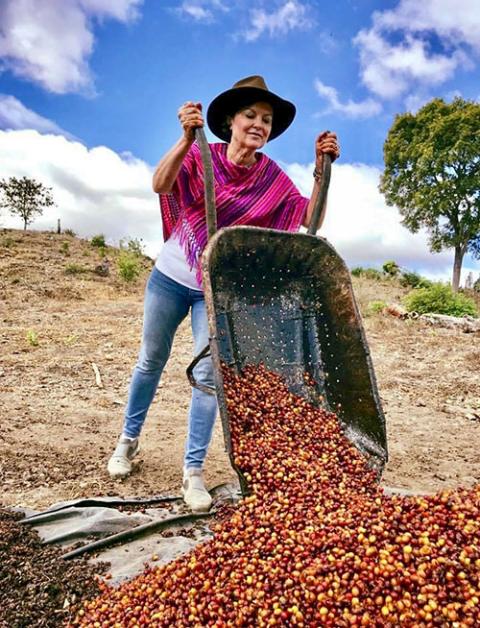
Heidi Kühn in the Central Highlands of Guatemala in 2019 (Courtesy of Gary Kühn)
One of the farmers supported through the program is Juanita Chiroy, an Indigenous smallholder and single mother of five from Cunén, in the department of Quiché. With Roots of Peace assistance, she installed low-pressure drip irrigation and shifted part of her maize-and-beans plot to vegetables such as onions and broccoli, while keeping maize for household food.
"With this new technique, in the same cycle of production she achieved four times more than in other years," Sandoval said to NCR.
He said he believes cases like Chiroy's can be replicated widely in Guatemala with the right amount of funding.
Despite decades of work, Kühn does not describe the effort as nearing completion. "There's still 110 million land mines in 70 countries nearly three decades later, and 30% of Ukraine is now mined," she said.
"I think we have to demine not only the soil but the soul, and demine our hearts, demine our minds and what is needed now in this world is a word we rarely use, and that's love."
In recent years, Kühn has launched additional initiatives, including "Global Gardens" and the "White Rose" projects, which focus on small-scale food production and symbolic plantings tied to peacebuilding.
Her Catholic identity remains central for this mission, she said, adding that she met four times with Pope Francis and brought him white roses. The last time she saw him in 2024, she told him: "Santo Papa, no mas minas, solamente rosas blancas. No more land mines, only white roses."