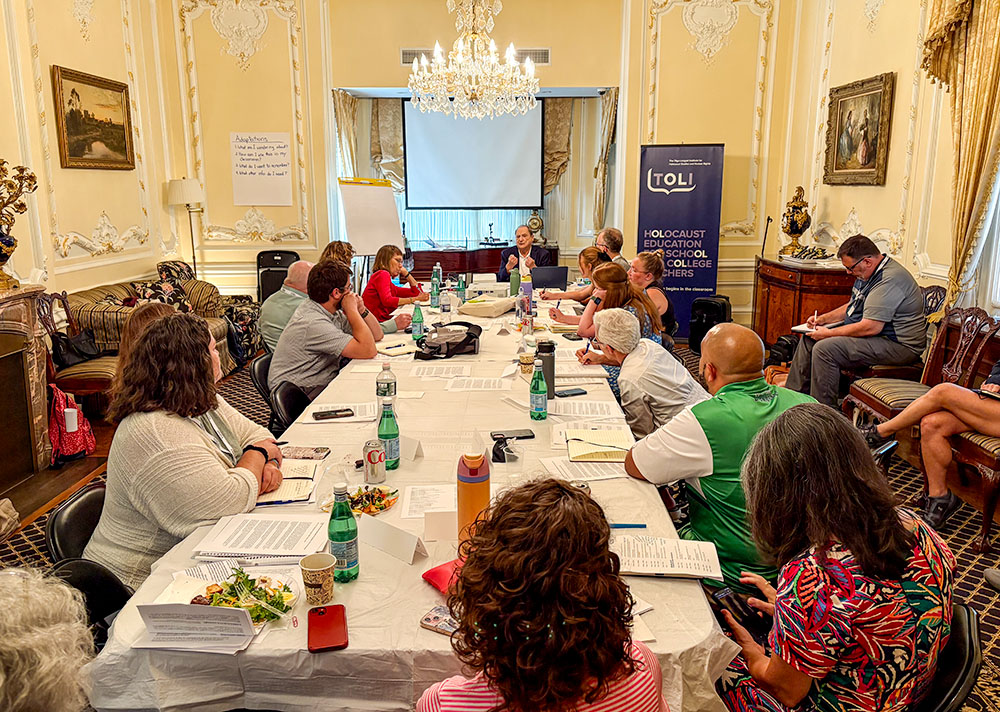
Catholic teachers sit around a table listening to Abraham Foxman's story as a Holocaust survivor hidden by a Catholic community, as part of a seminar organized by the Olga Lengyel Institute for Holocaust Studies and Human Rights in New York, July 25, 2025. (NCR photo/Camillo Barone)

It was an ordinary fall day in 1988 at the U.S. Conference of Catholic Bishops in Washington when Fr. Dennis McManus, then a young liturgist with no expectation of higher visibility, received an urgent call. On the line was the archbishop of Washington, Cardinal James Hickey, shaken and breathless, from just returning from a visit to Auschwitz, the former Nazi concentration camp in Poland. At the time McManus was already well known in the American church as a young expert on the Holocaust and Jewish-Catholic history.
"I need to talk to someone who understands prayer," Hickey told him. "Something happened."
Hickey had been part of a private tour of the camp. Walking through the gas chambers and crematoriums where hundreds of thousands were killed, he paused before one of the ovens, still lined with ashes and fragments of bone. Overwhelmed, he placed his hand in the ashes and began to pray.
Suddenly, he wasn't alone.
A group of men in striped prison uniforms surrounded him, speaking in Polish, German, Hungarian Yiddish — languages he couldn't understand. He turned to address them. "I'm sorry," he said. "I don't understand."
Then, they all vanished in a few seconds.
Shaken by that vision, Hickey flew to Rome. In a private meeting, he recounted the incident to Pope John Paul II. The pope listened and immediately nodded. "It has happened before to other priests who visited Auschwitz," he said. "They are saying: This must never happen again."
Fast forward to late July 2025, when McManus, now professor of dogmatics at St. Patrick's Seminary in Menlo Park, California, a senior fellow at the University of Georgetown and the U.S. bishops' delegate for Jewish affairs, stood at the head of a long wooden table in a quiet dining room in a Manhattan house once owned by Holocaust survivor Olga Lengyel.
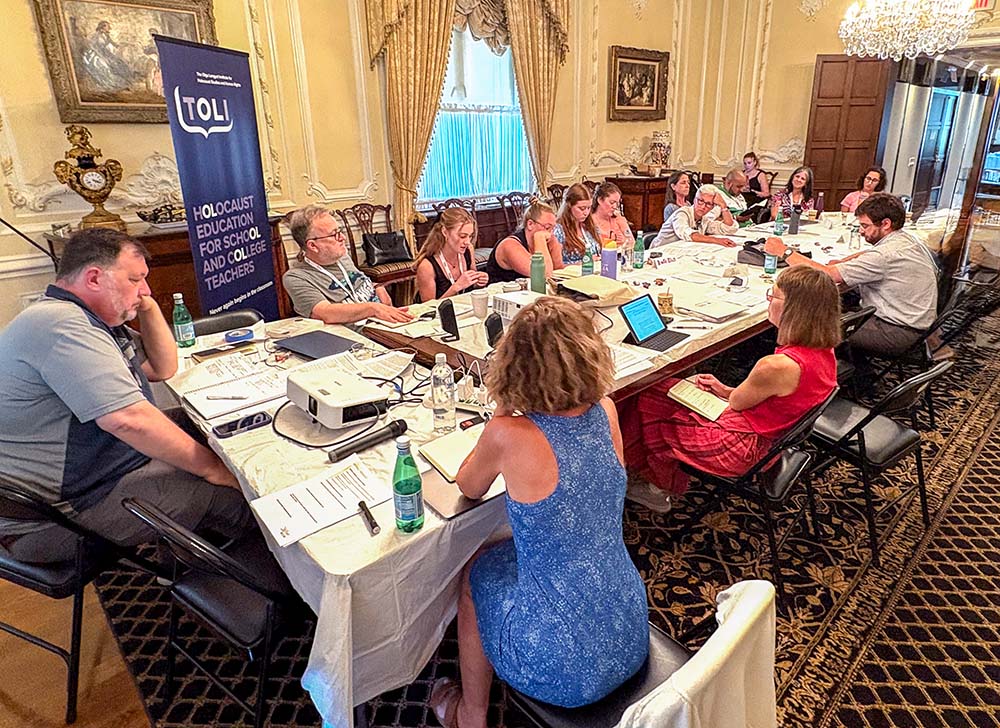
Catholic teachers participate in a workshop activity as part of a seminar organized by the Olga Lengyel Institute for Holocaust Studies and Human Rights in New York, July 25, 2025. (NCR photo/Camillo Barone)
As he recounted the moment Hickey stood alone in the ashes of Auschwitz, the room fell still. Around him, some two dozen Catholic teachers from across the country listened, visibly moved. Some with hands folded, others holding back tears.
Lengyel's former home in New York is now the headquarters of TOLI, the Olga Lengyel Institute for Holocaust Studies and Human Rights. Since Lengyel's death in 2001, the institute has trained teachers across the U.S. and Europe in Holocaust education. This session, held in partnership with the Bearing Witness Institute at Marist School in Georgia, focused solely on Catholic teachers — and for many, Hickey's haunting experience was a story they had never heard.
For Mark Berez, president and cofounder of the institute, the mission is personal. His own mother survived the Auschwitz, Buchenwald and Bergen-Belsen concentration camps.
A chance request from Lengyel's neurologist brought him into the orbit of the woman whose wartime memoir had inspired the novel Sophie's Choice.
"I thought I was just helping her with a financial issue," Berez said, chuckling softly. "Then she started calling every day."
Lengyel had survived Auschwitz, too. Her entire family — husband, two sons and parents — were murdered by the Nazis. In the 1990s, she asked Berez and three others to carry on her mission: to tell the story, to make sure it would never happen again. "She told me, 'You'll do it for your mother.' And I did."
When Lengyel died in 2001, she left behind not only her memoir, Five Chimneys, but also the Manhattan townhouse she had purchased with reparations funds reclaimed from the French government. It was this house, now transformed into a center for Holocaust education, that hosted the Catholic educators and McManus this summer.
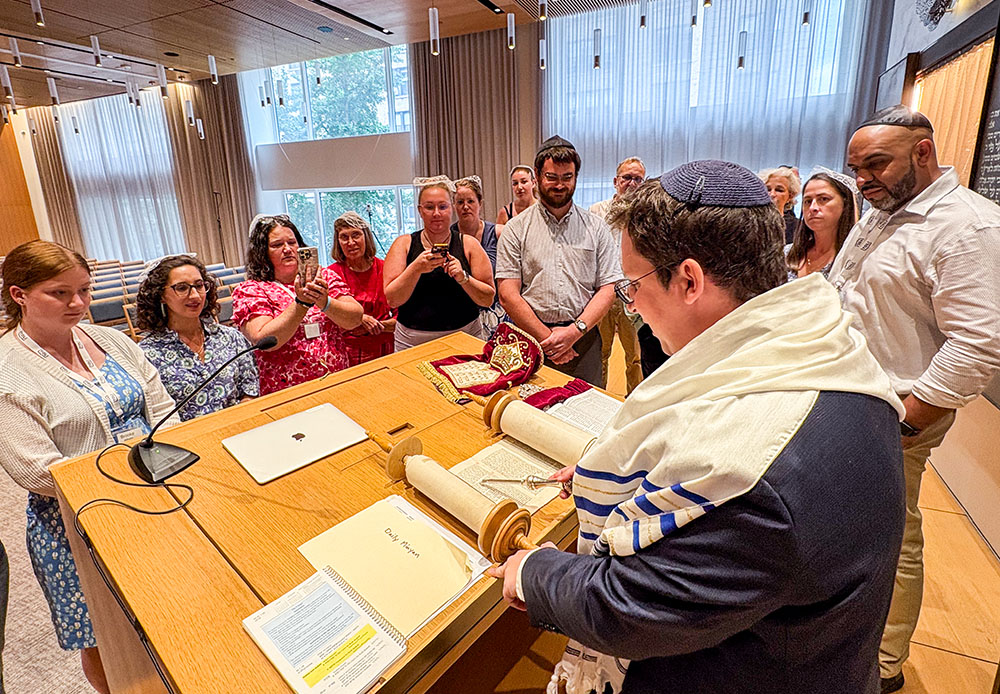
Rabbi Aiden Pink at Park Avenue Synagogue in Manhattan's Upper East Side shows a Torah to Catholic teachers who gathered in New York for the TOLI seminar, explaining to them how to read it, July 25, 2025. (NCR photo/Camillo Barone)
"We believe education is everything," Berez said. "We've brought more than 6,000 teachers through our programs since 2001."
"We're definitely at a disturbing, pivotal time in history," said Deborah Lauter, executive director of the Holocaust studies group. Lauter has worked for more than three decades to combat antisemitism worldwide.
"There's been an escalation of incidents, vandalism, harassment, assault. And the worst is murder," she told National Catholic Reporter.
She also called attention to a growing fear of abandonment by non-Jews, especially in light of rising polarization around the Israel-Hamas war. "Holocaust survivors are dying," and with that, the risk grows of the Holocaust becoming a fading memory, she said.
The Bearing Witness Institute, a co-organizer of the seminar with TOLI, says it exists to address a long-neglected reality within Catholic education: the church's complicity in centuries of antisemitism, and the urgent need to teach the theology that seeks to repair it. Founded and directed by Brendan Murphy at the Marist School in Atlanta, the institute works nationally to train educators in teaching the Holocaust, the Christian roots of anti-Judaism, and Nostra Aetate — the pivotal Second Vatican Council document that marked a radical shift in the church's teachings on Jews and Judaism.
Issued in 1965, Nostra Aetate rejected the doctrine of "deicide" — the false accusation that Jews were collectively responsible for the death of Jesus — and formally denounced antisemitism. It overturned nearly two millennia of church teaching that had marginalized, demonized and endangered Jewish lives.
Advertisement
That history helped make possible the Holocaust, which occurred "in the heart of European Christendom," Murphy emphasized. "There was a nearly 2,000-year legacy of deeply rooted Christian anti-Judaism."
While the church did not officially support Nazi ideology, Murphy said that "many Nazi officials were devout Catholics or Christians." Acknowledging this legacy is crucial to Catholic conscience, he said.
Murphy's own journey began two decades ago, inspired by McManus. "I was one of those teachers sitting at the table," he recalled. "And I came back to Atlanta and said, 'I've got to do something.' "
"Catholic teachers didn't know the history behind Nostra Aetate, didn't know why it was necessary. And that's the problem. It's not being taught in Catholic schools, in local parishes, in most Catholic communities."
During the July 23-26 seminar, the teachers gathered in small groups to explore how the church's seven themes of social teaching could help heal the historical rupture between Catholics and Jews. Based on what teachers might experience in real classroom settings, discussions touched on transgender rights, euthanasia, immigration raids, and bullying.
Teachers also reflected on the church's historical failures, including that nearly a quarter of the SS, or security force for the Nazi party, were Catholic and that some perpetrators received postwar help from church networks.
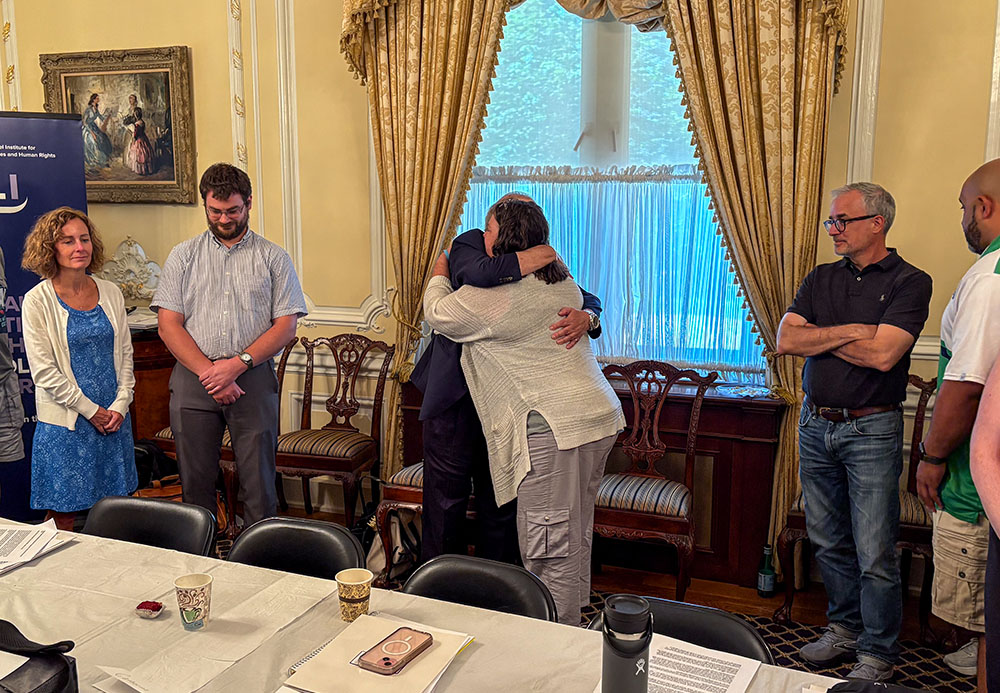
Catholic teachers individually hug Abraham Foxman during a seminar organized by the Olga Lengyel Institute for Holocaust Studies and Human Rights in New York, July 25, 2025. Foxman is a Holocaust survivor who had been hidden by a Catholic community (NCR photo/Camillo Barone)
Murphy of the Bearing Witness Institute led a session on acknowledging Christian antisemitism, resistance during Vatican II, and the church's ongoing responsibility. Holocaust survivor Abraham Foxman shared his story of survival — hidden by a Catholic community — and the complexity of gratitude and pain that followed. At the end of his testimony, all the teachers hugged him one by one and personally thanked him.
Teachers responded with writing reflections, some moved to tears, confronting their complicated relationships with the church.
"I feel a deep responsibility that is bigger than me," one wrote.
Another said: "Reluctance to speak is worse than silence."
That same evening, the teachers joined Rabbi Aiden Pink at Park Avenue Synagogue in Manhattan's Upper East Side for Shabbat services and dinner with the local Jewish community. Before the service began, Pink spent more than an hour introducing the group to Jewish prayer, Torah traditions and synagogue life, answering questions about faith and culture. The night concluded with music, dance and a shared meal.
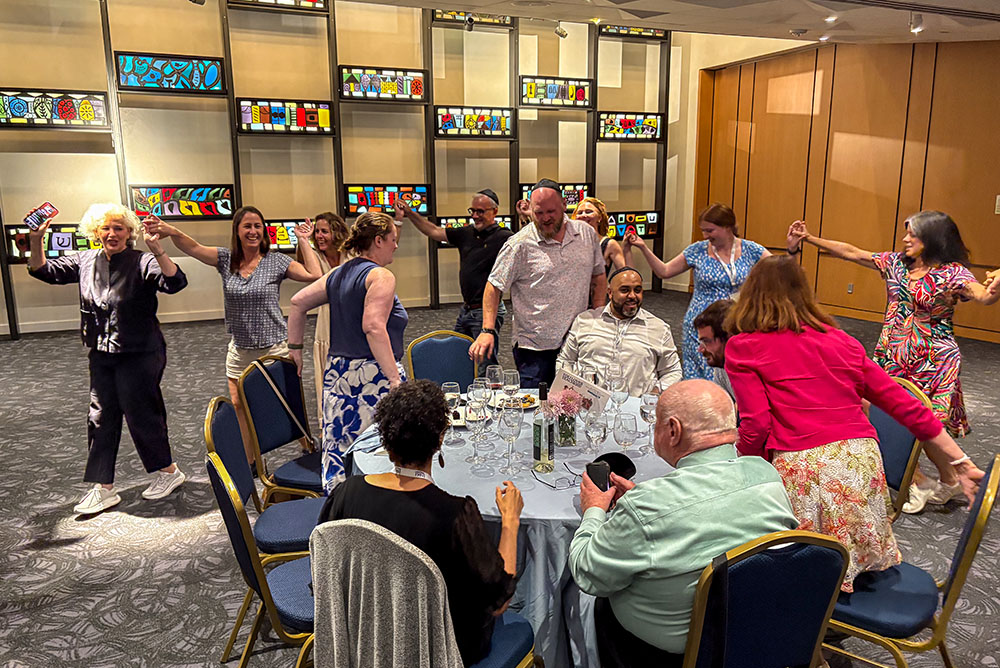
Catholic teachers do a traditional Jewish dance during a Shabbat dinner organized by the Olga Lengyel Institute for Holocaust Studies and Human Rights at Park Avenue Synagogue in Manhattan's Upper East Side, July 25, 2025. (NCR photo/Camillo Barone)
One of the most moving and transformative moments the teachers said they attended at the seminar was the joint Scripture reading and commentary offered by McManus and Rabbi David Fox Sandmel. The session focused on a passage from the Gospel of Luke — the story of the woman suffering from a hemorrhage — read through its original Jewish cultural context.
For many attendees, witnessing a Catholic priest and a rabbi analyze sacred text side by side was something they had never experienced. It was, in Sandmel's words, "mind-blowing."
Sandmel explained that when the woman in order to be saved touches the hem of Jesus' garment, the original Greek word used for it — craspidon — refers specifically to the Jewish ritual fringes (tzitzit) worn by observant Jews. Far from being a mere fashion detail, the woman was grasping at the symbol of divine commandments and covenant.
"She is a Jewish woman reaching for a Jewish teacher," Sandmel emphasized. Her healing, he said, comes not from any conscious action on Jesus' part, but from her own faith — a Jewish faith.
Together, McManus and Sandmel also challenged long-standing Christian misinterpretations that portray Judaism as rigid, legalistic or misogynistic. They showed how layers of anti-Jewish theology, sometimes stemming from early church fathers like Augustine, have skewed readings of Scripture for centuries.
Reframing these texts in a Jewish light was not only a theological correction, but also a deeply emotional experience for participants, one of the teachers told NCR.
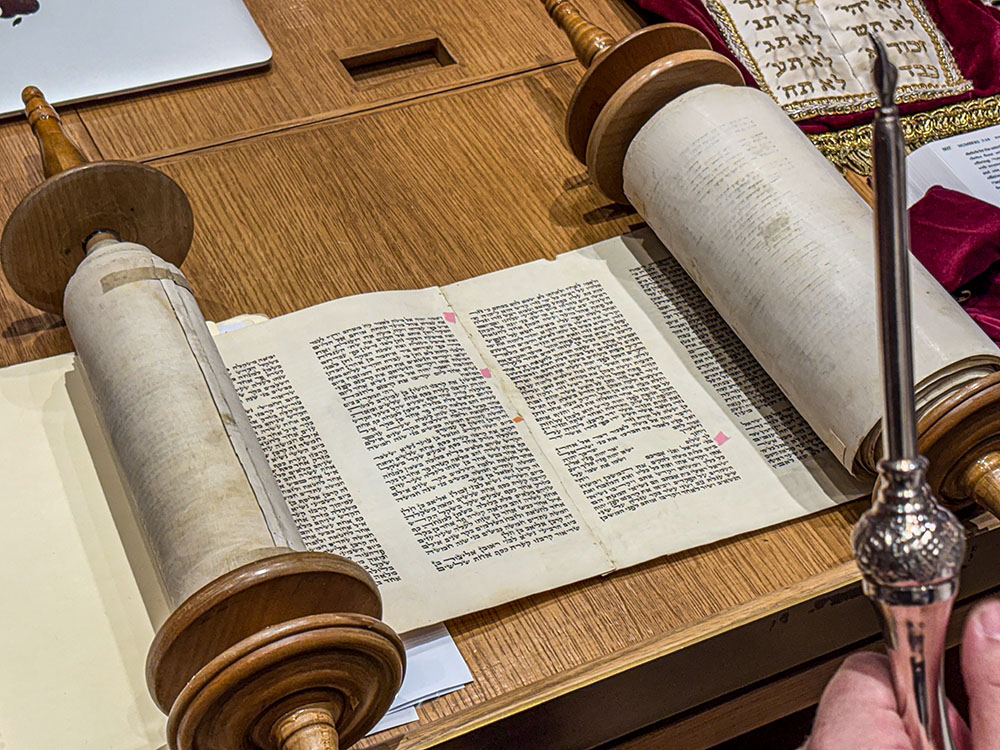
The opened Torah at Park Avenue Synagogue in Manhattan's Upper East Side is displayed for Catholic teachers who gathered in New York for a seminar organized by the Olga Lengyel Institute for Holocaust Studies and Human Rights in New York, July 25, 2025. (NCR photo/Camillo Barone)
Paul Ackerman, a Holocaust teacher at St. Mark's High School in Wilmington, Delaware, echoed the importance of building understanding. "Each year, I get into it a little bit more," he said, "and I'm hoping that when my students leave, they have a better understanding of their Jewish neighbors and then thus they hopefully can translate that into understanding other religions as well."
Christie Kurczak, a religion teacher at Blessed Sacrament Catholic School in Savannah, Georgia, said she came with the hope of connecting Catholic teaching more closely to the Holocaust and that she left with a deeper awareness of historical ignorance.
"I was really ignorant, to be honest," she said, "and unaware of things that our early church fathers had said and done, and how that affected antisemitism throughout the centuries."
For her, the challenge now is to bring this awareness to students and build bridges, she said. "We all are created in the image and likeness of God. We're called to love all individuals and to really put that in action."
Jason Liptow, a sixth-grade teacher at St. Joseph the Worker Catholic School in Beal City, Michigan, said he was struck by both the depth of church complicity in antisemitism and the model of interfaith friendship he witnessed.
"The rabbi and father's relationship and cooperation is a model for all of us," he said.