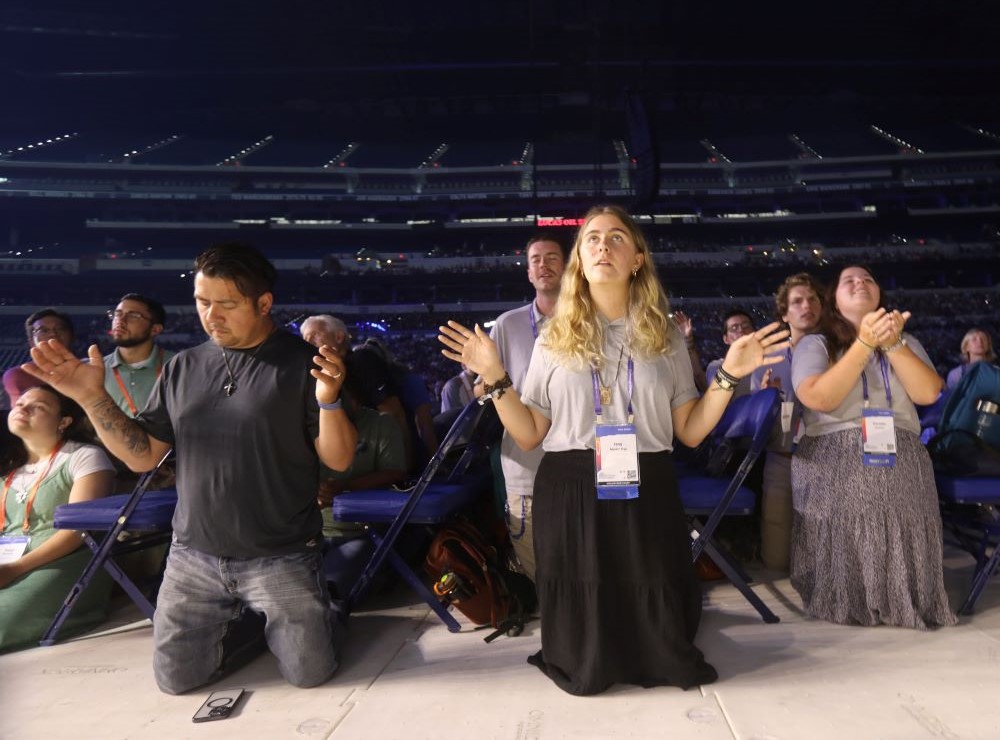
Participants pray during the opening revival night of the National Eucharistic Congress at Lucas Oil Stadium in Indianapolis July 17, 2024. The congress was the culmination of the U.S. Catholic Church's three-year National Eucharistic Revival. (OSV News/Bob Roller)

by Angeles Ponpa
Nearly two years ago, Anthony Zeszut stood among tens of thousands of worshippers inside Lucas Oil Stadium in Indianapolis, watching incense drift toward the rafters of a football arena more accustomed to crowd noise than silence.
Around him, people knelt, prayed and sang, filling the space not for a spectacle, but for worship.
"It was overwhelming, in a good way," said Zeszut, now a 24-year-old architecture graduate student from Kent State University in Ohio. "It was just so, so encouraging to see so many people take time out of their lives to attend this conference. So many people thought it was so important to do, and that was very inspiring."
Zeszut had traveled to Indiana for the National Eucharistic Congress in July 2024 — the culmination of the U.S. Catholic Church's three-year National Eucharistic Revival. He didn't initially plan to go but was encouraged by his parish priest and his younger sister.
The experience, he said, reshaped how he understood the Mass and what his faith required of him once he returned home from church
"Christ being present and us being able to encounter him in such an intimate way really inspired me, and I made it a point to get to as many daily Masses as I could throughout the week," he said.
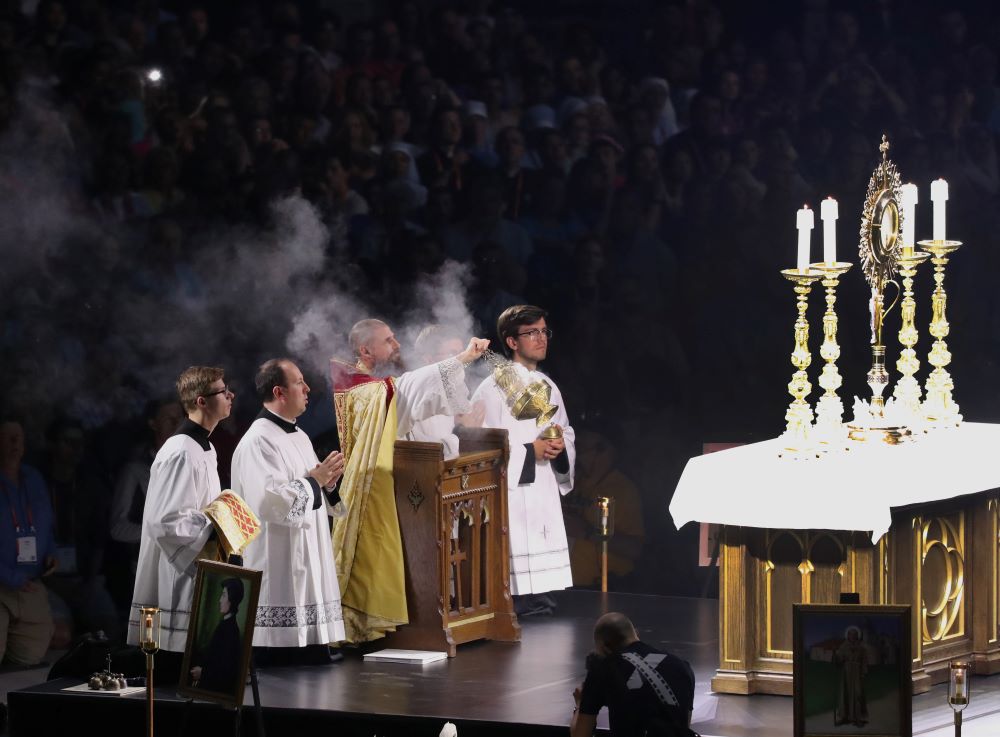
Fr. Boniface Hicks, a Benedictine monk of St. Vincent Archabbey in Latrobe, Pa., swings a censer in front of the monstrance during eucharistic adoration July 19, 2024, at the third revival night of the National Eucharistic Congress at Lucas Oil Stadium in Indianapolis. (OSV News/Bob Roller)
Zeszut's experience reflects a broader pattern emerging from the revival. Launched by the U.S. Conference of Catholic Bishops in 2022, the initiative aimed to renew belief in the real presence of Christ in the Eucharist. Designed as a nationwide effort, the eucharistic revival unfolded through parish, diocesan and regional events across the country. Church leaders emphasized that the congress was not meant to conclude the effort, but to commission participants to bring renewed devotion back to their local parishes.
For Zeszut, that commissioning translated into discipline. After returning to St. Stanislaus Church in Cleveland, he began attending daily Mass more frequently, even as his academic workload increased. He also became more intentional about his role as an altar server, working closely with his pastor to introduce small liturgical changes meant to emphasize reverence. The parish began using incense more deliberately during major feast days and paid closer attention to silence and posture during the consecration.
"We are both body and soul and the actions we do are so important," Zeszut said. "Using our senses to encounter God, whether that's incense or silence or posture, really helps you understand that something special is happening."
Those changes were subtle, but they prompted conversation, according to Zeszut, who explained to parishioners why certain gestures mattered and what they signified. For him, that curiosity marked success.
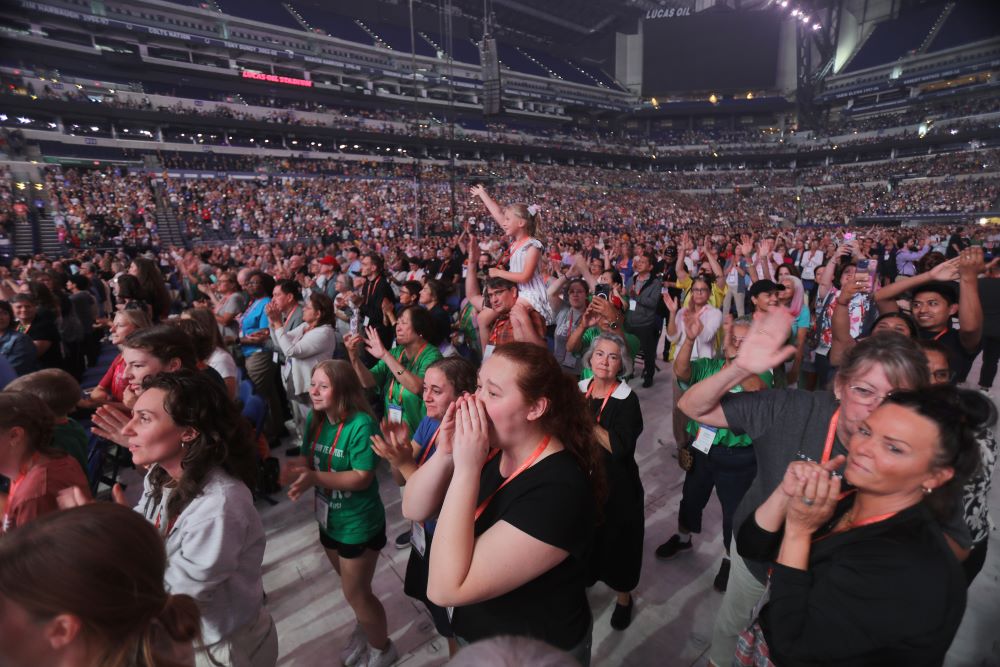
A young pilgrim watches from her father's shoulders as Dave and Lauren Moore and others perform July 19, 2024, during the third revival night of the National Eucharistic Congress at Lucas Oil Stadium in Indianapolis. (OSV News/Bob Roller)
In Green Bay, Wisconsin, Sydney Ditscheit, 23, experienced the revival from a different vantage point. She attended the Eucharistic Congress as an employee of the Diocese of Green Bay, where she worked in communications and marketing. Although her job was to document the event, one moment broke through and inspired her.
During an evening of eucharistic adoration, she watched as the crowd sat in near total silence.
"There were about 60,000 Catholics sitting in complete silence, worshipping together," Ditscheit said. "It was the most beautiful thing, praying together with that many people."
The silence stayed with her after she returned home. In conversations with a friend who had also attended the congress, Ditscheit realized their city lacked a unified young adult Catholic community, despite a growing number of young Catholics spread across multiple parishes.
"After the new revival, we were both inspired to do that," she said. "It was just kind of a calling from the Holy Spirit that we felt, and a gift that we both received during the congress was that affirmation to go and start this, and it's been very fruitful."
Within months, they launched a citywide young adult group which now includes more than 190 active members from across the Green Bay area.
Emmanuel Chavez, 25, leader of the Hive young adult group at St. Bernard Parish in Tracy, California, said he was influenced by one of the eucharistic revival's regional events. Drawn by the preaching of Marian Fr. Donald Calloway, known for emphasizing devotion and tradition, Chavez said the regional revival clarified for him the connection between belief and practice.
After the revival, Chavez said, he became more attentive to how young Catholics experience the Mass. In his work with young adults, he began emphasizing reverence as a responsibility rather than a preference, encouraging silence, posture and attentiveness during prayer.
His experience mirrors that of many young Catholics who participated in diocesan and regional revival events, suggesting that the initiative's most formative moments often occurred closer to home.
Advertisement
Timothy P. O'Malley, a theologian who studies liturgy and young adult faith at the University of Notre Dame, said the renewed interest among young Catholics and their faith cannot be traced to a single initiative, even one as visible as the National Eucharistic Revival.
"I think a huge factor would be the COVID-19 pandemic," O'Malley said. "It certainly shaped the way a lot of young people are asking questions and thinking about larger issues of meaning than previous generations might have thought about."
O'Malley cautioned against assuming the revival alone explains the shift.
"As sociologists say, correlation is not causality," he said. "You might have something like, 'Oh, the revival happened and therefore now our churches are full,' but there's a lot of things going on."
According to O'Malley, those broader forces are showing up at University of Notre Dame, where he said the number of students preparing for baptism has reached record levels over the past two to three years. He said similar increases are happening in parishes across the country.
Looking ahead, he said the challenge for the church is sustaining interest once the visibility of large-scale events fades.
"Christian life is mostly actually rigorous commitment to the daily life of prayer," he said, "caring for your family, engaging in work to the poor."