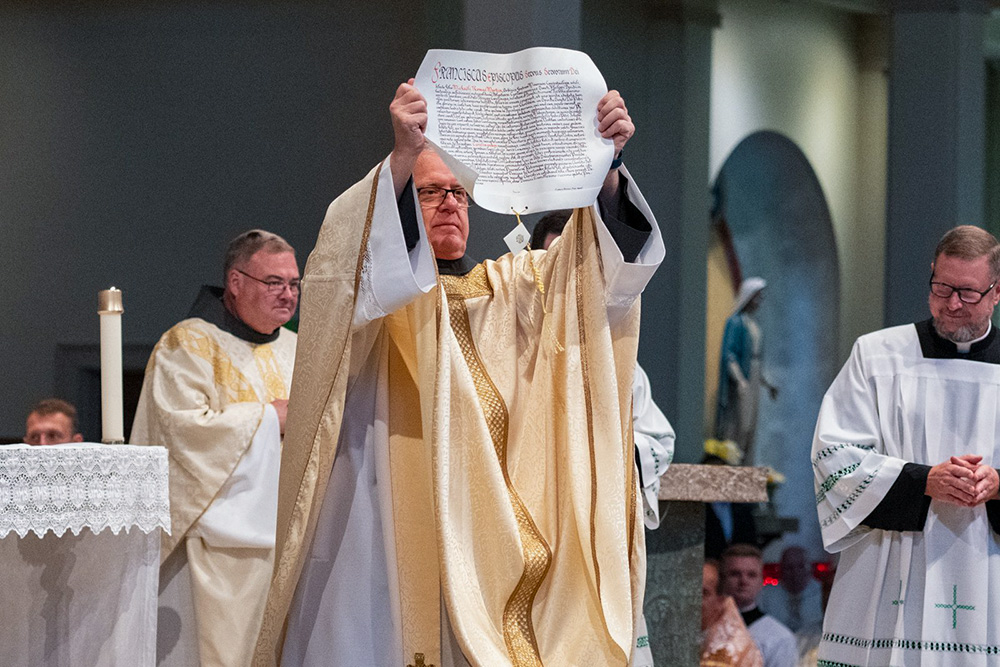
Bishop Michael Martin displays the papal bull from Pope Francis appointing him to head the Diocese of Charlotte, N.C., during his ordination and installation Mass at St. Mark Church in Huntersville, N.C., May 29, 2024. (OSV News/Catholic News Herald/Troy Hull)

by Peter Feuerherd
A common piece of advice to Catholic pastors undertaking a new assignment is to wait, go slow, check out the lay of the land and only then implement change.
Bishop Michael Martin of Charlotte, North Carolina, who came to the diocese in May 2024, either didn't get that memo or has ignored it.
In a little over a year and a half, Martin has:
- Put brakes on the growth of the traditional Latin Mass movement, acting to curtail it in parish life by confining the ritual to a single chapel site in a rural area outside of Charlotte.
- Ordered that diocesan parishes discontinue the use of altar rails to receive Communion and that parishes remove any portable kneelers.
- Urged that Communion be received standing instead of kneeling.
- Mandated another year in priestly formation at the local seminary, which has been known as a traditionalist enclave. Men seeking ordination must now spend a year teaching religion or another subject in diocesan middle or high schools, and living in a nearby rectory.
- Been confronted by a revolt among his younger clergy, who have signed a dubia, a petition to the Vatican, questioning Martin's approach to the traditional Latin Mass and the altar rail edict. About a third of the diocese's active priests signed the petition. A dubia is usually submitted by bishops and is rarely used by diocesan clergy against their bishop.
Some priests and laypeople told National Catholic Reporter that the conflicts in Charlotte are often overblown, that Catholic life thrives in large, well-attended parishes where churchgoers can find the kind of Mass that resonates with them.
But as the snow gradually melts in the most severe winter in North Carolina memory, some sense an icy distance among the opposing factions in the diocese.
Martin, who was previously a high school principal, basketball coach and campus minister at Duke University, is a Conventual Franciscan. He was sent to a diocese that, under his predecessor Bishop Peter Jugis, experienced rapid population growth and an influx of clergy supportive of the traditional Latin Mass.
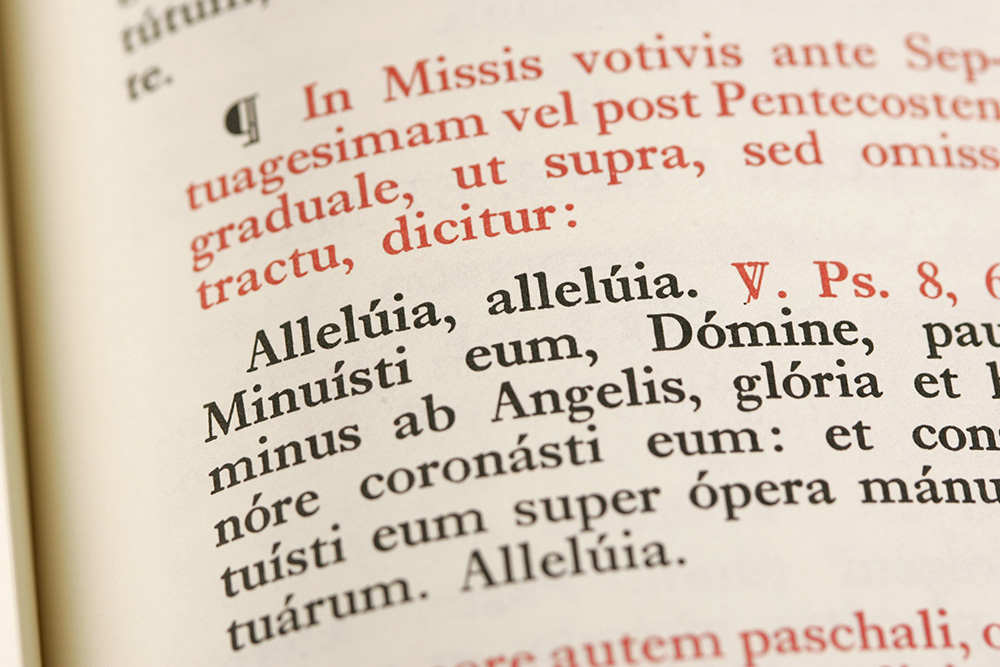
Shown is a detail of text in Latin from a page of the 1962 Roman Missal. (OSV News/Nancy Wiechec, file)
The Latin Mass flourished in the diocese, which includes Charlotte, its suburbs, and a wide swath of rural mountain territory in the western portion of the state. A major thoroughfare is the Billy Graham Parkway; the region once had the fewest percentage of Catholics in the country. That is no longer so, changed through population growth fueled by retirees, corporate transfers and Latino immigrants.
In a letter dated May 23, 2025, Martin announced that the traditional Latin Mass would no longer be celebrated at parish churches, but would be restricted to one then-unnamed chapel. He said the move was a step in implementing the 2021 apostolic letter Traditionis Custodes, which Pope Francis issued to curb Latin Mass movements.
Shortly afterward, on May 28, the blog Rorate Caeli published a leaked draft document in which Martin criticized practices of the traditional Latin Mass, including the use of Latin and having the priest celebrant face the altar instead of the congregation.
"I find it disturbing that so many pastors and celebrants are inclined to force an unknown language on their congregation when the Lord's mission is to engage the lost," Martin wrote in the undated draft of a pastoral letter, titled "Go In Peace, Glorifying the Lord by Your Life."
In response to the leak, diocesan communications director Liz Chandler told OSV News that the document was "an early draft that has gone through considerable change over several months," as part of an ongoing, consultative process to update liturgical norms in the diocese.
'I don't think this is just about the Latin Mass. It is about the authority of the bishop.'
—Fr. John Hoover
Martin proceeded to renovate the new Latin Mass chapel — the Chapel of the Little Flower — at a cost of $700,000. Allowing the Latin Mass at that single location in Mooresville, North Carolina, was seen as a compromise measure, but soon ran into opposition from local Latin Mass supporters. They argued that the chapel's location made it difficult for those used to celebrating the traditional Mass in their local parishes.
In the flap over language and liturgical rites, larger issues have emerged.
"I don't think this is just about the Latin Mass. It is about the authority of the bishop," said Fr. John Hoover, a retired priest of the diocese who has been outspoken in opposing traditionalism.
Hoover told NCR that the diocese has long been plagued by conflicts among the clergy, with older priests, trained in the aftermath of the 1962-65 Second Vatican Council, often at odds with younger priests who have become immersed in traditionalist practice.
Age-old issues of authority in the church in many ways have been turned upside down, as traditionalists publicly spar with their bishop, and Vatican II Catholics say that liturgical allowances have been too lax.
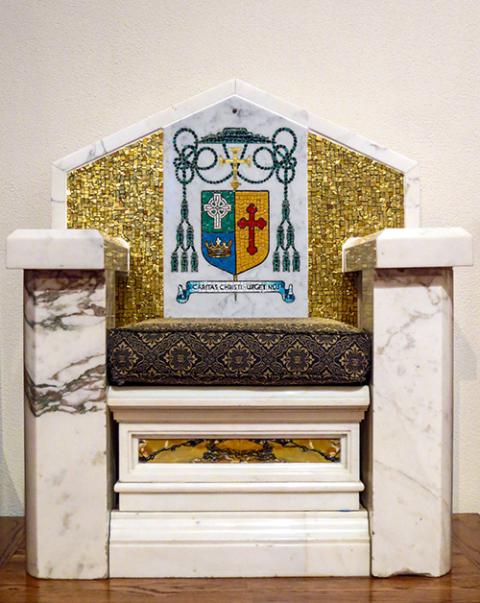
The bishop's seat, or cathedra, in the Cathedral of St. Patrick in Charlotte, N.C. (Wikimedia Commons/Nheyob)
The Charlotte flap is fodder on social media, with traditionalists arguing frequently for liturgical diversity. Martin has emphasized a need for the liturgy as a sign of church unity.
In mandating that the use of Communion rails be ended, Martin, in a Dec. 17, 2025, pastoral letter on norms for Communion, said that Communion "is to be done as the members of the faithful go in procession, witnessing that the Church journeys forward and receives Holy Communion as a pilgrim people." He emphasized that the Mass is a communal event.
Chris Lauer, a leader of the Charlotte Latin Mass Community group, said that the roots of the mushrooming movement in Charlotte dates to 2013, when the Vatican gave permission for Latin Mass at St. Ann Church in Charlotte. That allowance took place toward the end of the papacy of Benedict XVI.
"The initiation of the old Mass at St. Ann set off a chain reaction in the diocese," Lauer said, noting that younger priests, called in to celebrate the Mass, spread it to their parishes as well.
He said his group estimates that 1,200 Charlotte Catholics regularly attended the traditional Latin Mass when it was allowed in 11 diocesan parishes. Many were from younger families, he said.
"This is what really had church leaders scared. They simply could not tolerate a world where two liturgies coexist where the faithful were given a choice," he told NCR.
Compromises, such as the newly formed chapel, have failed to win over many Latin Mass adherents.
"I don't think anyone believes it is a good solution," Lauer said, noting that the chapel only offers Mass, and no devotions popular with traditionalist Catholics.
'They simply could not tolerate a world where two liturgies coexist where the faithful were given a choice.'
—Chris Lauer of the Charlotte Latin Mass Community
By contrast, other Charlotte Catholics say that the traditional Latin Mass community has held sway for too long. A group of parishioners from St. Elizabeth of the Hill Church in Boone, in the western edge of the diocese, spent much of the past five years worshiping at an antique auto shop and then a Lutheran church, with a Mass celebrated by priests from the diocese. They objected to the liturgical changes implemented by their pastor. They disbanded after Martin discouraged priests from celebrating Mass at the Lutheran church.
Some say the spirit of the bishop's liturgical vision is not being observed in many parishes. For example, noted one parishioner, pillows have taken the place of altar rail kneelers in some churches, ignoring Martin's comments about Catholics moving in procession to receive the Eucharist.
It is a point that permeates much of the liturgical wars playing out in the diocese, said the parishioner, who does some work for the church and wants to remain anonymous for fear of being swept up in the diocesan strife.
Advertisement
"There's an underlying attitude that the people who are kneeling have more reverence. It does lead to division," she said. The more traditionalist-oriented parishes have a kind of cultish feel, she said, freezing out those who prefer Vatican II-style liturgies. She said that in one parish young people who were judged to appear LGBTQ were prohibited from receiving Eucharist.
One compromise has been the sanctioning of the Vatican II rite in Latin, but that also fails to satisfy those on either side of the liturgy war in Charlotte. In those liturgies, the readings are in Latin, inaccessible to much of the congregation. Only the homily is in English.
Hoover said the diocese needs a synod, to help real the rift among clergy and parishioners. Lauer and other traditionalists argue that the ancient rites that fed spirituality in the church for centuries can coexist happily with the Vatican II Mass. Martin has emphasized the role of the liturgy as a sign of church unity.
Some look to Pope Leo XIV for a solution, as an American who might have insight into the liturgy wars roiling the church in the United States.
But the pope from Chicago has his own issues. Leo faces a potential schism, as the traditionalist Society of St. Pius X, based in Switzerland with a U.S. following, including in North Carolina, threatens to ordain bishops in defiance of the Vatican. That move might force more action in dioceses such as Charlotte, but both supporters and opponents of the traditional Latin Mass remain unsure of where that might lead.