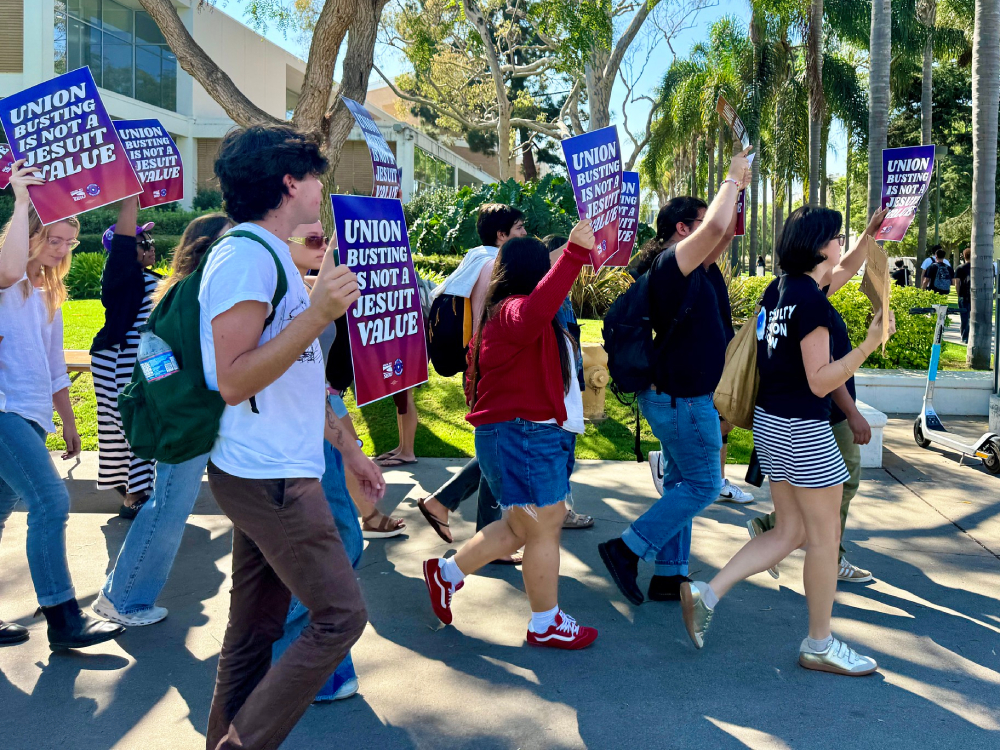
Protesters gathered Sept. 16 on the campus of Loyola Marymount University in Los Angeles, urging school officials not to dissolve the employee union. (Courtesy of SEIU Local 721/Emily Dorrel)

by Brian Fraga
Staff Reporter
Faculty members and students at Loyola Marymount University in Los Angeles have marched, signed petitions and participated in demonstrations since the university's board of trustees announced on Sept. 12 that it would no longer recognize unions representing university employees.
The trustees said its decision to invoke a religious exemption from the jurisdiction of the National Labor Relations Board was "final," but that has not stopped university employees, union leaders and labor activists from demanding that they return to the negotiating table and bargain in good faith.
"The message from the administration is that they did this, it's over, stop talking about it. But it's not going away," Bryan Wisch, a rhetorical arts professor at Loyola Marymount, told National Catholic Reporter.
Wisch is a member of the bargaining committee for the union that represents non-tenure track faculty at Loyola Marymount. For 10 months, the union had been in negotiations for a new contract with the university. Wisch said the union presented initial proposals for better pay, benefits and working conditions.

Bryan Wisch, rhetorical arts professor at Loyola Marymount University (Courtesy of Bryan Wisch)
"We never expected they were going to accept all of our proposals as is but we hoped they would engage with us in some collaborative problem solving," Wisch said. "What we got instead was blanket rejection."
Unable to reach an agreement with the union, the university stopped negotiating and invoked a religious exemption from federal statutes that govern collective bargaining for private sector employees.
"The invocation of a religious exemption was a shock to all of us. It feels like it's a legal maneuver for what is actually a financial assessment," said Linh Hua, a rhetorical arts instructor at Loyola Marymount who serves as an alternate member of the union's bargaining committee.
In addition to the religious exemption, the university also claimed that the union's proposals would lead to significant layoffs, 18% tuition hikes and sweeping program cuts while undermining the institution's near-term viability and long-term sustainability.
"In short, we reached this decision because the university must continue to put students — and the common good of the entire institution — first," Loyola Marymount Board of Trustees Chairman Paul Viviano said in a letter posted on the university's website.
'Respecting workers and choosing a different path are not contradictions; they are how LMU lives its mission in practice.'
—Loyola Marymount University statement
In a statement provided to NCR, Loyola Marymount University said it invoked a religious exemption from the National Labor Relations Board "to safeguard its mission and preserve the university's ability to carry out its Catholic, Jesuit, and Marymount values.
The university also said: "Catholic social teaching affirms the dignity of work and the rights of workers — principles LMU deeply upholds. The university believes the best way to honor these values is through direct engagement with faculty. Respecting workers and choosing a different path are not contradictions; they are how LMU lives its mission in practice."
However, faculty members at Loyola Marymount and Catholic labor scholars are accusing the university of betraying a key principle of Catholic social teaching: workers' right to unionize.
"There is no way to square what they are doing with Catholic social teaching," said Joseph McCartin, a history professor at Georgetown University who also serves as the executive director of Georgetown's Kalmanovitz Initiative for Labor and the Working Poor.
"I think what we see here is a clear case where they didn't want to reach an agreement with this union regarding financial questions and they're justifying it by walking away and claiming that they have the right to do so as a religious institution," McCartin told NCR.
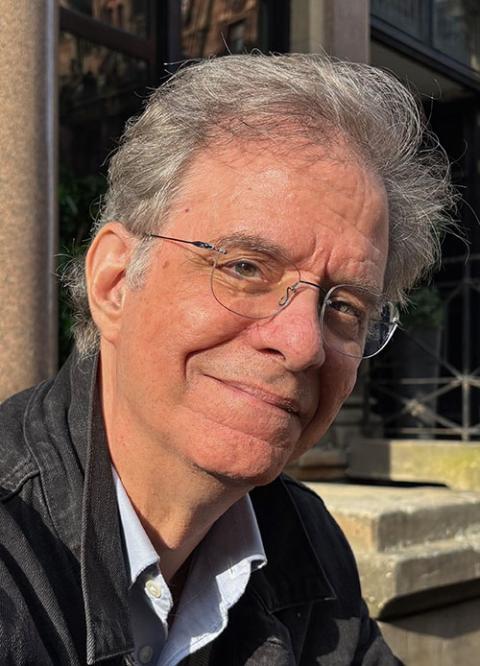
Joseph McCartin, executive director of the Kalmanovitz Initiative for Labor and the Working Poor (Courtesy of Joseph McCartin)
In addition to the fact that the Catholic Church has recognized the rights of workers to form unions since Pope Leo XIII's 1891 encyclical Rerum Novarum, McCartin noted that the U.S. Catholic bishops addressed the issue of labor unions and Catholic institutions in their 1986 pastoral letter, "Economic Justice for All."
In that document, the bishops wrote in Paragraph 353 that "all church institutions" must "fully recognize the rights of employees to organize and bargain collectively with the institution through whatever association or organization they freely choose."
"I can't imagine a clearer violation of that than this case," McCartin said.
Hannah Petersen, vice president of the Catholic Labor Network, a Washington D.C.-based nonprofit that advocates for the rights of workers, told NCR that she found Loyola Marymount University's actions to be "cowardly" and "unchristian-like."
"Their response is the opposite of what the Gospels, and furthermore what Catholic social doctrine, calls us to," said Petersen, who is an organizer with a different union that represents hospitality workers at Loyola Marymount.
Petersen said the Catholic Labor Network has launched a petition, written letters to Catholic leaders in Los Angeles and participated in campus actions to call attention to the issues and demand that university leaders "live out Catholic social doctrine."
"Because Loyola Marymount is a Jesuit university," Petersen said, "I believe they have a higher moral ground to be accountable to; and the fact that they are just leaving the table is very counterintuitive to Catholic social teaching and counterintuitive to higher education, where the whole purpose is about dialoguing and teaching young people how to critically think."
'There is no way to square what they are doing with Catholic social teaching.'
—Joseph McCartin
In his Sept. 12 letter, Viviano, the Loyola Marymount board of trustees chairman, said that while Catholic social teaching "affirms the dignity of work and workers' rights," it also calls on leaders "to safeguard the common good."
"For LMU, that means addressing concerns through direct dialogue and shared governance, rather than through third-party intermediaries who may not share the university's mission or student-centered focus. This approach best advances progress and mutual responsibility for student success," Viviano said.
Over the last five years, a handful of Catholic colleges have cited the same exemption from federal collective bargaining statutes when faculty tried to unionize on their campuses. They include Boston College, Duquesne University, St. Leo University and Marquette University.
In 2020, the National Labor Relations Board declared that it does not have jurisdiction over religious campuses. The board's decision overturned an Obama-era rule that had made it easier to form unions at religious colleges.
The question of whether the National Labor Relations Board has jurisdiction over religious colleges has been debated for decades. In 1979, the U.S. Supreme Court, in NLRB v. Catholic Bishop of Chicago, ruled that the National Labor Relations Act — which guarantees the right of private-sector employees to unionize — does not apply to lay teachers at church-operated schools.
'The invocation of a religious exemption was a shock to all of us. It feels like it's a legal maneuver for what is actually a financial assessment.'
—Linh Hua
"There have been cases dating back decades since Catholic Bishop in which institutions argued that the National Labor Relations Board should not take the case because of the idea of avoiding constitutional questions between religious liberty and statutory rights," said William Herbert, a public policy professor who is the executive director of the National Center for the Study of Collective Bargaining in Higher Education and the Professions at Hunter College in New York City.
While other religious colleges have stopped negotiating with faculty unions since 2020, Herbert told NCR that what is unusual about the situation at Loyola Marymount is that the trustees there did not raise the issue until more than a year after the non-tenure track faculty voted in June 2024 to join SEIU Local 721.
"Certainly the question has to be raised about what's motivating Loyola Marymount to do this in light of Catholic social teachings," said Herbert, who noted that other Catholic colleges, such as Georgetown, Fordham University and Siena College, did not claim a religious exemption in recent negotiations with faculty unions.
In its statement to NCR, Loyola Marymount University said it recognizes that non-tenure-track and visiting faculty have "important concerns and remains committed to addressing them."
Advertisement
The university said: "LMU has already made commitments to our faculty that are backed with real action, including retroactive salary and merit increases averaging 7.8% for non-tenure-track faculty. The university offers benchmark pay at the 75th percentile of the market — not the 50th — creating higher pay opportunities."
SEIU Local 721 — which represents nearly 400 instructors in three of Loyola Marymount's colleges — has said it will file an unfair labor practice charge against the university. The union also voted on Sept. 30 to authorize a strike.
"We're hoping it doesn't come to a strike, but if they refuse to come back to the bargaining table, we're ready to take action and protect our right to collectively bargain." said Wisch, 33, who graduated from the university in 2015 and has taught there for eight years.
In addition to teaching three courses during the semester, Wisch said he works a second job as a content writer to make ends meet in the Los Angeles area. He said it is not unusual for other instructors to juggle three or four jobs and added that one colleague lived out of his office for a time.
"We're at an inflection point," Wisch said. "Is education the priority of the university? I think that's the question that has to be answered here."
Hua, who also teaches three courses this semester and works a second job as a part-time bookkeeper for a small nonprofit, said the support from students and Catholic labor leaders has boosted morale and given faculty the sense that they are on the right side of history.
"We're hoping the board of trustees does the right thing and returns to the bargaining table," Hua said. "That's all we want."