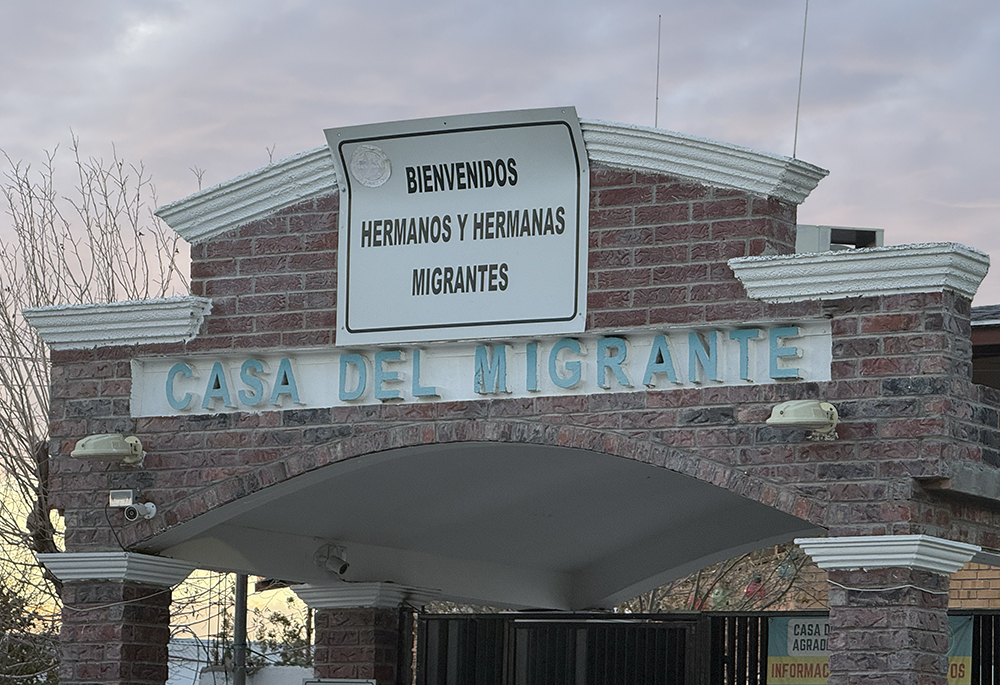
"Welcome brother and sister migrants," reads a sign at the Casa del Migrante in Ciudad Juárez, Mexico. (NCR photo/Brian Fraga)

by Brian Fraga
Staff Reporter
A framed portrait of St. Oscar Romero. A statue of Our Lady of Guadalupe. Rosaries draped around a small crucifix.
The prayer corner, also adorned with prayer cards and miniature saint statues, offered a place of spiritual respite for the 46 migrants, most of them families with young children, who were staying at a migrant shelter in Ciudad Juárez.
"Right now I have several people who have been at the shelter for a year, or several months, because they are stranded here at the border," said the director of the migrant shelter, who asked that she and the shelter not be named for security reasons.
"In fact, something that's happening is that people who started to settle down, because they had already begun to develop their life plans to settle in Juárez, have returned to the shelter because the conditions outside are no longer viable," she said. "These are people who've lost their jobs, who can't pay the rent, who can't make ends meet. They've been coming back to the shelter."
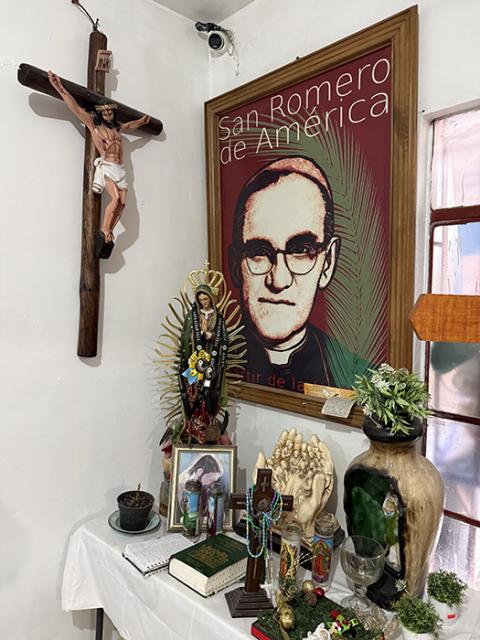
A prayer corner is adorned with a framed portrait of St. Oscar Romero, an Our Lady of Guadalupe statue, rosaries, prayer cards and miniature saint statues in a migrant shelter in Ciudad Juarez, Mexico. (NCR photo/Brian Fraga)
Since taking office in January 2025, President Donald Trump's administration's moves to close the U.S.-Mexico border to refugees and asylum-seekers have upended the lives of countless migrants who undertook dangerous trips through South and Central America with the hopes of reaching the United States.
Deterred by the administration's rhetoric and hardline immigration policies, fewer migrants are arriving in Juárez, a Mexican border city of nearly 1.7 million people located across the Rio Grande from El Paso, Texas. Migrant shelters in the city are operating at about 20% capacity, officials said.
"We have seen a huge decrease in migrant flows to Juarez, and a lot of it is because of the fear that has been instilled by the second Trump administration," Santiago Gonzalez Reyes, the director of human rights for Ciudad Juárez, told National Catholic Reporter through an interpreter.
But spurred by the hopes of a better life in the United States, migrants are still making their way to Juárez, where they often find themselves stranded with no legal pathways to cross the border.
"We don't migrate because we want to. It's out of need," said a man from Venezuela who traveled to Juárez with his wife and two children in the hopes of reaching the United States. Speaking through an interpreter, he asked that his name not be published for safety reasons.
Advertisement
Often experiencing violence, including kidnappings, on their treks north, migrants in Mexican border cities are vulnerable to exploitation by drug cartels and human traffickers. In late January, police in Juárez freed 21 migrants who were being held against their will by smugglers.
Migrants in Juárez are staying longer in shelters that until two years ago were serving as temporary lodgings, straining resources in a time when shelter directors and others who assist migrants say some international donors are cutting back funding.
"Covering the entire cost of the shelter is more difficult these days," said the shelter director who asked that her name not be published.
Their life plans thrown into disarray, migrants in Juárez oftentimes are struggling with depression and anxiety. Many have become desperate to the point of suicide, according to immigration advocates.
"I think that the fact that people's life projects were dashed really affected their ability to make decisions, to resume or create new projects for their lives. And this has brought a lot of anxiety, a lot of depression in people, despair in general, a lot of desolation, and also a lot of disorientation," Iveth Marin, a staff member with Jesuit Refugee Services in Juárez, told NCR through an interpreter.
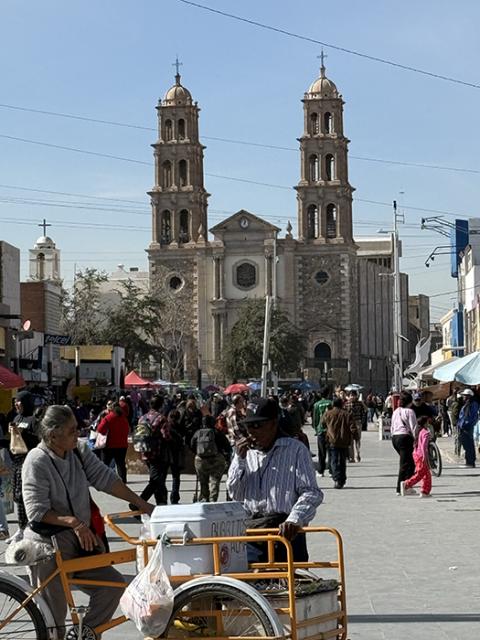
The Catedral de Nuestra Señora de Guadalupe de Ciudad Juárez is pictured in Ciudad Juárez, Mexico. (NCR photo/Brian Fraga)
Jesuit Refugee Services, or JRS, is among several organizations affiliated with the Catholic Church in Juárez that are striving to meet the various needs of migrants, which not only include food and shelter but also medical and legal assistance, as well as help finding work and educational opportunities for their children.
Marin said Jesuit Refugee Services' mission in Juárez is to accompany migrants, which often takes the form of providing them with psychological and social support. The agency links the migrants with psychologists to provide them with mental health support and provides food aid, hygiene kits, baby supplies and health-related assistance.
"Accompaniment for us is walking next to the person," Marin said. "We don't consider ourselves like a company that only provides services, where the person comes and I offer you what you need, and that's it. Accompaniment is walking with the person. This means that I will offer you what you need and accompany you on that journey."
Marin estimated that more than 70% of the migrants whom Jesuit Refugee Services assists in Juárez are survivors of kidnappings, torture and other acts of extreme violence.
"So that requires a lot more effort on the part of JRS to be there for them," said Marin, who noted that JRS is carrying out its mission in Juárez this year with 50% fewer staff members because of the loss of foreign aid funding from the United States and other countries.
Marin said Jesuit Refugee Services recently eliminated its program that used to provide migrants with legal assistance. Given the lingering uncertainty over long-term funding, Marin said the agency's other services could also eventually be impacted.
"We all have the responsibility to welcome people, to protect, promote and integrate as Pope Francis said," Marin said. "I think it's our responsibility as Christians."
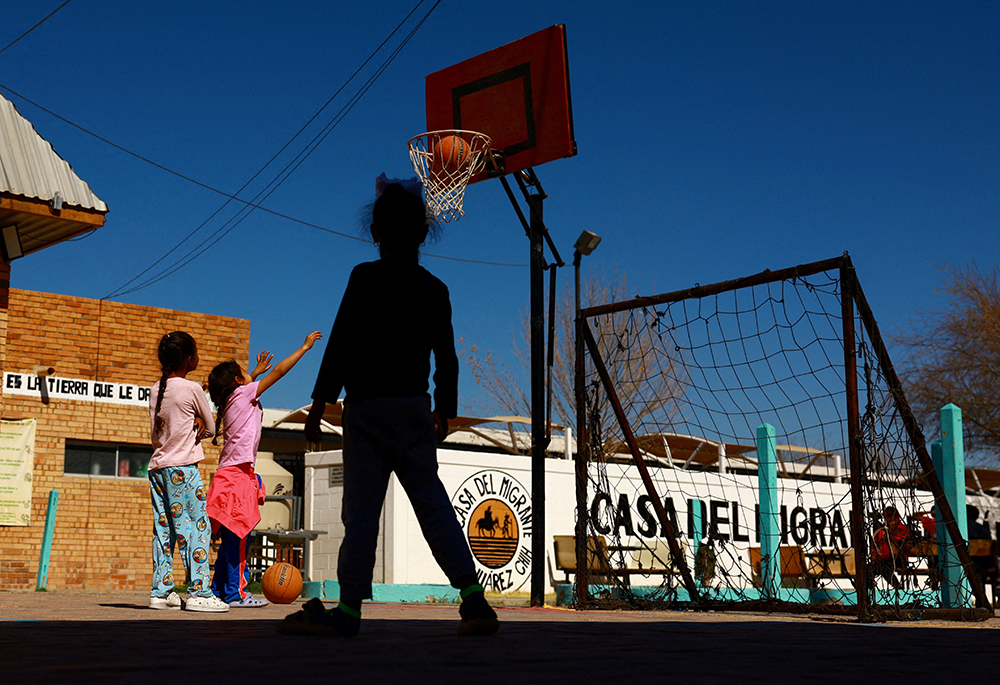
Migrant girls play at the Casa del Migrante shelter in Ciudad Juarez, Mexico, Feb. 22, 2025. (OSV News/Reuters/Jose Luis Gonzalez)
At Casa del Migrante, a shelter in Juárez operated by the local diocese, 12 single men were recently housed; a sharp decrease from the 1,300 migrants the shelter housed during the height of migration flows through the region in 2019.
"People are staying much longer at the shelter, in some cases up to nine months," said Fr. Francisco Javier Bueno Guillén, a priest of the Diocese of Ciudad Juárez who serves as director general of the Casa del Migrante.
Guillén told NCR through an interpreter that when the shelter first opened more than a decade ago, it mainly served people who had been deported from the United States to Mexico and it only housed them for a few days.
"However, when migration patterns changed in 2019, when Juárez became a port of entry, well, the length of stay changed and it became a longer period," Guillén said. "Then, when the immigration processes [into the United States] changed, the stays here became even longer."
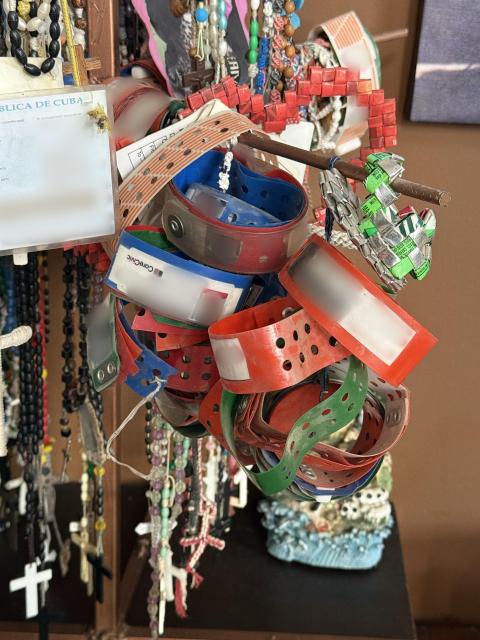
Inside Casa Del Migrante in Ciudad Juarez is a display of rosaries and wristbands worn by migrants (details obscured for privacy) when they were processed for deportation in the United States. (NCR photo/Brian Fraga)
When migrants arrive at Casa del Migrante, their most common basic need is usually food.
"Sometimes people arrive here and they haven't eaten in a few days. So we always make sure to meet that basic need first," said Guillén, who added that the shelter also provides a legal orientation for migrants to know their rights.
"Many people have been victims of crimes on their journey here," Guillén said. "If they want to put in an official complaint with the city or to file a claim or file anything legally, the shelter also provides that guidance and tries to give them the most up-to-date information that we have.
"And then finally, we offer psychosocial support, because a lot of people have experienced really traumatic events on their journey,"said Guillén, who added that Catholic social teaching informs the shelter's operations.
"We try to make the house a dignified space for the people who seek it," he said. "It's called the Casa del Migrante for a reason. It's a casa, a home. The most important thing we want to do is really make this a place where we can attend to the needs of people and meet the integral needs of the whole human person."
Outside Guillén's office, near the shelter's foyer, was a small display of rosaries and orange and blue plastic wristbands worn by some migrants when they were processed for deportation in the United States.
Though the migration statistics are down, Guillén emphasized that people are still moving through the region, in search of better lives.
"We're talking about persons, human beings," he said. "You can't just ignore the people who are still crossing."