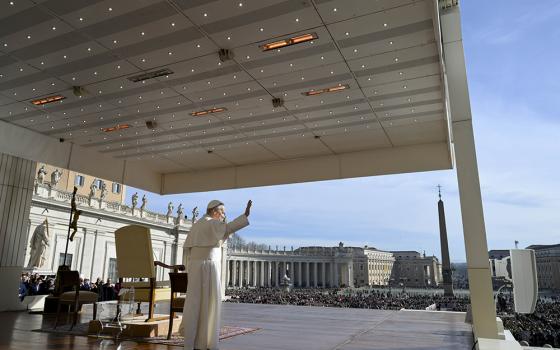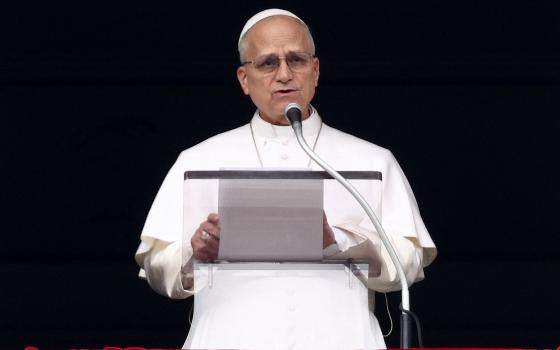
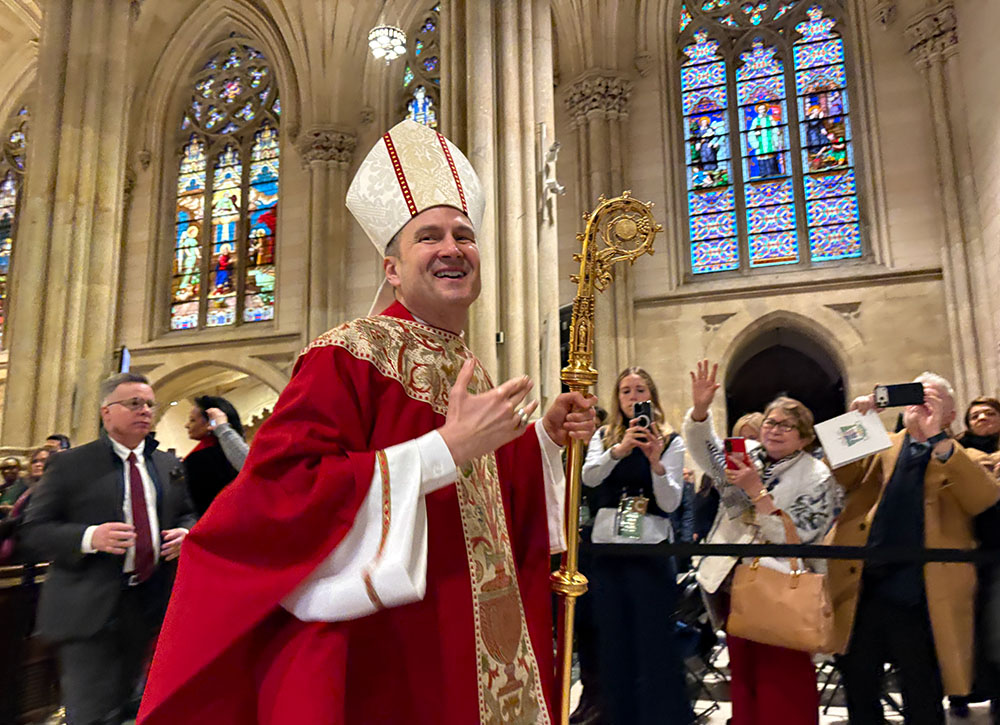
Archbishop Ronald Hicks blesses the congregation Feb. 6, 2026, at the end of the installation Mass as the 11th archbishop of New York at St. Patrick's Cathedral in New York City. (NCR photo/Camillo Barone)

The drums came first, then the trumpets, then the low, insistent pulse of bongos echoing up Fifth Avenue in New York City.
Outside St. Patrick's Cathedral, beneath the towering spires, Bishop Ronald Hicks stood before the massive golden doors, closed and gleaming. Hispanic church songs rang out, loud and joyful, cutting through the city's familiar roar.
Hicks knocked.
From inside, the doors swung open. Fr. Enrique Salvo, the cathedral's rector, greeted him. Beyond the threshold, under murals depicting St. Frances Cabrini, Dorothy Day, immigrants past and present, and the first responders of 9/11, nearly 90 bishops from across the United States applauded.
Hicks stepped forward, kissed a crucifix resting on a pillow and sprinkled holy water in wide arcs blessing those closest to him.
By the time Hicks processed down the central aisle, more than 2,000 people filled the cathedral: seven cardinals, about 90 bishops, roughly 400 priests, religious sisters and brothers, civic leaders, family members, longtime friends and parishioners. They had traveled from Chicago and the previous diocese Hicks led, Joliet, Illinois; from Central America; and from neighborhoods across the New York Archdiocese's three boroughs and seven counties.
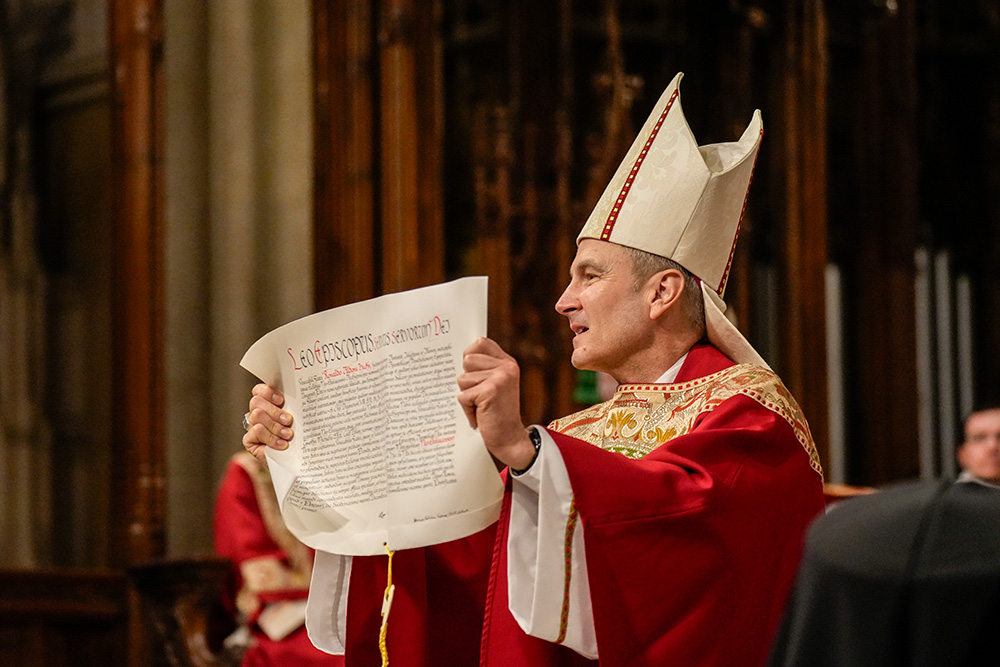
Archbishop Ronald Hicks holds the apostolic mandate from Pope Leo XIV appointing him as the new archbishop of New York during his installation Mass at St. Patrick's Cathedral in New York City Feb. 6, 2026. (OSV News/Gregory A. Shemitz)
It was the public beginning of Hicks' ministry as the 11th archbishop of New York — and the culmination of a life shaped by migration, mission, and quiet leadership and service across multiple dioceses in both North and Central America.
At the altar, Cardinal Christophe Pierre, papal nuncio to the United States, read the official letter appointing Hicks as archbishop on behalf of Pope Leo XIV. Hicks listened, bowed his head and accepted the mandate.
Cardinal Timothy Dolan, who has led the New York Archdiocese for 17 years, stood smiling as the crowd offered a long standing ovation. It happened to be Dolan's 76th birthday, and the entire cathedral sang "Happy Birthday," accompanied by organ and brass, before Dolan stepped aside.
Then Hicks held the appointment letter high for all to see and walked to the archbishop's cathedra, the chair that symbolizes pastoral authority. He sat. Applause rolled through the nave once more.
The first reading was proclaimed by Samuel Jiménez Coreas, a Salvadoran lay Catholic whose life story is intertwined with Hicks' own. Jiménez Coreas immigrated to the U.S. after a childhood marked by extreme violence: abandoned in a trash dump as an infant, shot by bandits, abused by adoptive parents. As a boy, he lived in the orphanage in El Salvador that Hicks once led as a priest.
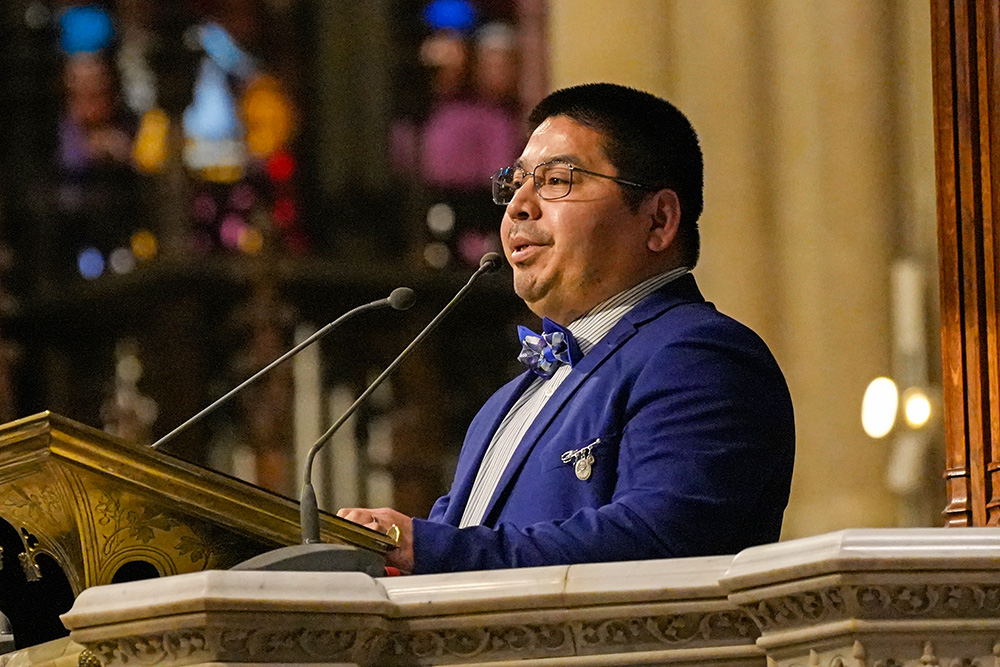
Samuel Jiménez Coreas proclaims the first reading in Spanish during the installation Mass of Archbishop Ronald Hicks as the new archbishop of at St. Patrick's Cathedral in New York City Feb. 6, 2026. (OSV News/Gregory A. Shemitz)
By asking Jiménez Coreas to read, Hicks was making a statement, he said during a press conference Feb. 5. Every reading, chant, prayer, and the homily itself unfolded in both English and Spanish, at Hicks' request.
Hicks' homily began with a Hispanic church song called "Missionary Soul." Then, smiling, he pivoted. "I love music. I love all types of music. And I almost always have a song playing in my head. There are so many songs about New York," he said.
Hicks stitched together lines from Bad Bunny, Frank Sinatra, Alicia Keys, Jay-Z, and others, forming a playful collage of his first impressions of the city.
"Here are a few things you should know about me: I love Jesus. I love the church. And I love people," he added.
He thanked God, the pope and Cardinals Pierre, Dolan and Blase Cupich of Chicago. He thanked bishops, priests, his parents watching by livestream, family and friends, civic leaders, first responders and people of every faith tradition.
"I love being a priest. Thank you for your yes and I look forward to getting to know this wonderful presbyterate here in the archdiocese."
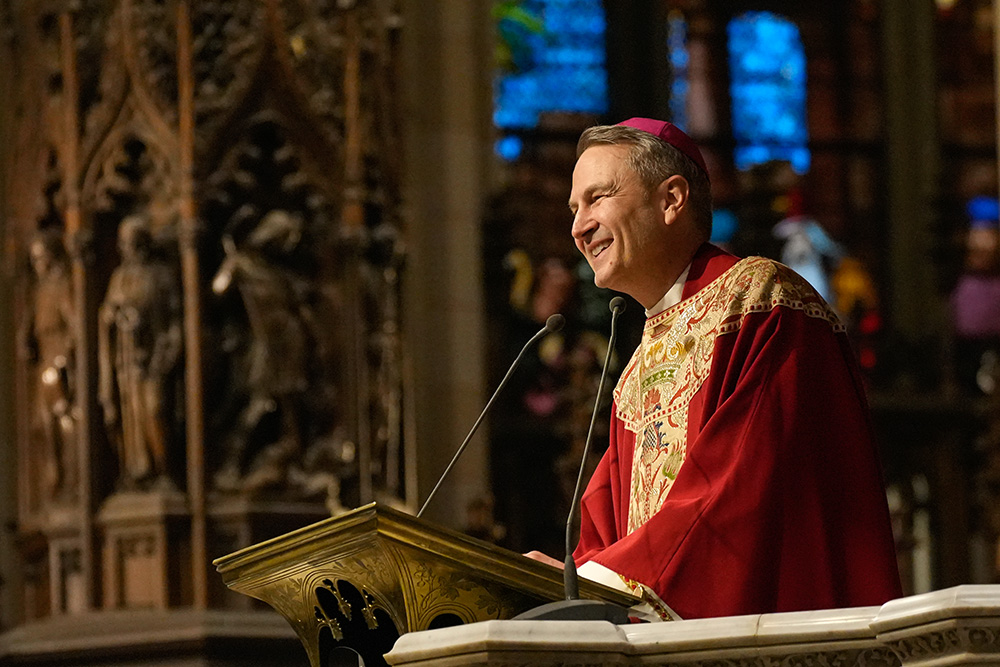
Archbishop Ronald Hicks smiles as he delivers the homily during his installation Mass as the new archbishop of New York at St. Patrick's Cathedral in New York City Feb. 6, 2026. (OSV News/Gregory A. Shemitz)
Turning to the Gospel, Hicks framed his vision: "This is a call to be a missionary church, not a country club. A club exists to serve its members. The church, on the other hand, exists to go out and serve all people, on fire with faith, hope and charity in the name of Jesus Christ."
He described a church that feeds the hungry, heals wounds, upholds human dignity, protects children, promotes healing for survivors, cares for creation and builds unity across cultures and generations.
"I believe the world always has and always will need a missionary church. A church that proclaims Jesus Christ clearly and without fear. A church that forms missionary disciples, not passive spectators. A church that goes out to the peripheries."
In the pews, Bishop Gerald Kicanas, 84, apostolic administrator of the Diocese of Tucson, Arizona, watched with emotion. He has known and mentored Hicks since seminary days.
Advertisement
"When you see a 13-year-old boy, you always wonder what his future will be," Kicanas said. "And from the very time he was a young man, he was very attentive to the needs of others. I can't think of anyone more ready to serve the community here than Archbishop Ron Hicks," he told the National Catholic Reporter.
Kicanas described Hicks as a "man who cares for others. He has always been interested in service. He is very much of a missionary."
Also among the 400 priests watching from the pews was Fr. Jack Wall, president of the Catholic Extension Society. Wall has worked closely with Hicks for years and shares with him not only a professional bond but also a common Chicago upbringing.
"Ron Hicks, Pope Leo and myself, we all grew up in about 10 blocks difference in Chicago," Wall said. "The values that I've heard Ron talk about, that I talk about, that come out of that ecclesial experience, out of the neighborhood, family, are the same."
Those roots, Wall said, formed a priesthood centered on people rather than institutional structures.
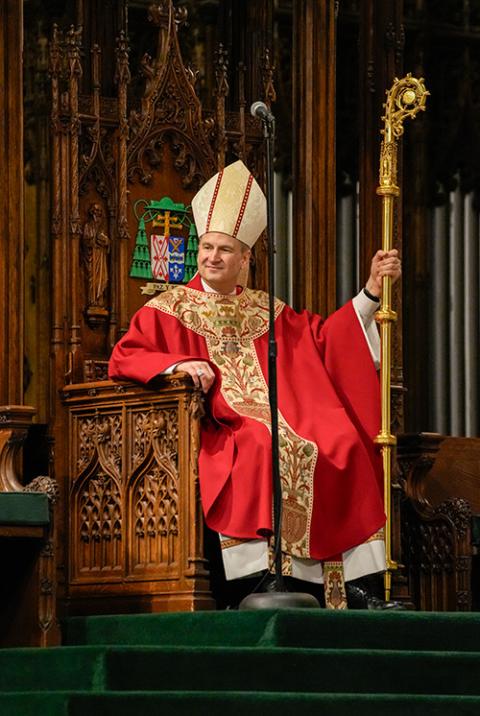
Archbishop Ronald Hicks sits in the cathedra during his installation Mass as the new archbishop of New York at St. Patrick's Cathedral in New York City Feb. 6, 2026. (OSV News/Gregory A. Shemitz)
"There's something we grew up with in Chicago that really focused on the people of God," he said. "I was once told, 'Don't be a priest unless you believe in the vocation of the laity.' And that was really lived. The church is the people of God. We come from that people. We live out of that experience."
Watching Hicks take possession of the cathedra stirred a mix of pride and awe, he said.
"He's going to be contemporary with the pope," Wall said. "His time as archbishop and Leo's time as pope is going to be contemporary. It's a mystery of God's providence — God at work in our lives — and now he's being allowed to express that faithfulness on a very big stage."
Joseph Boland, chief mission officer at Catholic Extension Society and personal friend of Hicks, echoed that portrait, describing Hicks as a steady presence in his life for more than two decades.
"A mentor of mine, a priest who has ministered to my own family at various moments, a friend, a person who I trust," Boland said of Hicks, adding that he was "someone who I've known for a quarter century and always looked up to and admired."
Boland said he believes Hicks understands that his voice now carries far beyond New York.
"He's going to speak understanding that he's not only speaking to the people of New York, but he's speaking across the country," Boland said. "That's his missionary identity — that the church is more than just a physical place and that the sacred is to be found in so many places and in so many people."
At the end of Mass, the choir sang "In Christ There Is No East or West," followed by "Missionary Soul." Outside, a crowd of faithful singing in Spanish on Fifth Avenue was waiting again for their new archbishop.