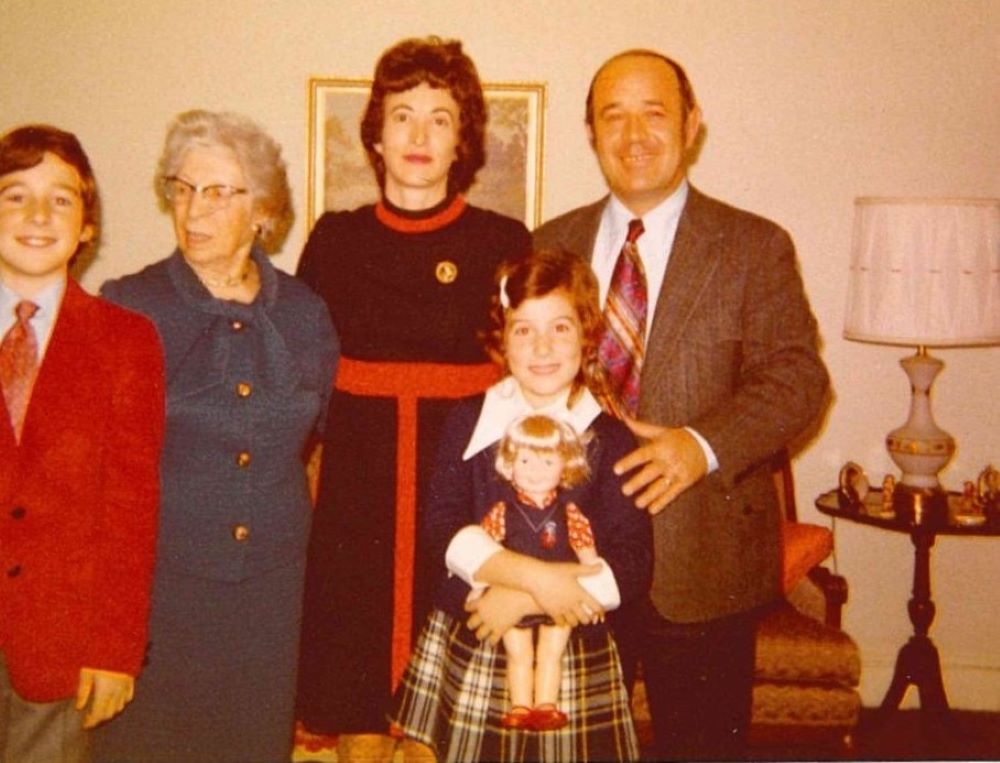
Jesuit Fr. James Martin stands with his grandmother, parents and sister in 1973. Martin's new book is "Work in Progress," a memoir that describes the jobs and challenges that led to his religious vocation. (Courtesy of James Martin)

The title of Jesuit Fr. James Martin's new book is among the longest of the 20 books he has authored and edited so far, and that is no accident.
Martin's life, as he tells it in Work in Progress: Confessions of a busboy, dishwasher, caddy, usher, factory worker, bank teller, corporate tool, and priest (to be published Feb. 3), has been long, layered and crowded with unforgettable yet rough experiences: summer jobs taken for spending money and survival, deep friendships forged and lost, unexpected encounters across social classes and a sudden priesthood vocation he could no longer resist.
In this book, Martin — a high-profile, widely read Catholic voice — turns his gaze almost entirely on himself and his relationship to God. The book traces his life from his middle-class childhood in Plymouth Meeting, Pennsylvania, through his teenage years and early adulthood, his Ivy League education and corporate career and finally his decision to enter the Society of Jesus.
Work in Progress is a memoir, and also a social justice document, a vocational narrative, and an examination of how ordinary work quietly forms a conscience.
Martin, 65, is editor at large of America magazine and founder of Outreach, an LGBTQ+ Catholic resource. He also is a consultor to the Vatican's Dicastery for Communication. He is the author of bestselling books My Life with the Saints and Building a Bridge, among others.
'Being kind isn't all of Christianity, but it's about 90% of it.'
—Jesuit Fr. James Martin
Drawing on his high school diary, memories confirmed by family and friends and return visits to the places where he grew up, Martin recounts a long list of jobs that shaped him well before he ever thought about priesthood: paperboy, lawn-mowing kid, busboy and dishwasher, golf caddy, movie theater usher, factory worker packaging pills at a Sharp pharmaceutical packaging factory, bank teller and eventually a financier and human resources manager at General Electric in Manhattan and Connecticut, where he spent six years before entering the Jesuits.
A common thread running through nearly all of Martin's early work experiences is what he describes as a deep desire to be liked, to be accepted, to belong. "One of my chief concerns was getting people to like me," he wrote. As a teenage busboy and dishwasher, "I was too intent on not messing up, [...], so the other employees wouldn't deem me unworthy of respect."
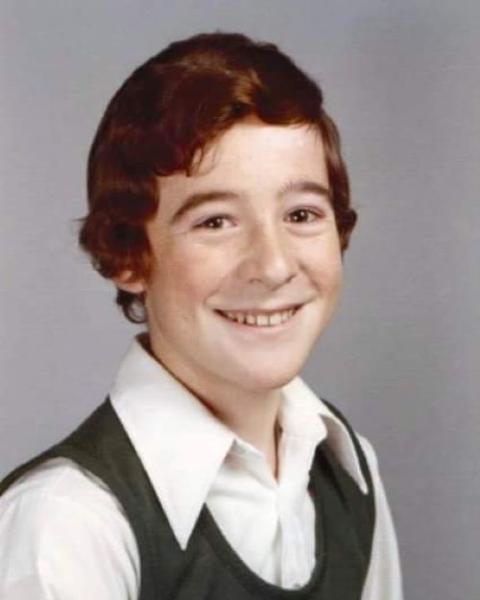
Jesuit Fr. James Martin is pictured in 1973 at about age 12. (Courtesy of James Martin)
Being at the bottom of the workplace hierarchy, he recalls, was an "emotional struggle."
The humiliations were not uncommon, as he recounts in the book. Some customers yelled. Some supervisors barked orders. Wealthy golfers barely acknowledged his presence. Of his days as a caddy for millionaires, Martin wrote, "I felt invisible." Yet those experiences left a mark, he said. Through being demeaned, he learned a vow he would later keep as a priest: Never treat others with the same meanness he sometimes endured.
School, by contrast, was a refuge. Academically gifted, Martin thrived in classrooms, becoming student body president, working on the yearbook and excelling in his studies. It was also on his way to school that he experienced one of his earliest, if unrecognized, spiritual moments — a sense of God's presence that he did not yet have language for. Still, even that stability could not soften the ache of transition. On his last day of high school, he cried alone in his bedroom, acutely aware that a defining chapter of his life with his closest friends had ended.
The power of Martin's account lies in its cross section of American social life in the 1970s and 1980s. While at the Wharton School at the University of Pennsylvania, he spent one summer on a pills-packaging assembly line at Sharp, repeating the same motions for more than eight hours a day.
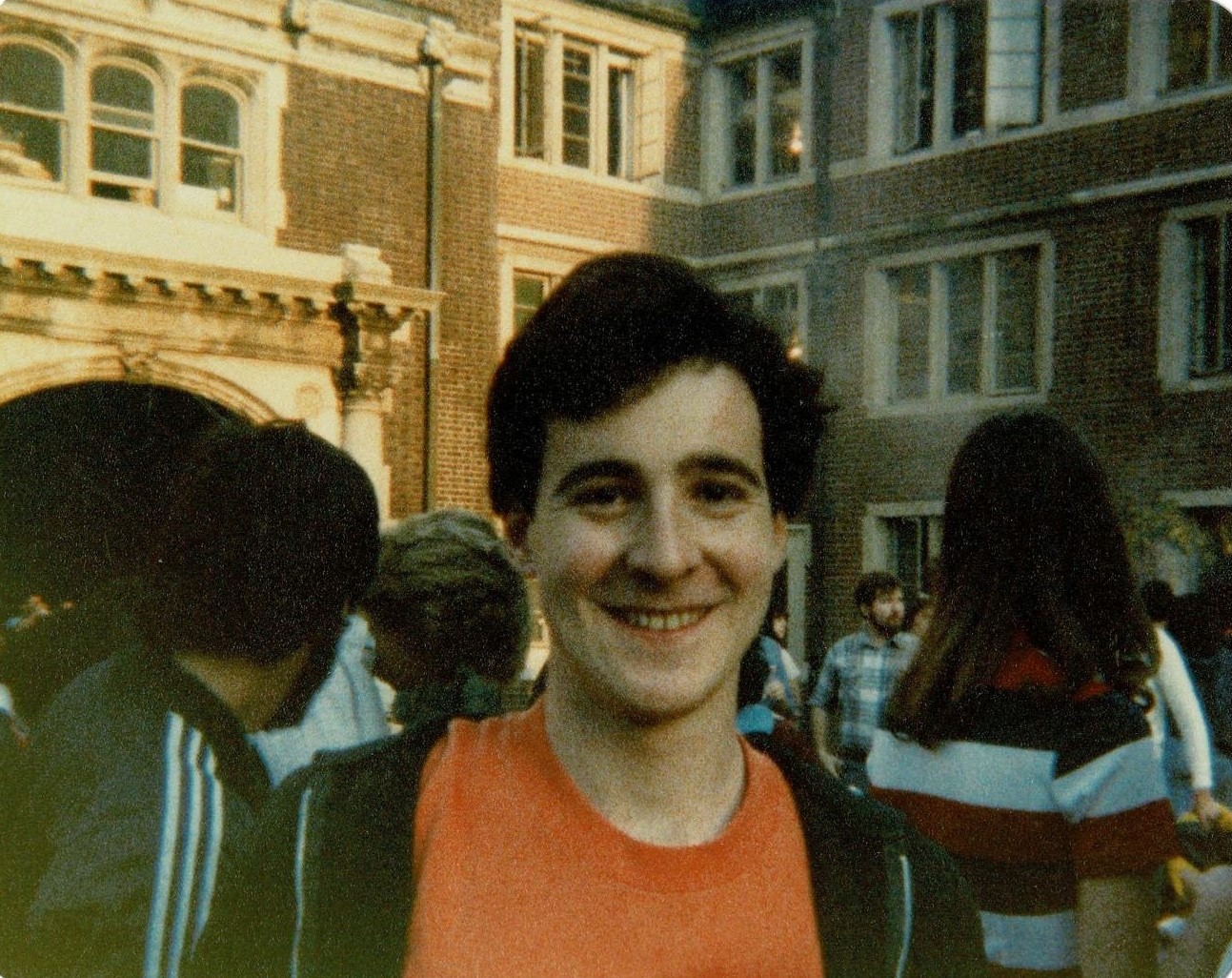
Jesuit Fr. James Martin during his freshman year at the Wharton School, University of Pennsylvania, in 1978 (Courtesy of James Martin)
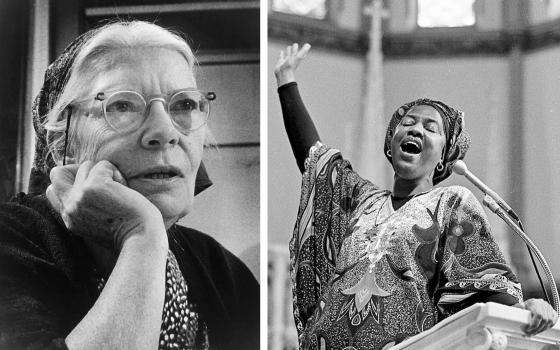
His co-workers included people far poorer and more marginalized than himself: an unforgettable Holocaust survivor who, he said, reminded him of Dorothy Day, and workers exhausted enough to beg him to throw a ruler into the machine so it would jam and force a break. "We need a break, Jimmy!" they would yell, asking him to take the responsibility since he was expected to spend just one summer there.
Some of these stories are undeniably hilarious. Others are tragic. Together, they expose the deep inequalities produced by deregulated American capitalism — inequalities that Martin admitted he largely ignored at the time.
Looking back on his years at Wharton and in New York finance, Martin offers one of the book's most searing confessions: His concern for the poor was "nonexistent," and his relationship with God was thin and transactional.
"I'm amazed by how uninterested I was in other people's lives back then. So much of my life as a child and adolescent was focused on myself. The selfishness was perhaps natural for a young person, but it also meant that I missed a great deal around me," he wrote.
In New York, Martin writes, he was "more interested in having fun than discerning my future, and more interested in money than in God." That trajectory culminated in burnout during his final stretch at General Electric, where he worked in financial management and human resources.
When he asked a manager to show mercy to a colleague about to be fired, the response was blunt: "F — K compassion!" Physical symptoms followed — migraines, stomach pain — and despair seeped into his daily routine. "I hate my life," he remembered scribbling on his desk blotter.
The turning point came unexpectedly, when he watched a PBS documentary on Thomas Merton. That night, Martin began reading Merton's work and felt something shift irreversibly. "That night, in bed, I started his book and within a few pages thought, Why have I never read anything like this before? Why have I not learned about spirituality? Why have I not been interested in religion?"
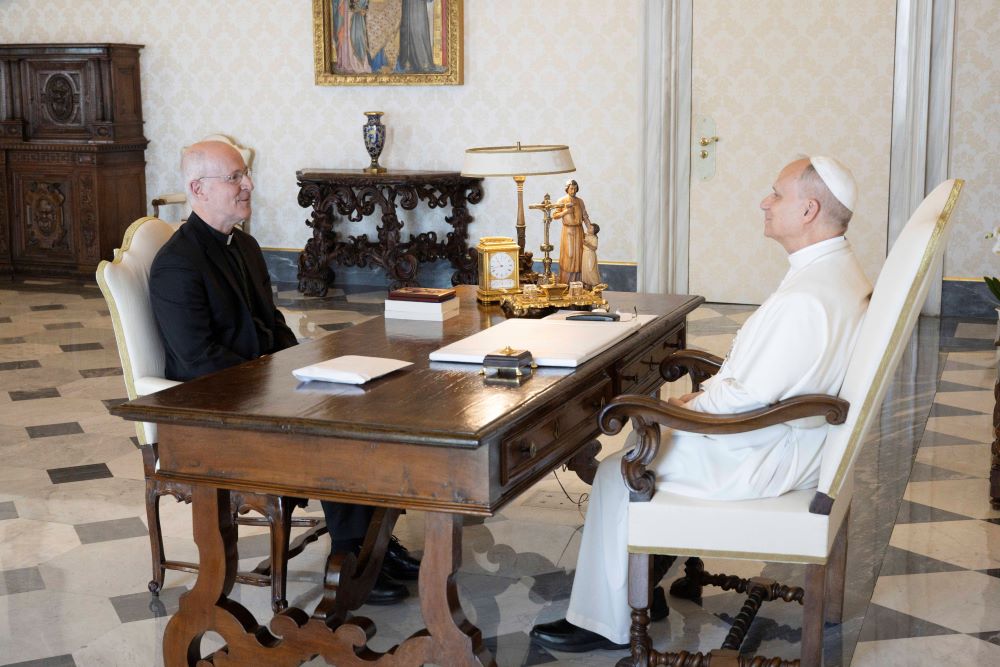
Pope Leo XIV meets with Jesuit Fr. James Martin, an author and editor at large at America magazine, in the library of the Apostolic Palace at the Vatican Sept. 1, 2025. Martin previously met with Pope Francis in 2019. (CNS/Vatican Media)
From there, the path toward the Jesuits opened, though haltingly. Martin admits he knew almost nothing about church history or priestly life. He had to learn everything from scratch.
In an interview with the National Catholic Reporter, Martin said the greatest challenge of writing this book was humility. "How can I write in a way that's accessible and inviting to people, and tell the story about how God worked through my life without being vain?" he asked. "The center of the story is really God."
One of the book's most striking dimensions is its implicit critique of ultra-capitalist economic life. Reading his past through Jesuit eyes, Martin said he recognizes what Catholic social teaching would later give him language for: structural injustice. "I look at capitalism differently now," he said. "I'm still a capitalist. I still think the markets are the most efficient way to distribute goods and services, but it can't be without some sort of regulation."
Those factory summers, he believes, taught him solidarity. They also cured him of any temptation to mistreat workers.
Ultimately, Work in Progress argues that nothing in Martin's life was wasted — not even his most superficial years. Every job, every failure, every embarrassment carried a lesson that would later shape his priesthood, he said. Above all, they taught him compassion.
"Being kind isn't all of Christianity, but it's about 90% of it," he wrote.
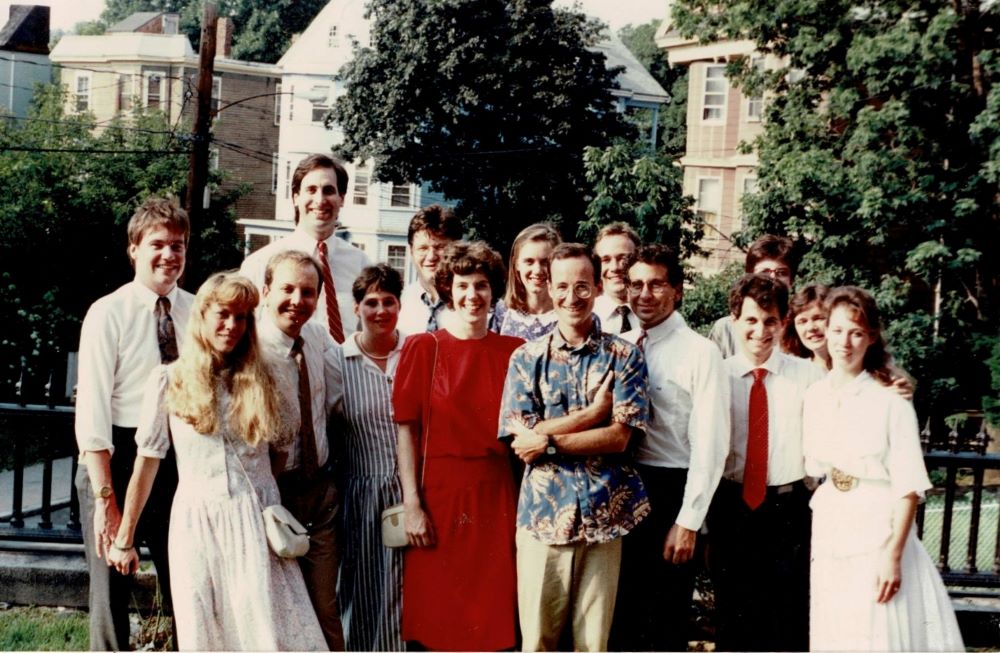
Jesuit Fr. James Martin poses with some of his high school and college friends on the day of his first vows as a Jesuit in 1990. (Courtesy of James Martin)
Asked what he would change about his younger self, Martin's answer is simple and consistent with the book's core theme: letting go of the need to be liked. "Otherwise you're paralyzed," he said.
Letting go of it, he added, was essential to his spiritual growth. "I had to let go of that in the Jesuits," he said, describing a process that involved "a lot of spiritual direction," and a gradual recognition that "God loves you for who you are, not who you think you should present to the world."
That freedom was tested most intensely later in his ministry. "When I started working with LGBTQ+ people, people hated me," he said. "And so I had to, again, be free of that need, which was from childhood."
Advertisement
In the end, the book is not only about a Jesuit priest. It is about how God works quietly through ordinary labor, awkward adolescence and imperfect ambition. As Martin put it, borrowing from Ignatius of Loyola: "You go in their door and you come out your door." Readers may enter through funny summer job stories, but they leave with something deeper — a sense that vocation can emerge anywhere, even at "the low end of the work totem pole."
"I'm trying to show them how God is at work everywhere," he said.