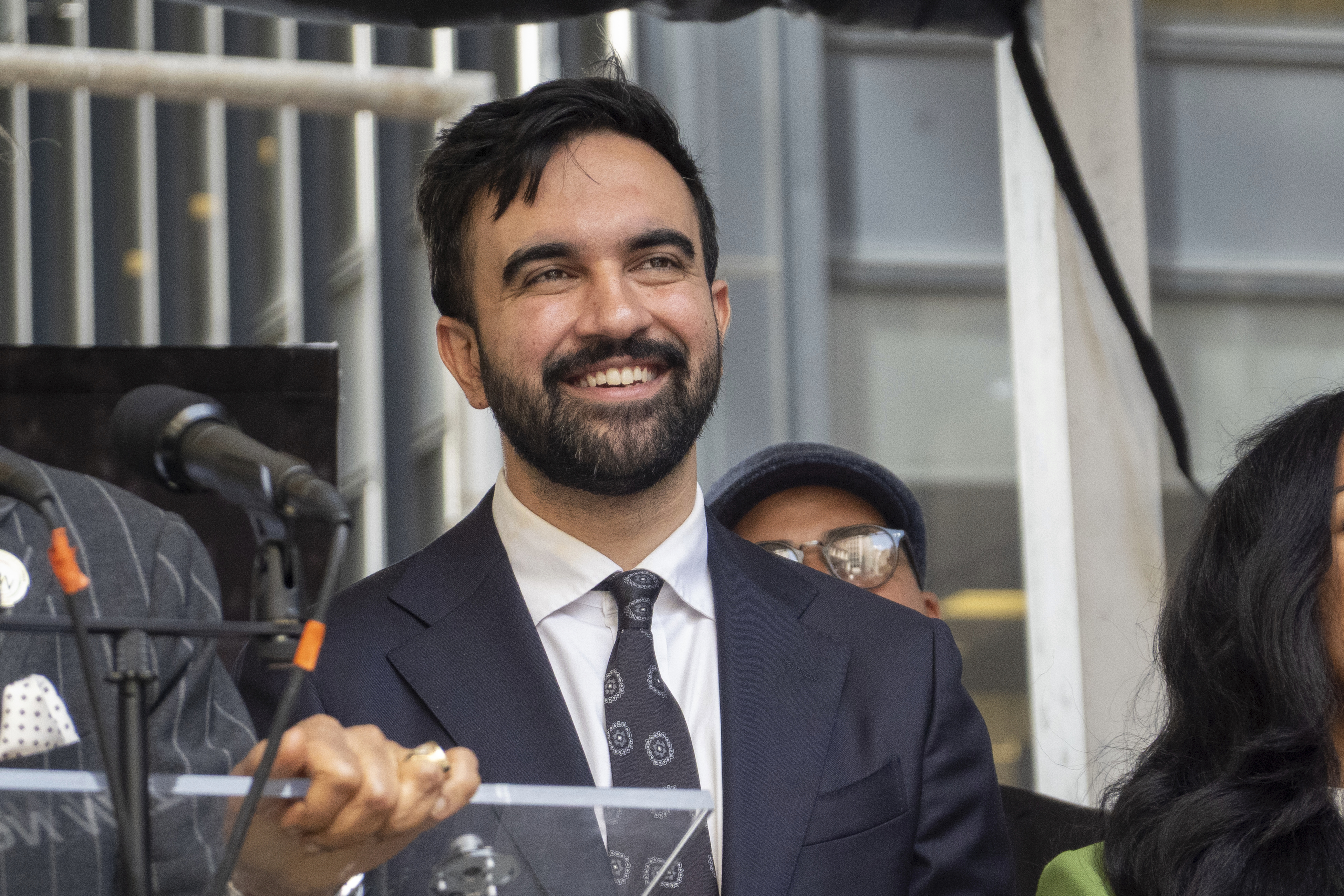
New York City Democratic mayoral candidate Zohran Mamdani is on stage at the March on Wall Street on Aug. 28, 2025, in New York. (AP photo/Ted Shaffrey)

by Peter Feuerherd
Although most polls show Democratic candidate Zohran Mamdani as the winner in this year's New York mayoral race, that doesn't mean the city's first potential Muslim mayor is guaranteed a smooth victory.
And while attention focuses on his faith, as well as what the Associated Press describes as "outspoken support for Palestinian causes" and its possible impact on Jewish voters, the city's dispersed Catholic voters may ultimately hold the key to who wins this highly contested race.
Mamdani, described as a socialist, shocked the political world with a victory in June's Democratic mayoral primary. Just 33 years old, the New York state assemblyman campaigned on a platform to freeze rents, establish city-owned grocery stores and free-fare buses.
Mamdani's victory jolted the city's political establishment, sparking an effort to unite against him. According to The New York Times, after his win financiers and real estate titans pledged to raise millions to defeat him, and as of Sept. 26 "the effort to damage his campaign has begun."
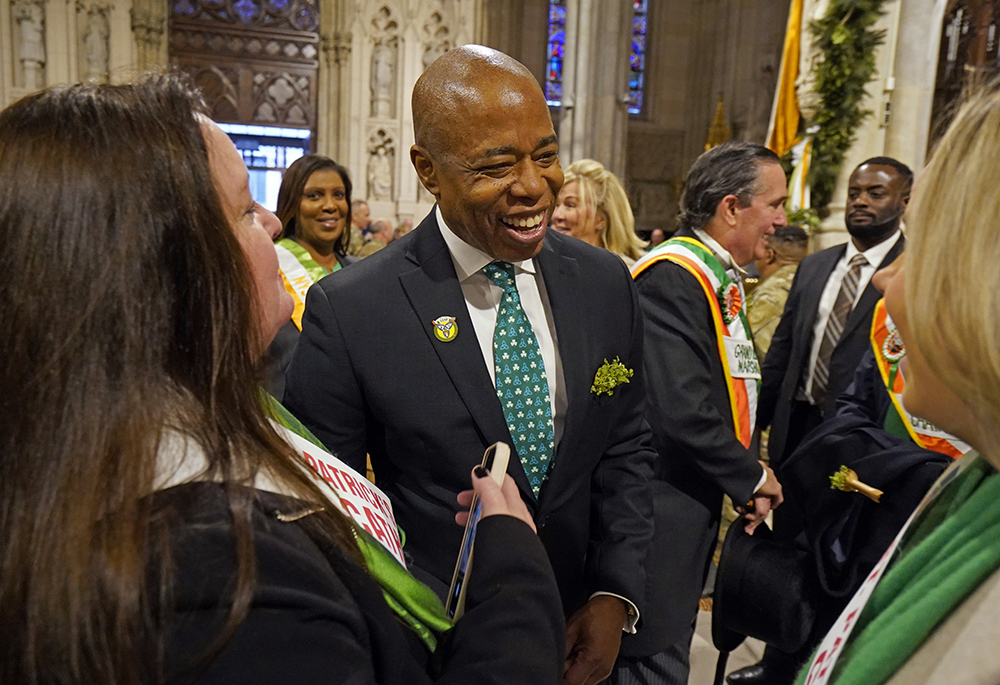
New York Mayor Eric Adams chats with well-wishers after attending the St. Patrick's Day Mass at St. Patrick's Cathedral in New York City March 17, 2023. (OSV News/Gregory A. Shemitz)
Additionally, incumbent Mayor Eric Adams announced he was quitting the race Sept 28, leaving the anti-Mamdani vote to coalesce around two candidates, former Gov. Andrew Cuomo and Republican candidate Curtis Sliwa.
Mamdani has made successful inroads into establishment circles, winning the endorsement of Gov. Kathy Hochul.
Paul Moses, chronicler of religion and politics and retired journalism professor at the City University of New York, said that while nearly one-third of New Yorkers identify themselves as Catholics, their influence is diffused. Still, he noted, it was the Catholic vote which swung heavily in electing two recent Republican mayors, Rudolph Giuliani and Michael Bloomberg.
Catholic voters will have their say this year, said Moses, prior to Adams dropping out. "That's a vote that would favor Adams, Sliwa and Cuomo. Not so much Mamdani."
Hochul's Mamdani endorsement came via a New York Times op-ed. The governor, often labeled a moderate Democrat, noted her disagreements with Mamdani. But she said he remains "a leader who is focused on making New York City affordable," a message that resonated with Democratic primary voters.
New York Catholic politicians rarely wear their religion on their sleeves. But they are known to pay the church regards, with appearances at St. Patrick's Cathedral during ceremonial occasions. Mamdani met with Cardinal Timothy Dolan in a private audience. Sliwa and Cuomo, the two baptized Catholics in the race, have had more icy relationships with church entities.
Advertisement
"Sliwa has been outspoken in attacking Catholic Charities over immigration," noted Moses, who said the Guardian Angels founder led rallies against a city-run migrant encampment in Brooklyn.
At one rally that Moses wrote about for Commonweal, Sliwa proclaimed that migrants were a terrorist threat and said Catholic Charities was "a racket."
Cuomo has a long resume, but his abrasive style, including run-ins with mayors, may have turned off voters, said Moses. As governor, Cuomo had his flaps with bishops, as did his late father, former Gov. Mario Cuomo. Andrew Cuomo was successfully sued by the Diocese of Brooklyn, which argued that the then-governor had overstepped his authority and violated religious freedom in restricting worship services during the COVID-19 pandemic.
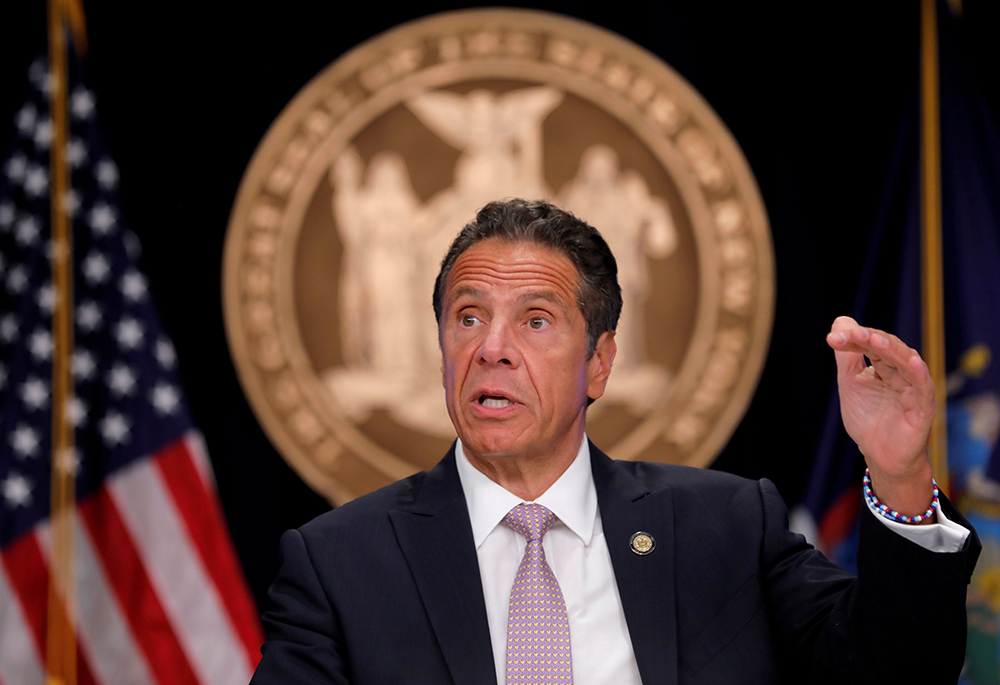
Former New York Gov. Andrew Cuomo speaks July 13, 2020, during a daily briefing in Albany, New York, amid the coronavirus pandemic. (CNS/Reuters/Mike Segar)
Sliwa, a New York fixture, could be the wild card. At 71, he is known for his trademark red beret, the symbol of the Guardian Angels, the anti-crime group with the Catholic moniker he founded while working as a manager of a McDonald's in a Bronx neighborhood during the 1970s.
The shadow of President Donald Trump also hangs over the race. According to the AP, Trump has threatened to deploy the National Guard to New York among other U.S. cities.
Although Kamala Harris won the popular vote in New York City in the 2024 presidential race, Trump took in about 30% of the city's vote, making inroads in the outer boroughs and minority neighborhoods.
Moses pointed to the variety of Catholics in the city, including Latinos and Blacks, particularly those from the Caribbean, as well as more conservative Italians, Irish and Poles, where Sliwa is popular, and said that neighborhoods in south Brooklyn and Queens are dotted with his campaign signs.
Mamdani's family tree represents much of the city's ethnic mix: He is of Indian background, was born in Uganda and came to New York as an immigrant child.
Mamdani surged forward with likely voters with a summer Zenith poll showing him at 50% in a 5-way race, followed by Cuomo at 22%, Sliwa at 13% and Adams, now out of the race, at 7%.
In an off-year election, the race has generated unusual national prominence. On election night attention will be paid to the results as the nation looks to its largest city, wondering whether its politics are a bizarre outlier or a harbinger of things to come.