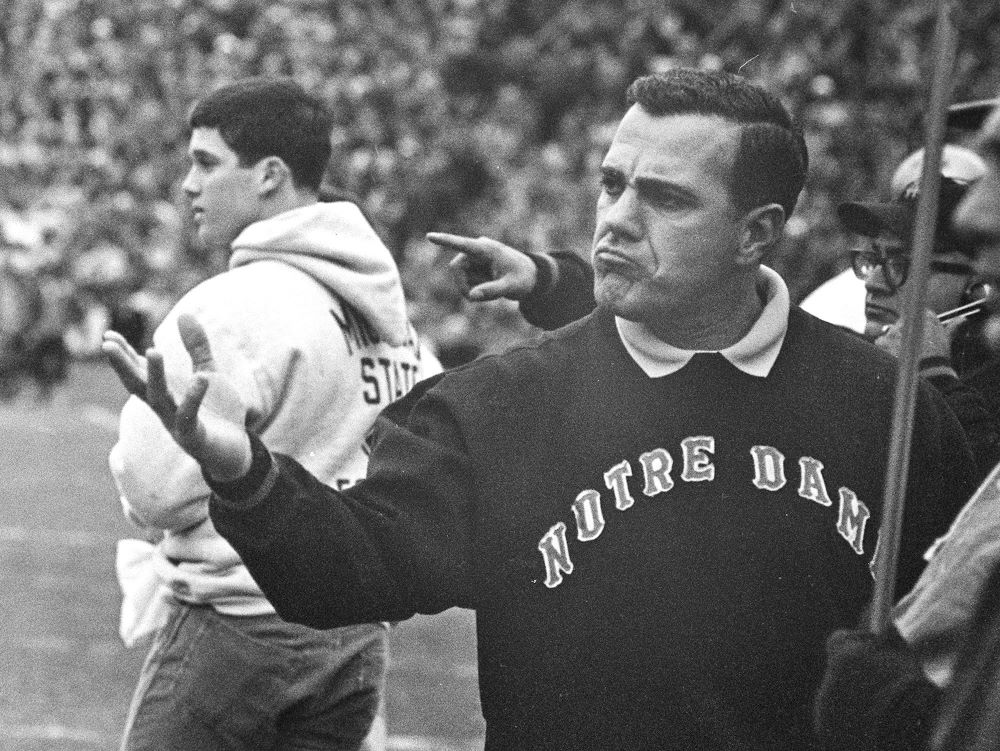
Notre Dame coach Ara Parseghian gestures during a college football game against Michigan State, in East Lansing, Mich. Nov. 19, 1966. Parseghian, who took over a foundering Notre Dame football program and restored it to glory with two national championships in 11 seasons, is the namesake of a rare diseases research program at Notre Dame. (AP/file)

by Sean Piccoli
A rare diseases research program at the University of Notre Dame named for the legendary Fighting Irish football coach Ara Parseghian is at the center of a legal battle between a Parseghian heir and a longtime faculty member who was forced out as the program's founding director.
The internal rift at the Boler-Parseghian Center for Rare Diseases, which is housed at the Catholic university in South Bend, Indiana, has surfaced in a federal court case pitting the late Ara Parseghian's daughter-in-law, Cindy Parseghian, against a Notre Dame biochemistry scholar who works on debilitating and deadly illnesses, Kasturi Haldar.
In 2009, Cindy Parseghian and Haldar were the public faces of a new effort at Notre Dame to combat diseases overlooked by mainstream medical science. Both appeared in a broadcast video that aired in September 2009 during Notre Dame's season-opening football game to highlight the university's push for treatments and cures.
Cindy and Mike Parseghian, the football coach’s son, were motivated to create the research center to find a cure for a disease sometimes called "childhood Alzheimer's," which killed three of their four children.
Now, the Boler-Parseghian Center is searching for a director after three years without a full-time leader. The research laboratory that Haldar operated there was shut down in December. And Haldar, a tenured Notre Dame lecturer, filed suit in October in U.S. District Court for Northern Indiana alleging race and age discrimination, and breach of contract.
She is suing Parseghian; the University of Notre Dame; and a former dean of science, Santiago Schnell, who left Notre Dame in June.
In an interview with the National Catholic Reporter, Haldar, 67, said she was "very badly hurt by a rogue dean and an out-of-control trustee" who pushed her out of the research center's directorship and then closed her laboratory at the center.
Notre Dame, Parseghian and Schnell are seeking to have the case dismissed. They deny discriminating against Haldar and deny colluding to replace her in violation of her contract and her civil rights. The defendants respond in court records that the university took appropriate actions against an employee whose productivity as a grant recipient and researcher had declined.
The defendants also allege that Haldar was a bad manager who mistreated staff and neglected to mentor students, pointing to an internal investigation whose findings were upheld by a faculty grievance committee.
Notre Dame has won several procedural rulings in the case. In November, U.S. District Judge Cristal Brisco denied Haldar's emergency request to be reinstated as the center's director and prevent her laboratory from being closed. In May, Brisco, a Notre Dame Law School graduate appointed by President Joe Biden, denied a motion because Haldar "had not made a strong showing of success on the merits of any of her claims."
Haldar spent 13 years leading the rare diseases center, which combines research, teaching and patient advocacy at its headquarters inside the university's life sciences building. The lawsuit is ongoing, with no trial date set.
Notre Dame said in a statement, "We are confident that we have handled this matter in keeping with the University's values and high standards, and stand by the positions we have taken in our court filings."
Schnell, now provost of Dartmouth University in New Hampshire, declined to comment and referred NCR to Notre Dame's statement.
Cindy Parseghian in a statement said that the lawsuit's claims are meritless and that she expects to prevail in court.
Ara Parseghian, who died in 2017, was beloved for leading the fabled Fighting Irish football program to a pair of national championships in 1966 and 1973, and was a popular commentator who called football games for ABC and CBS television for 13 years until 1988.
He is also the namesake for the Ara Parseghian Medical Research Foundation, the charity that was founded in 1994 by Cindy Parseghian and her husband, Michael Parseghian — Ara's son — after three of their children were diagnosed with Niemann-Pick Disease Type C, or NPC.
The Parseghian children ultimately died of the rare disease — an inherited condition that damages vital organs and the central nervous system by disrupting the ability of the body's cells to burn fat. Infants and children with NPC rarely survive into adolescence.
The family-founded charity officially merged with Notre Dame in 2016 and became the Ara Parseghian Medical Research Fund.
The earlier foundation went from reporting roughly $1 million in annual contributions in years before the merger to eventually reporting no income or expenditures afterwards, according to tax filings.
The current, campus-run Parseghian Fund raises money for NPC research conducted at Notre Dame and other institutions worldwide, but has no formal relationship with the Boler-Parseghian research center beyond donating to its work, said two university sources familiar with the dispute who requested anonymity to speak about the case. Cindy and Michael Parseghian sit on the fund's advisory board but have no fiduciary role, and are not on the science panel that decides which research projects to fund, the sources said. Cindy Parseghian also has no role with the Boler-Parseghian research center and is not one of its benefactors, the sources said.
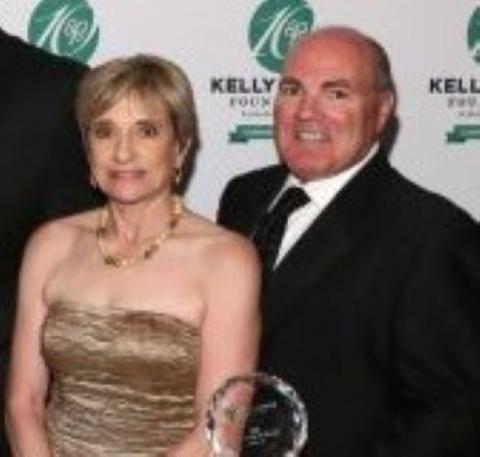
Cindy and Mike Parseghian are pictured at a Kelly Cares Foundation gala on May 7, 2018, in New York. Mike Parseghian is the son of former Notre Dame football coach Ara Parseghian. (AP/Invision for Kelly Cares Foundation/Stuart Ramson)
Haldar alleges that Parseghian had enough clout on campus to wrest control of the Boler-Parseghian Center away from her and to enlist Schnell in the effort shortly after he arrived at Notre Dame's College of Science in 2021 to become its dean. Schnell obliged Parseghian by falsely accusing Haldar of misconduct and poor job performance, according to Haldar's lawsuit.
The lawsuit also claims that Parseghian once told Haldar that she doesn't represent her Notre Dame — meaning Parseghian's Notre Dame. Haldar took that to be a racial slur about her Southeast Asian descent. Parseghian, in an affidavit in the case, said she doesn't remember the conversation and denied any racial animus toward Haldar.
Parseghian's affidavit said her disagreements with Haldar were strictly professional.
Haldar still has a home near the university and taught a full course load through the end of the 2024-25 school year. She said she will do so again this fall. But in addition to her removal as center director and the closure of her laboratory, she has been stripped of an endowed professorship and the extra income that came with it, barred from advising students, and denied access to university research funds.
Haldar said the conflict has halted her donor-funded research into treatments for two rare and debilitating diseases. One is Nonketotic hyperglycinemia, or NKH, a metabolic disease that causes muscle loss, cognitive disabilities and seizures; the other is Kabuki syndrome, a genetic mutation that leads to organ defects, cognitive impairment and abnormal facial features.
The dispute also has stymied Haldar’s ongoing work to treat drug-resistant strains of malaria, according to her lawsuit.
Notre Dame recently euthanized some mice in a colony that Haldar bred for NKH research, with remains including embryos cryo-preserved for use in future research, and some of the mice kept alive for future breeding, a university source told NCR. The Boler-Parseghian website still lists NKH and Kabuki syndrome as diseases it is researching.
Notre Dame in a statement said the university is "deeply committed to the critical work of researching rare and neglected diseases, both at the University and in the broader scientific community."
"The Boler-Parshegian Center is one of many entities that executes research associated with NPC, amongst other rare and neglected diseases," the statement read.
At least two other schools, the University of Colorado and University College London, conduct NKH research.
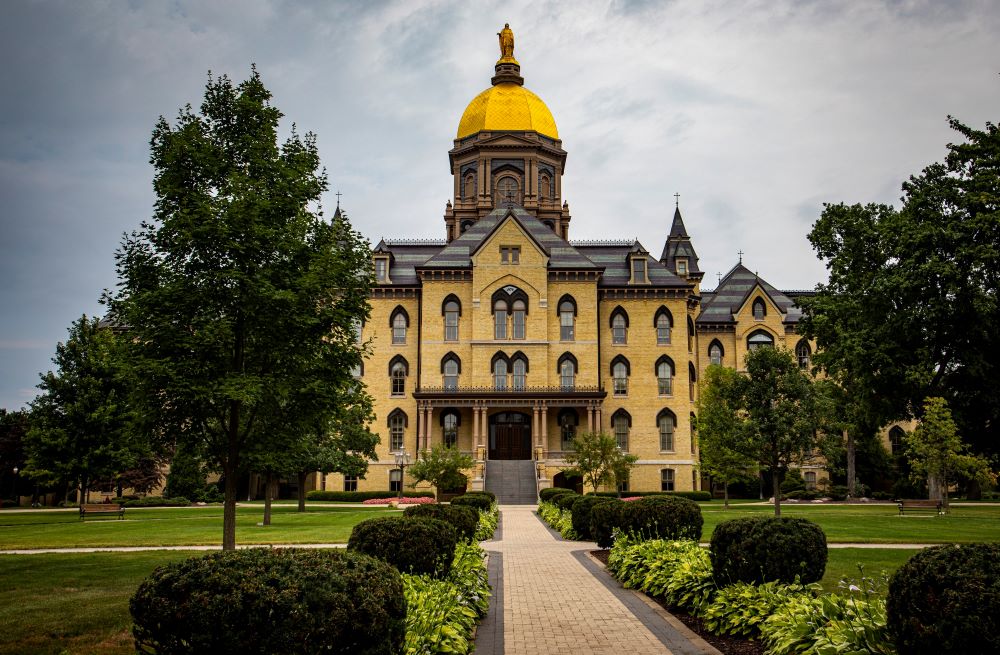
The Golden Dome with its statue of Mary is seen Aug. 6, 2021, atop the administration building of the University of Notre Dame in Notre Dame, Indiana. (OSV News/CNS/Chaz Muth)
Haldar also denied that she was unproductive or unprofessional.
In court filings and an interview, Haldar said that she has successfully mentored scores of students, and that any disagreements over their hours and instructional needs were always handled informally. "Their careers are very important to me," she said of the students who came through her laboratory as trainees.
She said she was no more demanding of students and staff than any faculty member responsible for high-level university scientific research. "The work that we do is not easy," she said.
A former doctoral student, Alejandro Lopez Ramirez, said in an affidavit in October that he had an "excellent" experience with Haldar. "Before May 2022, our laboratory was a vibrant, supportive place," Lopez Ramirez wrote.
"Once Dr. Haldar was no longer allowed to hire graduate students or employees, it became much more difficult to complete experiments in a timely manner and often required outside help" from other labs, he said in the affidavit.
Lopez Ramirez did not respond to requests for comment.
Haldar received her doctorate in biochemistry from Massachusetts Institute of Technology. Before working at Notre Dame, she held posts at Northwestern and Stanford universities. Her lawsuit states that she has helped to bring in some $20 million to Notre Dame in donations, endowment money and federal grants for research into rare diseases.
Documents filed by defendants Notre Dame, Parseghian and Schnell portray Haldar as failing in recent years to seek and attract enough federal research grant money and refusing to participate in an audit of her work.
“Your record of obtaining research funding from externally funded, peer-reviewed sponsored programs is unacceptably weak and nearly non-existent in recent years,” Schnell wrote in a letter to Haldar dated Sept. 6, 2024. "Your conduct in connection with the College’s review of your research activity has also been unprofessional."
Advertisement
Before Haldar's laboratory was closed in December, she said, her output as a researcher, scholar and inventor remained strong despite "draconian restrictions" Schnell imposed on her.
"We maintained our pace against all odds," she said, even as her access to research funds was curtailed and her laboratory was being downsized.
She is the credited inventor of four medical patents assigned to Notre Dame, including one for a test method for detecting NPC, and one for a new combination of enzymes and molecules for treating chronic pain. Haldar said she has two patent applications in the pipeline, as well as two scholarly articles pending peer review.
Haldar said Notre Dame owns the rights to much of her work. She also said the stress of fighting to salvage her career and to resume her work in full, has caused her health problems.
The dispute, she said, has "taken away the thing that I love to do — research in my lab."