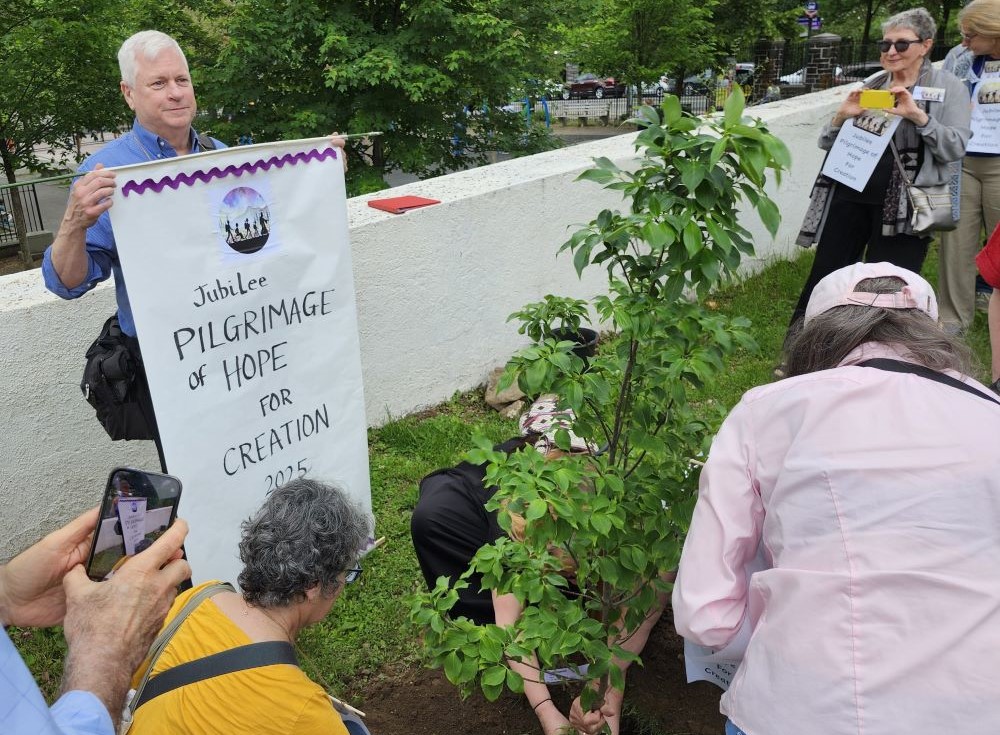
Members of the Metro New York Catholic Climate Movement plant a tree in remembrance of Pope Francis at the Shrine of St. Frances Xavier Cabrini in northern Manhattan. The visit was part of the Pilgrimages of Hope for Creation organized across the U.S. to mark the Jubilee Year in 2025. (Metro New York Catholic Climate Movement)

As Archbishop-designate Ronald Hicks stands inside New York's St. Patrick's Cathedral for his installation Mass Feb. 6, he's likely to feel some heat beneath his feet.
Since 2017, St. Patrick's, perhaps the best-known Catholic church in the United States, has relied on a 10-well geothermal system to regulate temperatures year-round inside the 147-year-old holy space, utilizing the earth below to store heat in warm months and extract it during colder periods.
The system has not only reduced the cathedral's energy use and carbon footprint — offsetting annually the emissions equivalent to 10,577 gallons of gasoline — but it stands out as one of the most visible signs of the New York Archdiocese's efforts to live out Pope Francis' 2015 encyclical, "Laudato Si', on Care for Our Common Home."
Hicks led the Joliet, Illinois, suburban diocese outside Chicago for the last five years. There he oversaw a number of efforts to embed ecological concern deeper into Catholic life, including joining the Vatican's premier initiative to live out Francis' call to care for God's creation.
That background has New York Catholics who are involved in Laudato Si' ministries hopeful their new archbishop will not only support their work but help to root it even deeper into one of the country's largest dioceses that counts 2.5 million Catholics and nearly 300 parishes.
"We're excited that he's coming," said Nancy Lorence, founding member of the Metro New York Catholic Climate Movement, a chapter of the global Laudato Si' Movement. "We're hopeful that we'll be able to do more and that there will be more of a promotion of Laudato Si' in the parishes."
Laudato Si' in Joliet
In December, Hicks, 58, was named by fellow Chicagoan Pope Leo XIV as the 14th archbishop of New York. While in Joliet, Hicks developed a reputation as a pastoral shepherd in the mold of the past two popes and strong supporter of Catholic social teaching, which includes care for God's creation.
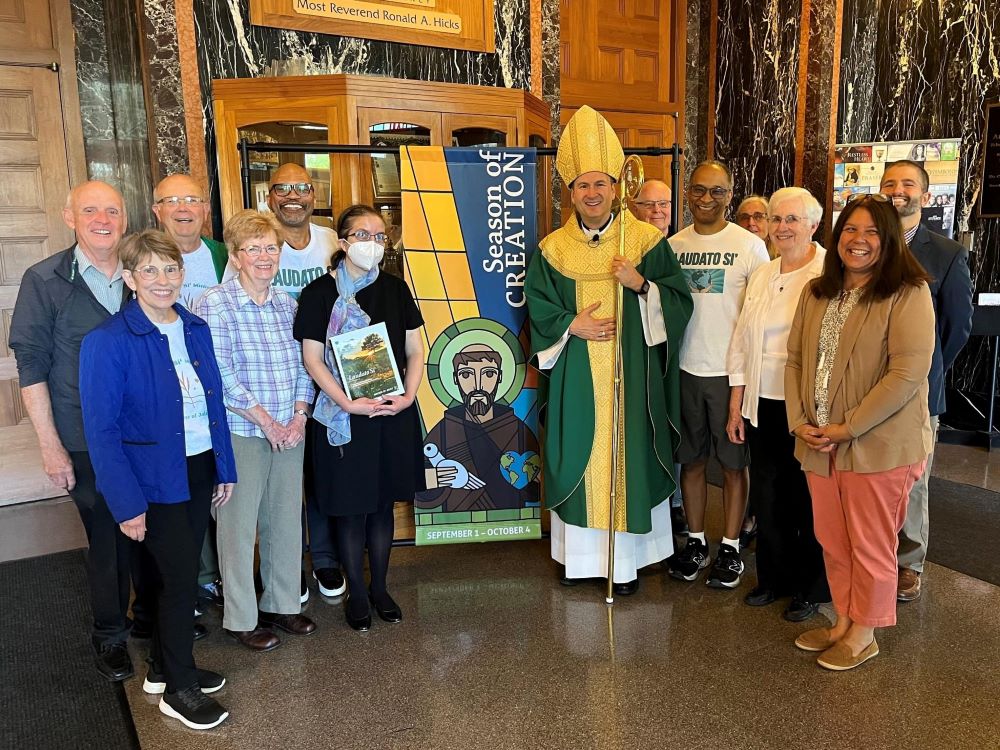
Joliet Bishop Ronald Hicks meets with members of the diocese's Laudato Si' Committee after Mass at the Cathedral of St. Raymond Nonnatus, in Joliet, Illinois. The Mass kicked off the diocese's enrollment in the Laudato Si' Action Platform, the Vatican initiative for Catholic institutions to live out teachings of Pope Francis' 2015 encyclical "Laudato Si'." (Julian Brown)
"It gives us practical ways to love and to care for our common home, the Earth," Hicks said of Laudato Si' in a video inviting Catholics to commemorate the 2024 Season of Creation, which he said offers "an opportunity to renew our relationship with God the creator and with creation through celebration, conversation and commitment together."
Under Hicks, the Joliet Diocese enrolled in 2023 in the Laudato Si' Action Platform, the Vatican initiative offering Catholic institutions a roadmap for implementing the encyclical's teachings. Hicks also participated an ecclesial meeting last year on ingraining Laudato Si' more widely in the life of the U.S. church. So far, 30-plus U.S. dioceses have enrolled in the Vatican platform.
"We are each called to protect our common home according to our ability and means," Hicks wrote in an introductory letter to Joliet's diocesan action plan. He invited all Catholics "in a new dialogue on Care for Creation for future generations in our diocese, so that they too can enjoy the natural beauty and splendor of our local prairies, wetlands, and woodlands; our great Lake Michigan and mighty Mississippi River; and our cities, suburbs, and farming communities."
Joliet was the first U.S. diocese to have a full-time staff position overseeing Laudato Si' ministries, which was created under Bishop Daniel Conlon and fully funded by a grant. While that position was eventually eliminated as part of a 2022 reorganization of the diocesan offices under Hicks, much of its work has continued through the department of catechesis and evangelization, as well as a Laudato Si' committee made up of volunteers.
Hicks met with members of the committee after a Mass in September 2023 marking the launch of the diocesan Laudato Si' plan.
"[He] gave us some very encouraging words, saying that we should lead by example," said Julian Brown, a parishioner at St. Francis of Assisi Church in Bolingbrook who served as the first chair of the Joliet Laudato Si' committee and served on Hicks' diocesan pastoral council.
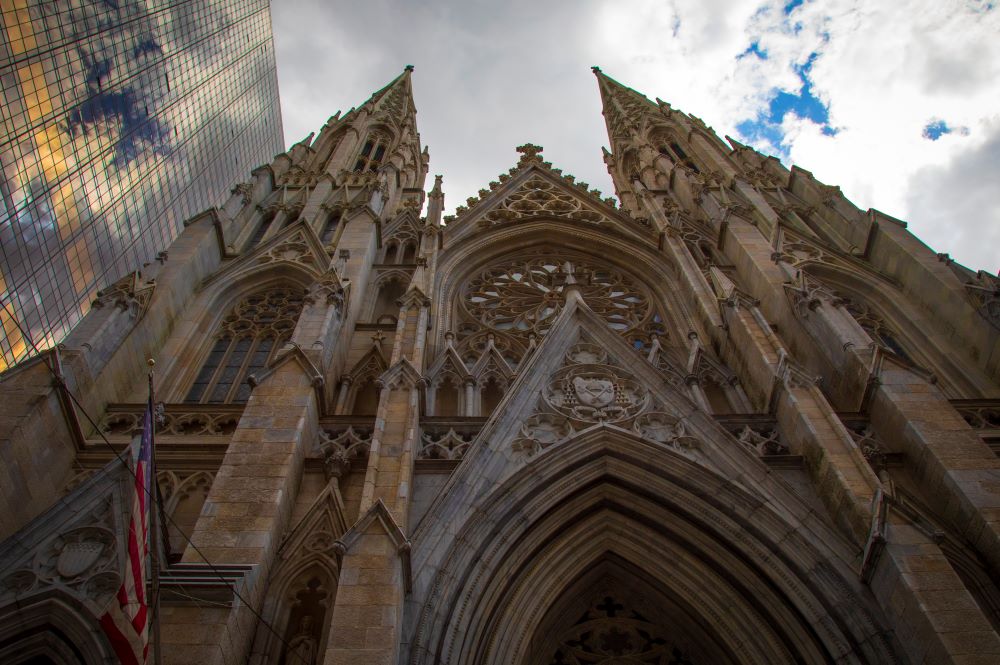
Since 2017, New York's St. Patrick's Cathedral has heated and cooled through a 10-well geothermal system, which reduces both its energy use and carbon footprint. (CNS/Chaz Muth)
Last fall, Hicks in a pastoral letter titled "Make" again emphasized environmental concern in listing "when we care for creation" among 12 ways to make disciples.
Brown said the bishop has supported the committee's work, which has included hosting programs with the Citizens Utility Board of Illinois to educate Catholics in the Joliet Diocese about available state tax credits for community and rooftop solar and other energy upgrades. They are also working with the diocese to explore solar installations for parishes.
In January, about a dozen parishes attended a first town hall to develop parish-level Laudato Si' plans. Like in many U.S. dioceses, getting more people on board is a slow process.
"It's an uphill battle. But the thing is that doing God's work is not easy," he said.
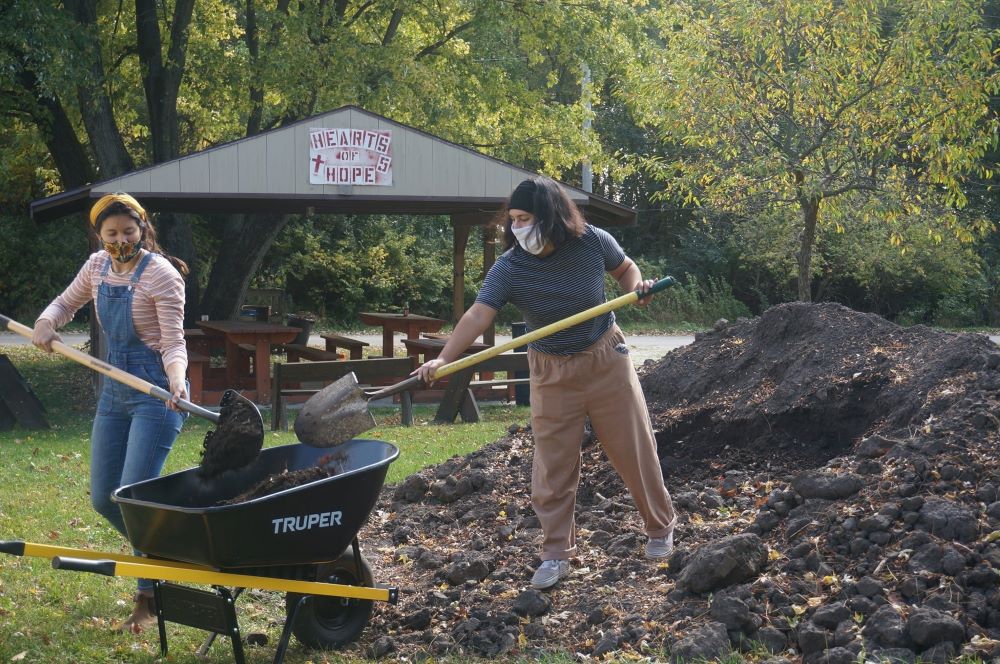
People work on a garden at Sacred Heart Parish Mission in the Diocese of Joliet, Illinois. The garden closed following a 2024 parish merger that closed the church. (CNS/Courtesy Diocese of Joliet)
Asked for his advice to New York Catholics ahead of Hicks' arrival, Brown suggested they put creation care ministries on his radar early.
"Hold up the Laudato Si' action plan from the [Joliet] diocese, and just say, we want one too," Brown said.
Energy a focus in NYC
In New York, Hicks will find church engagement around creation care on two fronts: grassroots parish efforts and the archdiocesan energy department.
The New York metro chapter of the Laudato Si' Movement began in 2014, shortly after the global People's Climate March that brought an estimated 310,000 people into the streets ahead of that year's United Nations climate conference. New York Cardinal Timothy Dolan encouraged participation, writing on his blog at the time "It would be wonderful if there were a strong Catholic presence at the march, to indicate our prayerful support of God's creation."
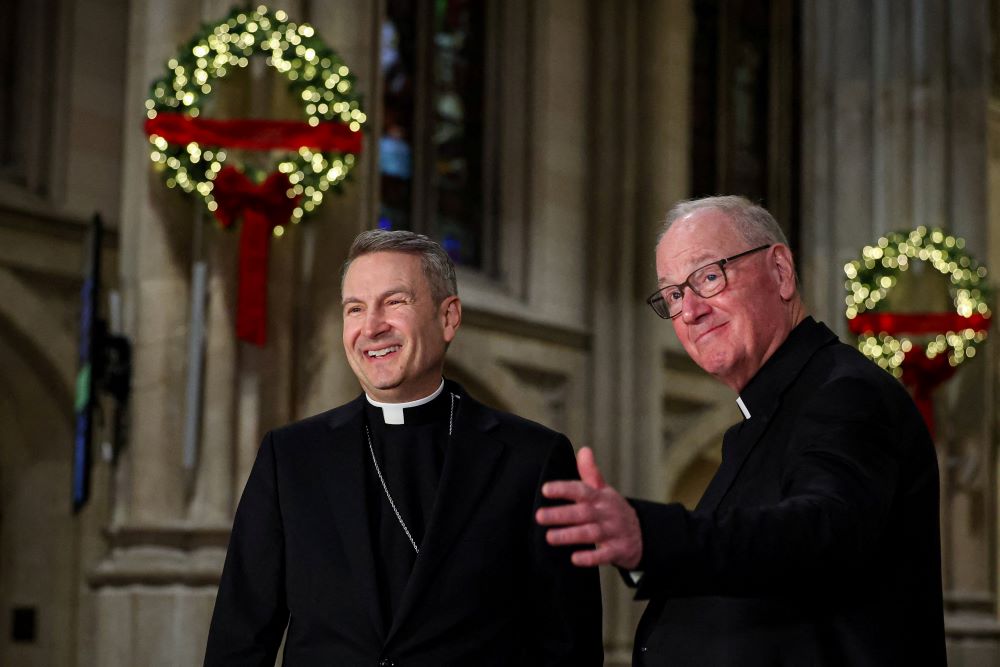
Archbishop Ronald Hicks and New York Cardinal Timothy Dolan smile during a news conference at St. Patrick's Cathedral in New York City Dec. 18 after Pope Leo XIV appointed Hicks as Dolan's successor. (OSV News/Reuters/Brendan McDermid)
To continue the march's momentum, Lorence helped establish a care for God's creation team that has served as a conduit among the archdiocese and parishes and groups like the NYC Laudato Si' chapter. At Dolan's direction, the informal committee meets regularly with Fr. Brian McWeeney, director of the Office of Ecumenism and Interreligious Affairs who reports back to the vicar general.
The collaboration keeps the archdiocese aware of Laudato Si' efforts across its boundaries and helps it promote events and initiatives. Last year, it co-sponsored a Mass during the Season of Creation at the Church of St. Francis Xavier in Manhattan. The archdiocese has also produced creation care resources for elementary schools and maintains a dedicated webpage for teachings and events related to creation.
"One of the great things is that there's so much going on that we're not even aware of all that's happening," said Charity Sr. Carol DeAngelo, a leader with both the creation care committee and Laudato Si' chapter.
While parish-level energy projects are still developing in Joliet, it has been one of the most active areas for Laudato Si' efforts in the New York Archdiocese.
Much of that work has been facilitated by the archdiocesan energy department, which Dolan created in 2014.
To date, the department — a rarity in U.S. dioceses — has conducted energy audits at more than 300 buildings. It has facilitated 13 solar installations, primarily at schools, and has four more in process. The archdiocese said it is on track to exceed its goal of reducing its total energy costs by 10%, or approximately $40 million annually, though it did not provide specific figures.
"It's a long process to get these things done, but we have a lot of patience and fortitude, and we're continuing to get at it," said Martin Susz, the archdiocese's director of energy management.
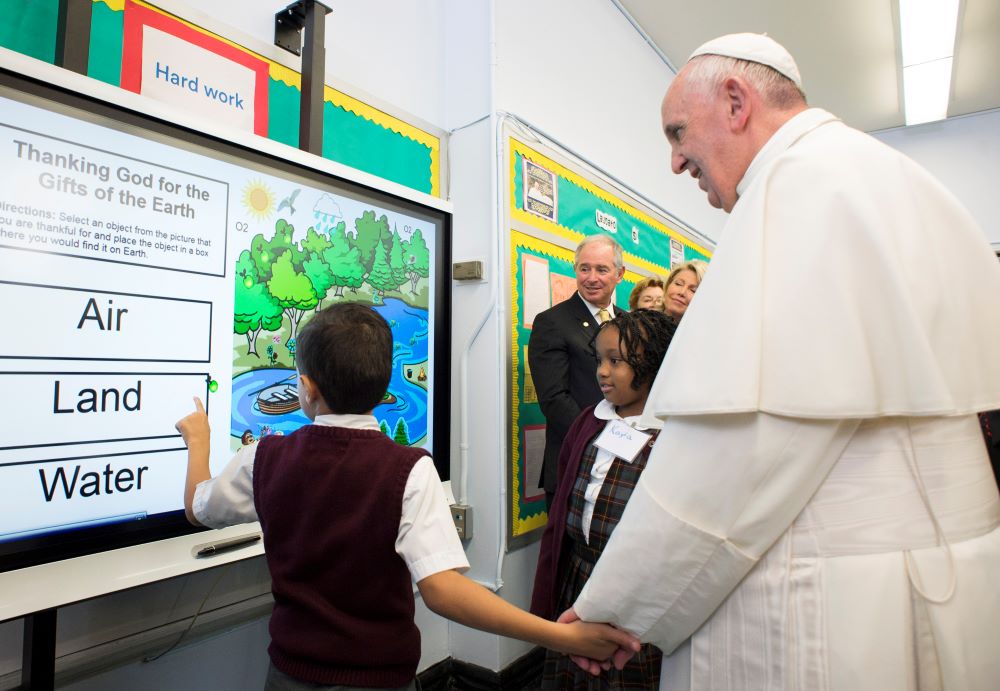
A student shows Pope Francis a lesson on the environment during his visit to Our Lady Queen of Angels School in the East Harlem area of New York Sept. 25, 2015. (CNS)
Laudato Si' isn't the lone driver of such efforts; New York city and state laws have set greenhouse gas emissions limits on large buildings. By 2030 more than 60 archdiocesan buildings must comply with Local Law 97, which requires most buildings over 25,000 square feet to reduce emissions, which drive climate change and are primarily released from burning fossil fuels.
"That's our single focus right now, our highest priority," Susz said.
The energy department also audits parish utility bills for overcharges and negotiates reduced fixed rates by grouping churches and schools. It has held parishioner workshops on how to make homes more energy efficient. At St. Augustine Church, in Ossining, it installed a 1-megawatt battery storage system that provides the utility electricity during high-demand periods and the parish an additional revenue stream.
"I think Archbishop-designate Hicks is going to come in, from an energy standpoint, to a well-oiled machine, which we weren't 10 years ago when we started," Susz said.
Still, he and others sense much more can be done in the archdiocese.
Engagement within the parishes remains limited, attributed in part to overworked priests often juggling multiple parishes. Securing financing for energy projects is also a challenge, made more so with the loss of federal clean energy tax credits.
"Some of the parishes are much more advanced than others," Lorence said.
Added Susz, "If I had one wish, if I had a magic wand, I'd like to hear more about Laudato Si', about care creation from the pulpit."
Advertisement
Recently, the archdiocese encouraged the care for God's creation team to meet with the priests' social justice committee. The committee has also begun discussions about incorporating the encyclical into religious education programs.
DeAngelo said she would like to see greater discussion around the interconnections between social issues — what Laudato Si' calls "integral ecology" — such as how rising temperatures and extending droughts play a role in driving migration from Latin America to the U.S.
One of the main challenges she sees Hicks facing in expanding New York Catholics' embrace of church teaching on creation is in the size of the archdiocese itself — spanning three of the city's five boroughs as well as rural counties outside the city. It presents diversity not only in geography but in views and priorities.
"It's hard because it's so big," DeAngelo said. "And then even when you do that, the parishes upstate are so different from the parishes downstate. So it is a real challenge."