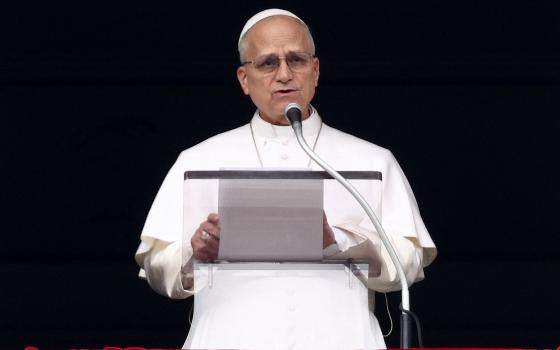
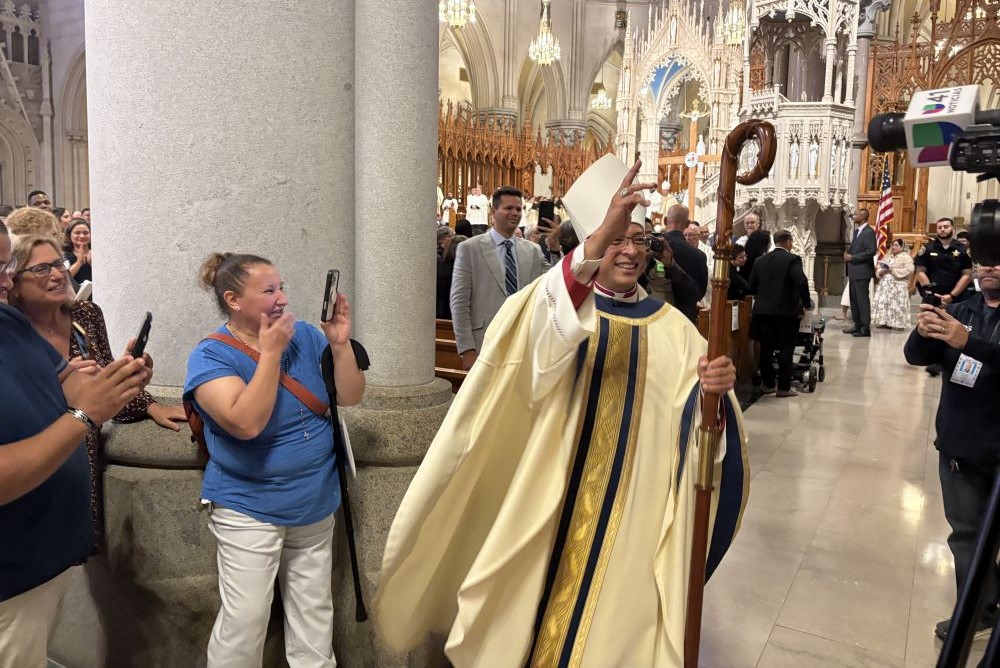
Auxiliary Bishop Bismarck Chau of Newark blesses the assembly at Cathedral Basilica of the Sacred Heart after he was consecrated as bishop during a Mass Sept. 8. Chau came to the U.S. as an undocumented immigrant from Nicaragua in 1984. (NCR photo/Camillo Barone)
At just 18 in 1985, alone in a Brooklyn apartment and in the country illegally, a Nicaraguan immigrant named Pedro Bismarck Chau found himself staring out an eighth-floor window, gripped by a hollow ache he could not identify.
"I felt a void in my heart," Chau said in a recent interview. "I must have fallen into a depression."
He was working long hours at a women's clothing factory, with no legal work documents. Unable to speak English or make new friends, Chau wondered about the point of living — and for a fleeting, dangerous moment, considered ending it all.
Nearly four decades later, on Sept. 8, Chau stood inside Newark's Cathedral Basilica of the Sacred Heart, robed in white and flanked by about 30 bishops and more than 100 priests, as the hands of Cardinal Joseph Tobin of Newark rested on his head in the ancient rite of episcopal ordination.
The young Nicaraguan immigrant who once felt invisible is now an auxiliary bishop of the Archdiocese of Newark. A naturalized American citizen, he was appointed by Pope Francis just a few days before his death in April, and confirmed by Pope Leo XIV in May.
When Chau walked into the cathedral to be ordained as an auxiliary bishop, he carried with him a lifetime of journeys — geographical, spiritual and deeply personal. Born in Managua, Nicaragua, in 1967, and the first Nicaragua-born bishop in the United States, his path to that moment began on the sun-soaked, rain-drenched streets of his childhood.
Chau grew up in a bustling household led by his mother, with six siblings and a father who was often away for work. His earliest memories are not of scarcity or absence, but of joy — barefoot games with friends, playing baseball on the block, lying in the grass as warm rains fell, and sneaking off to scare animals away so they wouldn't be hunted.
Faith was the constant in his family, even as the country around them grew tense. Nicaragua in the 1970s and 1980s was gripped by upheaval. Chau remembers government spies slipping into church gatherings to listen for homilies critical of the regime. He was a teenager when the conflict began to close in.
The government mandated military service at 17. In 1984, Chau was only months from his 17th birthday. He felt the pull of the military uniform, but his mother feared for his life. Training was minimal, she warned him, and boys were being sent directly into mountain combat against the counter-revolutionary forces. Quietly, she made a decision: He would have to leave the country.
In January 1984, at 16, Chau left Nicaragua. His older brothers arranged for a coyote, a smuggler, to meet him in Mexico and take him to the U.S. border. It was a terrifying prospect for a teenager traveling alone, he said in an interview with the National Catholic Reporter.
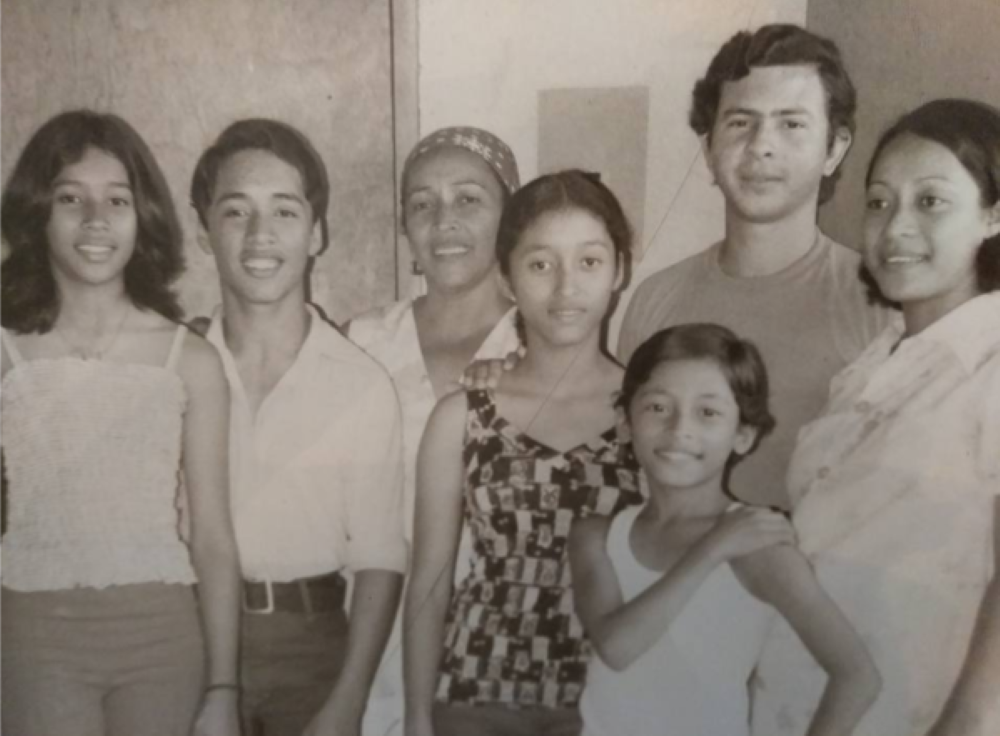
The future Auxiliary Bishop Pedro Bismarck Chau is the youngest child in this photo, shown with some of his six siblings and his mother in Nicaragua in 1971. (Courtesy of Pedro Bismarck Chau)
Yet, something providential unfolded. The woman who picked him up looked uncannily like his mother. She could credibly claim Chau as her own son and she resembled him closely enough to convince border agents. Instead of wading across a river or trekking through desert, Chau passed through an official legal crossing in a car on the border in Texas.
That grace has never left his mind, he said, especially when he thinks of migrants making the same journey today, but under far harsher conditions.
"Parents would do anything for their children to be protected and to be safe," the new bishop said. "My heart pains for what they're going through now, even harder, more difficult than what I went through."
After crossing the border in Brownsville, Texas, Chau flew to Houston with his sister-in-law and spent six months there, trying to find his footing in a new world. The teenager feared not the language or the culture so much as the possibility of losing his connection to God. In Nicaragua, he had been warned that the United States was a materialistic place where authentic religion withered.
"My fear coming to the United States was to lose my faith," he remembered. "I didn't want to lose my faith because I would become materialistic, which happened eventually, when I stopped praying, stopped going to church."
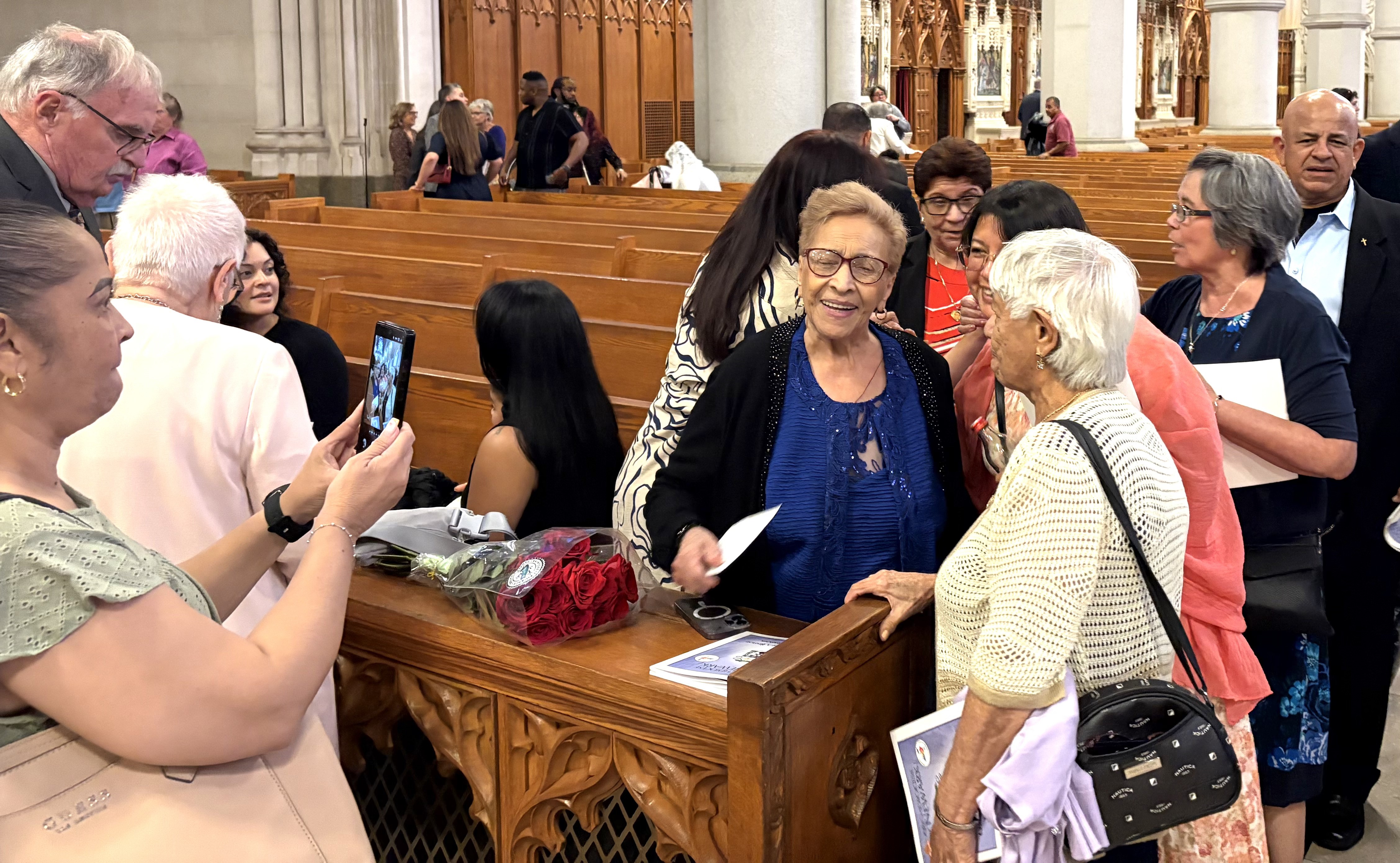
Friends, relatives and faithful from the Archdiocese of Newark greet Auxiliary Bishop Pedro Bismarck Chau's mother (center, in blue shirt) after Chau's consecration Mass, Sept. 8. (NCR photo/Camillo Barone)
In Houston, Chau began working at a restaurant — a job his brother helped him find. When his father, living in Tampa, Florida, offered to make up for lost time by bringing him to live there, Chau agreed. His father had converted to be a Jehovah's Witness, and the two eventually clashed. Chau quietly called his brothers for help. His brothers urged him to move to New York.
By the time he arrived in Brooklyn, his English had improved and he was eager to study. In Tampa, he could not attend high school because of his immigration status — he had entered the country illegally without papers. New York felt like a second chance. He enrolled in English classes at LaGuardia Community College while working at a women's clothing factory, eventually earning his high-school degree through a GED.
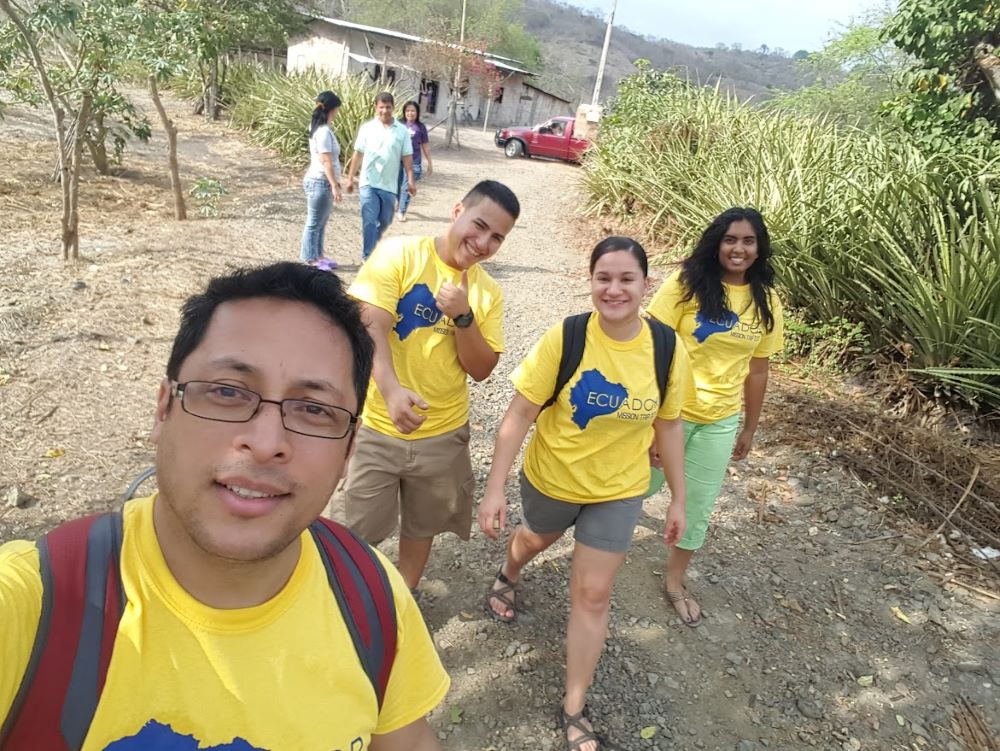
Then Fr. Pedro Bismarck Chau of Newark accompanies students during a 2017 mission trip to Ecuador in response to the 2016 earthquake. Chau was then a campus minister for Rutgers University and the New Jersey Institute of Technology. (Courtesy of Pedro Bismarck Chau)
Chau worked long hours to support his mother, his deaf sister, and his brother with cerebral palsy, who had come to the U.S. by the mid-1980s. But beneath the steady grind of work and responsibility, something hollow opened inside him. Living in a small two-bedroom apartment in Brooklyn's Williamsburg neighborhood with his mother and three of his siblings, he felt isolated, restless, and without purpose. He didn't recognize it then, but he said now he sees it as depression.
Meanwhile, his brother Marcos had gone on a youth retreat at a Catholic parish in Brooklyn and returned transformed. One day, Chau decided to walk through the church doors with his brother.
"I remember going into that church for the first time in a long time, and I said, 'Lord, I'm back.' "
A Puerto Rican parishioner invited Chau and his brother to a youth retreat. Chau went, hesitant at first. What he found there would change his life. Listening to a young man testify about how God had rescued him from a life of gangs and drugs, Chau heard his own longing echoed in that story.
"That void that I had was completely filled," Chau said. "I felt this joy that I never experienced before."
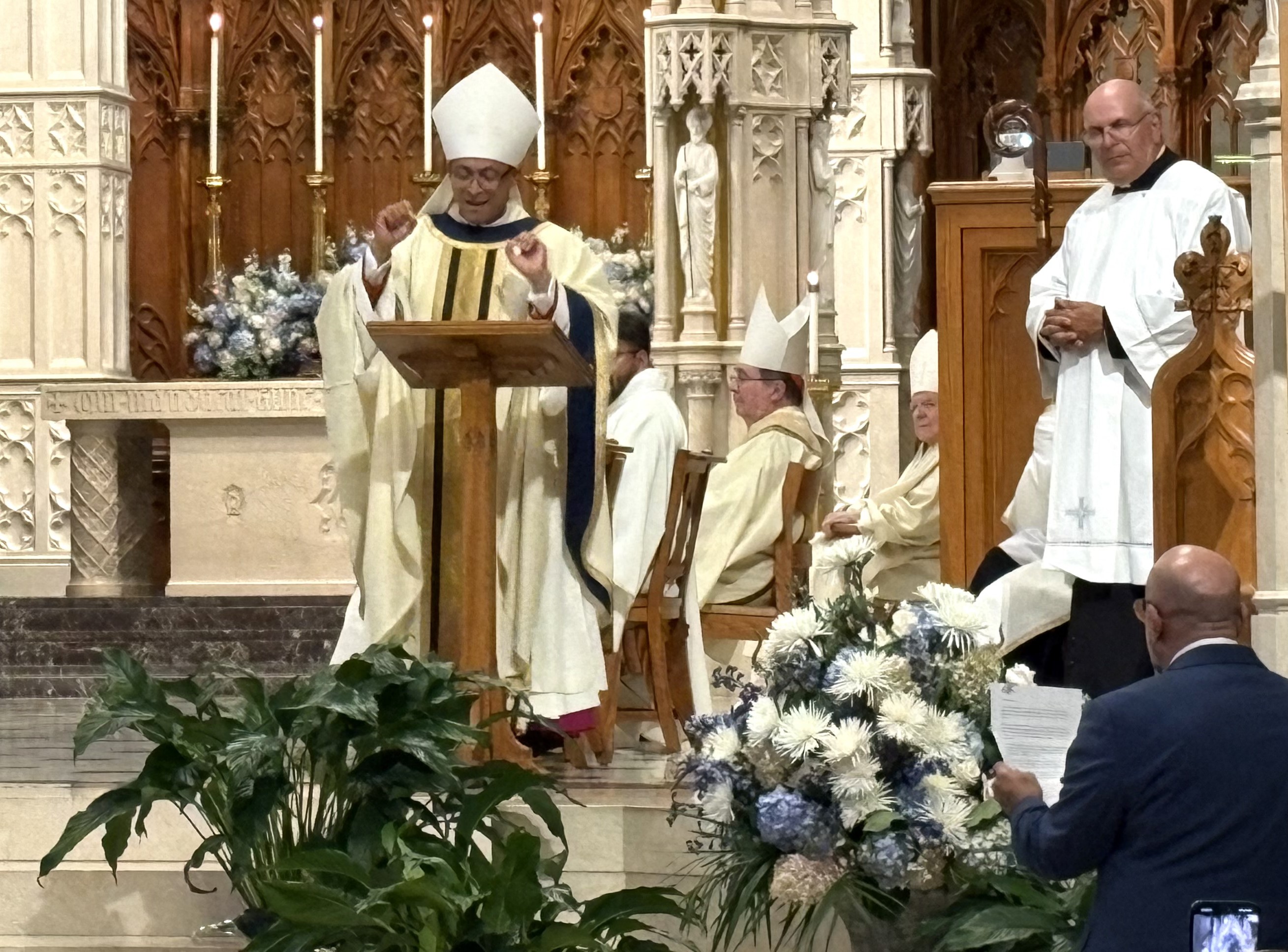
Auxiliary Bishop Pedro Bismarck Chau of Newark thanks the assembly in American Sign Language at his consecration Mass Sept. 8. (NCR photo/Camillo Barone)
He formed part of the parish's youth group, led its music ministry, and crisscrossed boroughs to play the keyboard at retreats. One evening, a newly ordained Franciscan friar came down those same basement stairs. Chau looked up and saw something that startled him.
"The funny thing is … I saw myself in him," he said. "From that moment on, I started asking, 'Lord, why is this happening? Are you calling me to this?' "
By 19, he was more certain than ever that he was being called to priesthood.
Yet Chau didn't enter seminary. Because he did not have legal immigrant status, he feared being seen as an imposter using the church to get a green card. "What if God is not calling me to the priesthood, and then you guys help me get my green card, and then I leave? No, I don't want to be counted as one of those men," he said.
So he set the dream aside. He built a different life — working for a life insurance company, dating, moving to Linden, New Jersey, while still serving at retreats and on the national youth committee of the Catholic Charismatic Renewal.
'Parents would do anything for their children to be protected and to be safe. My heart pains for what they're going through now, even harder, more difficult than what I went through.'
—Auxiliary Bishop Pedro Bismarck Chau
Then, at a Hispanic Leaders Charismatic Conference in San Diego, Chau heard a young priest describe how he had abandoned a successful law career because "something was missing."
Those words pierced him.
"At that time, I had a good job, I had my car and my apartment, but then when I heard him say that something is missing, that came back to me again," Chau said.
He returned to his parish in Brooklyn, told his pastor, and was immediately sent to the vocation office.
He was ordained as a priest in Newark in 2008 at age 40.
Now, as the new auxiliary bishop of Newark, Chau sees clearly the challenges facing his archdiocese. Immigration, he said, looms large. Under Cardinal Tobin's leadership, the archdiocese has established a migrant ministry, training parishioners to build support systems within their parishes — organizing prayer groups, connecting people to pro bono legal help, finding food or housing when needed.
"That's the way that we can be present," Chau said.
Once undocumented himself, he has watched political threats rise again. Yet he refuses to be afraid, he said. He does not fear the U.S. government or the Trump administration's aggressive mass deportation policy.
"If they revoke my citizenship, which Nicaragua already took away, I am of the church," Chau said. "Church is universal. I go wherever God wants me to go."
Chau said it pains him to see how migrants are treated now. He said he still remembers offering to accompany an Ecuadorian woman from his parish to her deportation hearing. "My fear was, how are they going to treat her? So I was going to go with her."
Vocations are another pressing concern. "We need more men and women to answer the call," he said.
Chau also speaks with quiet fire about Catholics who are deaf. His sister became Baptist after finding no access to the sacraments in the Catholic Church as a deaf person. "I was jealous," he admitted. "I tried to bring her back, but I was not fluent enough, and I felt that in trying to help her I was injuring her instead."
In seminary, he learned to celebrate Mass in sign language. "I don't want any other Catholic deaf go through what my sister went through," he said, moved to tears.
He dreams of finding money to send priests for sign-language immersion courses. "The church is trying, but we're not doing enough," he said.
Advertisement
The wounds of his homeland weigh heavily, too, Chau said. He has stayed in touch with Nicaraguan priests, though they speak cautiously. "They're afraid to speak. They don't say much," he said. "Even priests have contacted me from Nicaragua, but they cannot share because they're watching, they're listening, they're reading."
When he looks at his flock in Newark, Chau said he feels hope. He smiled as he showed his black socks patterned with tiny, white sheep. One reading at his consecration Mass was about the Good Shepherd. "That was my message to the deaf community," he said.
"Only Christ is the Good Shepherd, but we as bishops share that only if we are connected or become members in Christ's charity."