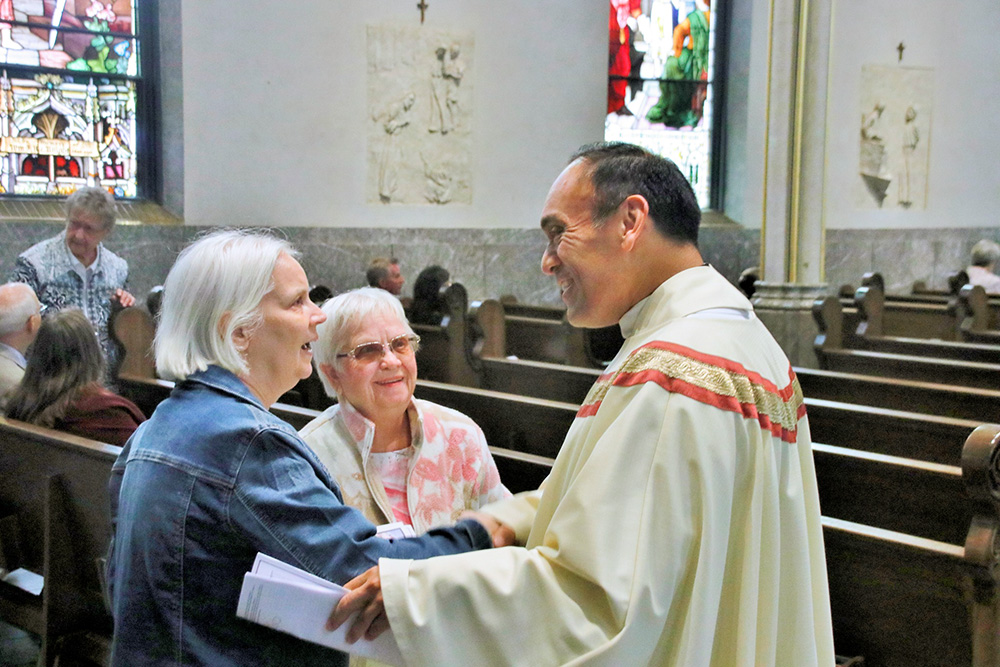
Paulist Fr. René Constanza, president of the Paulist Fathers, greets parishioners in Grand Rapids, Michigan, in 2024. (Courtesy of Paulist Fathers)

The reelection of Paulist Fathers president Fr. René Constanza comes at a moment of both continuity and challenge for one of the most distinctly American Catholic communities. Founded in 1858 as the first religious order of Catholic priests started in the U.S., the Paulists have long defined themselves by their outward-facing mission: engaging contemporary culture, accompanying those who feel distant from the church and proclaiming the Gospel beyond traditional ecclesial boundaries.
A former Catholic school principal, Constanza's own story embodies several recent pressing themes in the American church. A native of Belize and an immigrant to the U.S., he brings to the presidency a lived experience of cultural crossing that resonates deeply with the Paulist charism. His academic background — spanning biology, education, higher education administration and theology — reflects a pastoral style shaped by formation, teaching and institutional leadership.
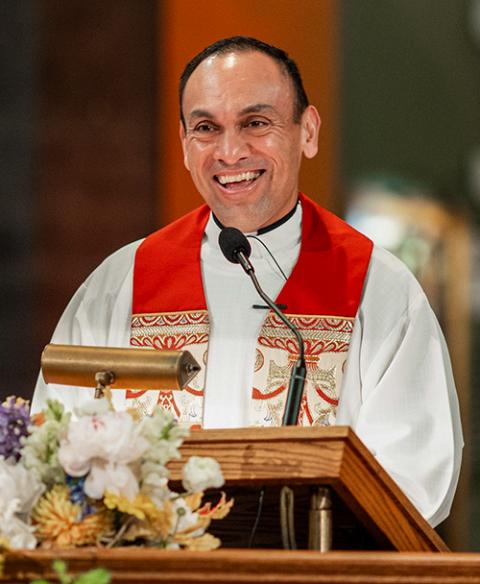
Fr. René Constanza, president of the Paulist Fathers (Courtesy of Paulist Fathers)
The Paulist Fathers' internal governance also sets them apart within Catholic religious life. Their electoral process, in which each member has one vote, is symbolic of both their American roots and the spirit of renewal encouraged by the 1962-65 Second Vatican Council.
"I believe that the next four years will require us Paulists to be one in understanding of who we are, our charism and our mission, and also have us move forward in being more of a prophetic voice in the American context," he said in an interview with the National Catholic Reporter on Feb. 15.
"We thank and praise God for that we do not mirror in the Paulist Fathers the toxic polarization that exists in society right now, because we are first and foremost fraternal to one another," he added.
The interview has been edited for length and clarity.
NCR: The Paulist Fathers' mission is focused on decreasing toxic polarizations in church and society, but the world outside seems to get increasingly polarized. How do you not lose hope in this battle?
Constanza: I think because the way we look at things is in the long run. It's not the short run, but in the long run. And we know that if we are guided by the Holy Spirit, that we are on the victorious side. Christ has won this, but we are just participating in that mission of addressing toxic polarization through building communion.
That is important to note: We cannot lose hope based on what's happening around us. We need to ensure that we remain persons of hope because we're rooted in Christ as the anchor of our faith.
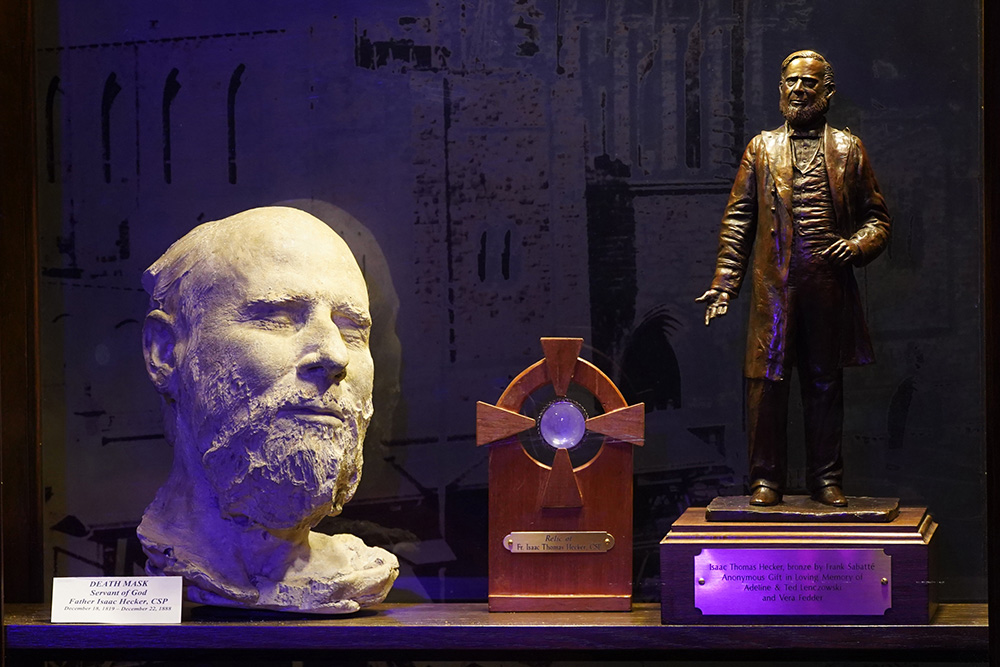
A death mask, relic and statue of Fr. Isaac Hecker are seen in a display case at St. Paul the Apostle Church in New York City on the 200th anniversary of his birth, Dec. 18, 2019. Hecker, who founded the Paulist Fathers in 1858, is entombed in the church. (CNS/Gregory A. Shemitz)
While the Paulist Fathers now have this big focus on polarization, how does that fit in with the Paulists' original charism of evangelization, which was the founder Fr. Isaac Hecker's original mission? In Hecker's mind, you were primarily an order positioned to bring the church to America and America to the church.
There has to be a connection, because if we are to engage the American culture, and we know that toxic polarization is a barrier to evangelization, we need to address that as well. This is something that came from our laypeople in the pre-assemblies of 2021. This wasn't something that the Paulist Fathers were the primary ones to rally. It was what we listened to and what we heard from the laypeople who asked us to address this.
And so then the 2022 general assembly said we must address this and see how best we can do that by bringing other people, experts to help direct that. That has given birth to the Communion Project, which is one area of addressing that in the church, but also in society.
The Paulist Fathers recently closed ministries in some areas of the country where they have served for decades. How did that affect your congregation and lay Catholics who used to rely there on you?
Anytime we have to let go of a ministry it's very hard and difficult for our Paulist priests, because we have relationships established and grounded in those places. We love the place where we serve.
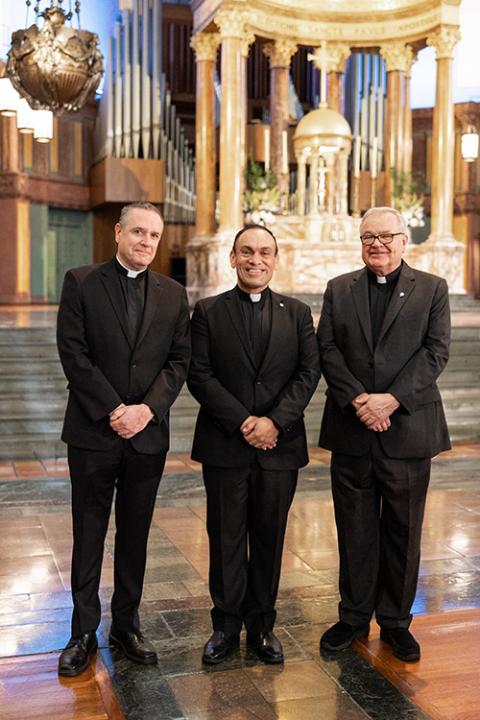
Fr. René Constanza, president of the Paulist Fathers (center) with Frs. Dave Dwyer, first consultor of Paulist Fathers (left) and Paulist John Ardis, vice president of Paulist Fathers (right). (Courtesy of Paulist Fathers)
There was a long Paulist history in some places like Columbus, Ohio, and Berkeley, California, and so it is very difficult to make these choices. Both Columbus and Berkeley were done in the last four years. One of them, we didn't want to leave, and the other one, it was an intentional decision from us.
We know that people who have been guided to be a church under the Paulist service, they will take that Paulist DNA wherever they are. And I'm seeing that more in Columbus. We left Columbus, and yet we have expanded the Paulist associates community there, which has grown. And, in fact, it's the largest Paulist associates as the lay body community that we have in the U.S. They gather and understand our history, our spirituality. They take their Paulist charism wherever they are, in their family, in their community, if they are professionals in their work and everywhere.
Like all the other religious orders and Western dioceses, the Paulist Fathers too are suffering the lack of sufficient new seminarians. What is your strategy on that?
You're right that the Paulists, as many communities, are experiencing a shortage in the number of people coming in. I think that is a good opportunity for us Paulists as well to ensure that we give witness to our life, not only in our local communities, but in our foundations, or in our apostolic services that we do, whether if it's parish or campus ministry — that we are joyful proclaimers of the Gospel; that we understand and know who we are, and invite others to see our communities to see our way of life as well as our prayer life. We need to ensure that others know that we are missionaries, that we exist for the mission.
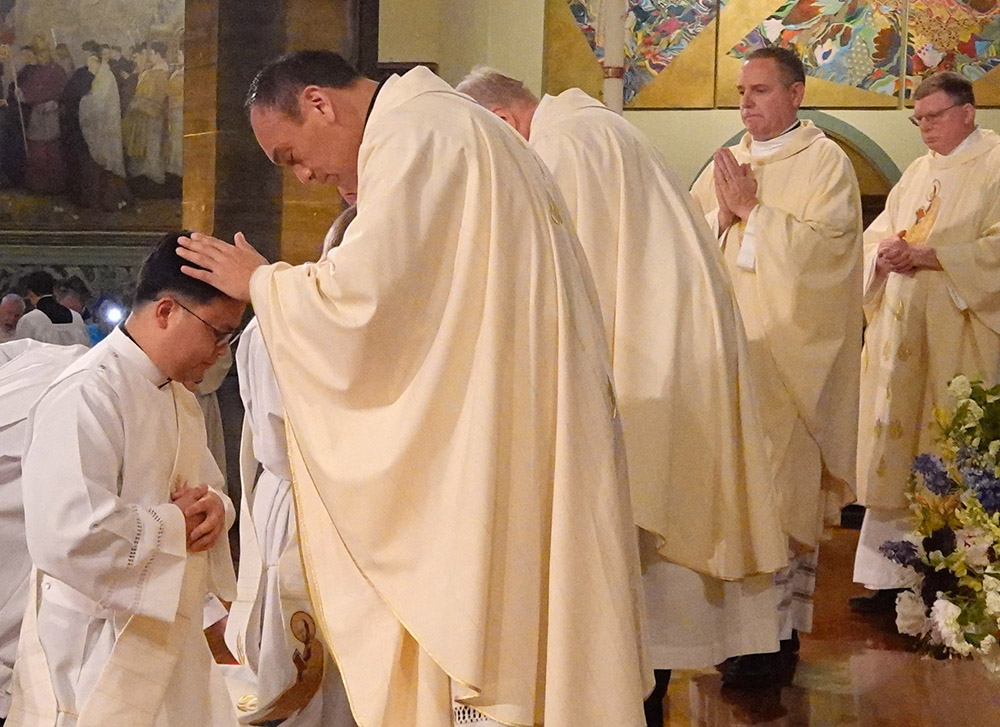
Paulist Fr. René Constanza blesses Paulist Fr. Dan Macalinao during his ordination in May 2024. (Courtesy of Paulist Fathers)
The next assembly, which is coming up in June and which is the highest form of authority of the Paulist Fathers, will be addressing a more intentional strategy and how we can do that. As a leader, I believe stronger local foundations will be very attractive. As Pope Francis always said, we draw people more by being attractive, joyful witnesses of the Gospel.
Why would a young Catholic man want to become a Paulist father versus a Jesuit, an Augustinian or a Franciscan in 2026?
Because we proclaim Christ in the American culture, you can ensure that your gifts and talents will be used for that purpose.
You are some of the few priests — both among religious orders and diocesan — that minister today to LGBTQ+ Catholics, preaching a more welcoming church. How can you do that in spite of the harsh critiques you constantly face from the most conservative groups in the U.S. church?
I personally believe that I'm not into the conservative and liberal aspect of this dichotomy. I am more about bringing the Gospel and the values out there and drawing people closer to Christ and to Christ's church. And if that means that we have to do like Christ did, and bring other people to embrace God's love, regardless of who they are, that's what we do.
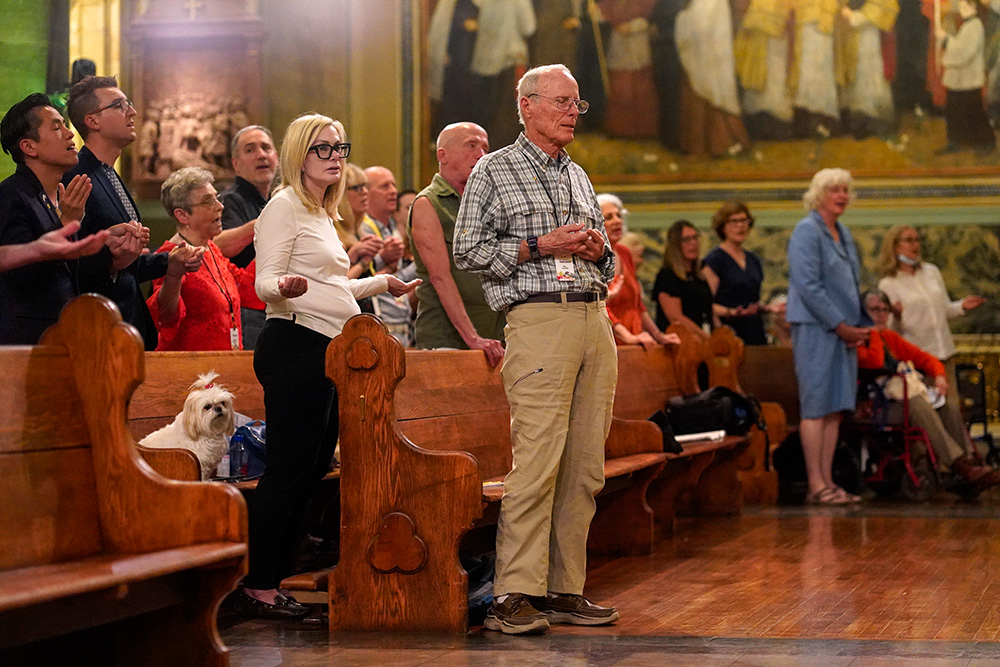
People pray during the closing Mass for the Outreach LGBTQ Catholic Ministry Conference at the Church of St. Paul the Apostle, the Paulist mother church, in New York City June 18, 2023. (OSV News/Gregory A. Shemitz)
We are there to make people understand that they are loved, that they belong and they are worth it, regardless of their immigration status, regardless of their sexual orientation, regardless of their past. We are being Christ-like to them.
So it is important for us to not get caught in this dichotomy. Pope Francis had a word to say that it's more of a "culture war." We're not going to get into that. I'm not encouraging the Paulists to get into that, but what I am encouraging as president is for us to be Gospel-centered in how we approach people and church.
You and your predecessor Fr. Eric Andrews both met privately with Pope Francis. What was his message for the Paulist communities in the U.S. and Rome?
He encouraged me and the community to continue engaging who comes before us, to engage the person, to meet people where they're at.
Advertisement
That was something he saw that we did, and is something that we know that Paulists do quite well. We meet people where they're at. We see a person before us. We see a Christ-like person before us.
In September, the New York choir of the Paulist mother church sang for Pope Leo, but you haven't met him yet formally as president of the religious order. How do you think the Paulists' mission aligns with Leo's first nine months of papacy?
I didn't have yet a one-on-one meeting with Leo, but I briefly spoke to him in November after he gave the papal audience to the Union of Superiors General. I gave him a gift and two letters, one inviting him to visit St. Patrick's in Rome, which is the American Paulist church in Rome, and the other one was to let him know that his concern and passion for unity and building bridges in society and in the church is something that as Paulists we're doing through our Communion Project.
We just received a letter two weeks ago, written by one of his secretaries, that stated that Pope Leo received it and is appreciative that we are also working on building bridges and seeking unity through the Communion Project.