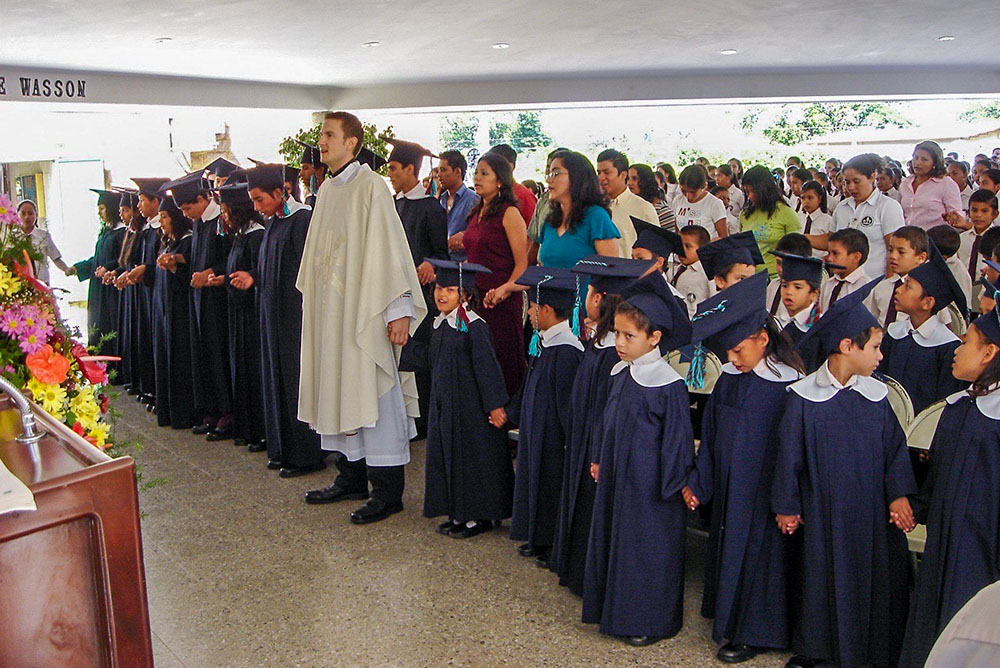
Then-Fr. Ronald Hicks prays with students from Nuestros Pequeños Hermanos in Texistepeque, El Salvador in this photo from a graduation in 2005. Hicks spent five years, 2005-2010, working with the organization for abandoned and vulnerable children. (Courtesy of Nuestros Pequeños Hermanos)
by Rhina Guidos
The roads leading to Texistepeque and its environs are dusty and there isn't much to look at, but Brenda Méndez remembers the priest from Illinois always seemed happy picking up and dropping off passengers who had a hard time getting in and out of the rural town in northern El Salvador.
From the moment he arrived in 2005 to work with Nuestros Pequeños Hermanos (Our Little Brothers and Sisters), a program for abandoned and underprivileged children, "Padre Ron" Hicks, now archbishop-elect of New York, seemed to fit in, Méndez said.
"You saw him and he was just like us, ate pupusas [a traditional Salvadoran dish] like us and he never seemed like a person who came from another country," she told National Catholic Reporter in a Dec. 17 interview via WhatsApp. "We didn't want him to leave and we said to him, 'Ask them to let you stay a few more years.'"
With Nuestros Pequeños Hermanos, Hicks left in El Salvador an unforgettable example, said Méndez, the organization's director of programs, who worked with him in his five-year-stint there.
The organization also serves children in Mexico, Honduras, Haiti, Nicaragua, Guatemala, El Salvador, Dominican Republic, Peru and Bolivia, according to its website. It was born out of an encounter between a U.S. priest in Mexico, Fr. William Wasson, and a 15-year-old boy who took money from the poor box in a church because he was hungry. Instead of pursuing criminal charges against the child, Wasson began to help the boy and others like him, founding Nuestros Pequeños Hermanos in 1954.
Just as the encounter with the hungry boy changed Wasson, Hicks said in his 2020 installation Mass as bishop of Joliet, Illinois, that an encounter with a group of children from Nuestros Pequeños Hermanos changed him. After he had kept a group of boys waiting because he was busy with administrative work, one of them told him: "You're more like a lawyer than a priest."
"His words broke my heart," he said.
But that pain made him see that his primary role is to be a pastor, he said.
Advertisement
And as a committed pastor is how Méndez said she remembers Hicks when he was the organization's director for Central America from 2005 to 2010. Though he was organized and disciplined with paperwork, he was primarily a pastor, running from baptisms to graduations, making sure the children as well as the staff had enough to eat, checking in on their well-being. He also made time to write staff individual Christmas and Easter cards with personal touches, she said.
At that time, not many people in the rural area had cellphones but Hicks had a camera and went around taking photos of baptisms and graduations and allowed people to borrow the camera for special occasions. When he returned from his home visits to the U.S., he would come back with boxes of photos he had developed and gave them out. He knew the families otherwise would not have keepsakes of those special days, she said.
His experience in El Salvador and its complexities seems to have touched him deeply, she said.
"The first thing he did when he arrived in 2005 was visit the tomb of [St.] Óscar Romero," Méndez said. "And if he had family or friends visiting, that's the place where he would start."
When Romero, who was martyred while celebrating Mass in 1980, was beatified in El Salvador in 2015, Hicks helped carry a relic of the Salvadoran martyr on its way to the altar. His episcopal coat of arms has a sprig of rosemary, to honor Romero, whose last name translates into English as "rosemary."
After he left El Salvador, Hicks still visited the program, Méndez said, spending Holy Week in the rural community, attending graduations and other special occasions related to Nuestros Pequeños Hermanos. As his responsibilities grew when he became a bishop in 2018, they have seen less of him but he's never too far away, she said.
"He still keeps tabs on us and it's really beautiful because he has identified himself with the Salvadoran people," Méndez said.
Regarding his new post in New York, she said: "I really admired and still admire him because he's a humble person but committed in his pastoral mission, always ready to serve where God places him," whether it be tiny Texistepeque, population 19,000, or the megacity of New York, and he really means it. "When we asked him to stay with us, he said, 'I have to go where the bishop tells me to go and where God wants me to go.' "