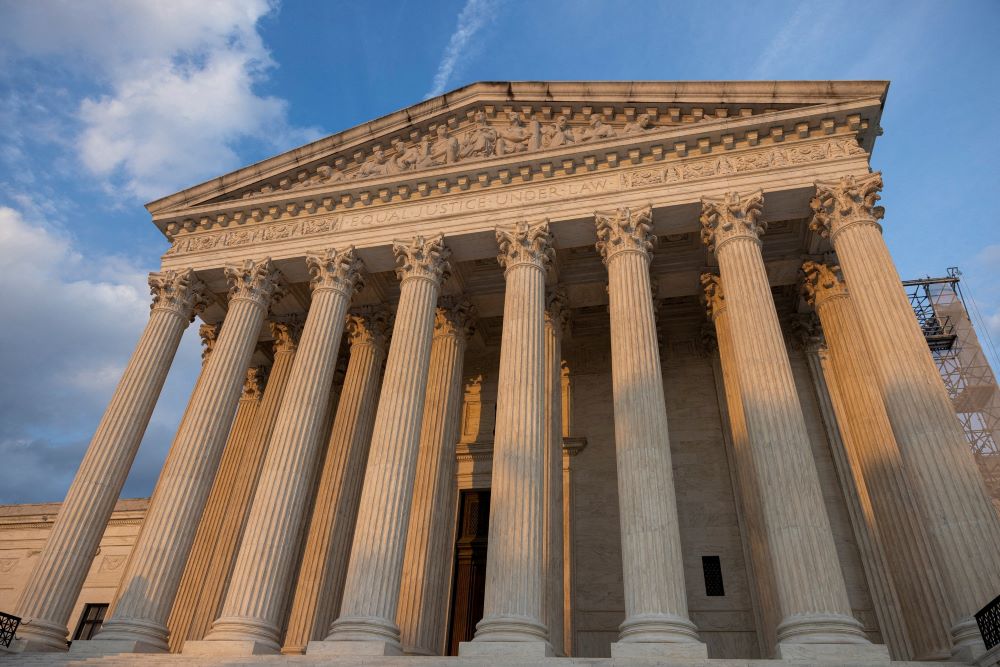
A view of the U.S. Supreme Court in Washington, D.C., July 19, 2024. The nation's highest court heard oral arguments Oct. 7 in a challenge to Colorado's ban on "conversion therapy" for minors who have gender dysphoria or same-sex attraction. (OSV News/Reuters/Kevin Mohatt)

by Brian Fraga
Staff Reporter
The U.S. Supreme Court justices Oct. 7 seemed skeptical of a ban on so-called conversion therapy in Colorado challenged by a Christian counselor who said the ban violated her First Amendment rights.
The justices heard more than 90 minutes of arguments over the 2019 state law that bars physicians and counselors from trying to change a minor's sexual orientation or gender identity. Attorneys against the ban argued that the high court should strike it down on freedom of speech grounds while Colorado attorneys said the law passes constitutional muster because states have the legal right to regulate medical care.
"The law falls squarely into reasonable regulation of professional conduct that does not trigger First Amendment scrutiny," Colorado Solicitor General Shannon Stevenson said while being questioned by the justices.
A majority of the court's six conservative judges questioned Stevenson's arguments that the state law does not infringe on freedom of speech and the First Amendment by engaging in viewpoint discrimination.
For example, Justice Samuel Alito suggested that a plain reading of the Colorado statute would penalize a therapist who helps a client cope with an unwanted attraction toward people of the same sex while affirming a therapist who guides a client to accept their sexual orientation.
"It seems to me your statute dictates opposite results in those situations, based on the viewpoint expressed … It looks like blatant viewpoint discrimination," Alito said.
The case, Chiles v. Salazar, heard on the second day of the high court's new term, could have a significant nationwide impact. More than two dozen states and Washington, D.C., have passed laws banning conversion therapy. The Colorado law prohibits licensed medical and mental health care professionals from using the practice on patients under age 18.
Stevenson said the law targets treatment "that does not work and carries great risk of harm." She added that the attorneys challenging the law did not provide any professional experts who endorse conversion therapy, adding that there is "a mountain of evidence to the contrary."
Leading health associations such as the American Psychological Association and the American Medical Association have spoken out against conversion therapy, saying that the practice increases the risk of suicide, drug abuse and depression among young people.
But lawyers arguing on behalf of Kaley Chiles, a licensed counselor in Colorado who identifies as a Christian, said the law prevents therapists from using talk therapy to help young people who want to align their sexual orientation and gender identity with their religious beliefs.
James Campbell, an attorney with Alliance Defending Freedom who is representing Chiles, told the justices that Colorado "can't deny that people have experienced life-changing benefits" from the kind of counseling offered by Chiles.
"One of the things that's so problematic about Colorado's law is that it undermines the well-being of kids who are struggling with gender dysphoria," said Campbell, referring to those who believe that their gender does not match the sex they were assigned at birth. He argued that state lawmakers in Colorado did not consider a law with fewer restrictions on free speech.
"The First Amendment doesn't permit Colorado's censorship," Campbell said.
Hashim Mooppan, the principal deputy U.S. solicitor general, added that the Colorado law wrongly prohibits speech based on content and viewpoint.
"There is no longstanding tradition of states imposing this type of categorical prior restraint on the speech of therapists," Mooppan said.
Since the Supreme Court agreed to hear oral arguments in this case it has been closely followed by LGBTQ advocates and those who see it as preventing a harmful and discredited practice.
"If the Supreme Court repeals Colorado's law banning so-called conversion therapy, it will create an extremely dangerous environment in our country, especially for LGBTQ+ youth and others who are just coming to awareness of their sexual and gender identities," said Francis DeBernardo, executive director of New Ways Ministry, an organization that serves LGBTQ Catholics.
Marianne Duddy-Burke, executive director of DignityUSA, told NCR that her organization has worked with "literally thousands of people" over the last half century who underwent a form of conversion therapy.
"We have seen the extreme damage that it has done to people," she said. "In our experiences, all that conversion therapy does is increase shame, and ignoring the science around that is only going to exacerbate a trend that frankly and happily has been decreasing in recent decades."
Advertisement
But for social conservatives and some Christian organizations, the case raises important questions about religious freedom and the First Amendment rights of Christian mental health professionals to counsel young people who want to live according to their interpretation of biblical principles.
"This case addresses a timeless and a nearly universal human experience: seeking counsel from a trusted adviser to discern right from wrong in confusing or complex situations," wrote attorneys representing the U.S. Conference of Catholic Bishops, Catholic University of America and the Colorado Catholic Conference.
In an amicus brief, attorneys representing those Catholic organizations said the case arose because Colorado wants to dictate how its citizens may seek out answers to life's "fundamental human questions."
"Specifically, Colorado is ordering Catholic clients and counselors that they may not — even when they want to — discuss the ideas that they believe in, or take the approach that their Church has expressly recommended," they wrote.
The Supreme Court is expected to issue its decision by the end of June 2026.