
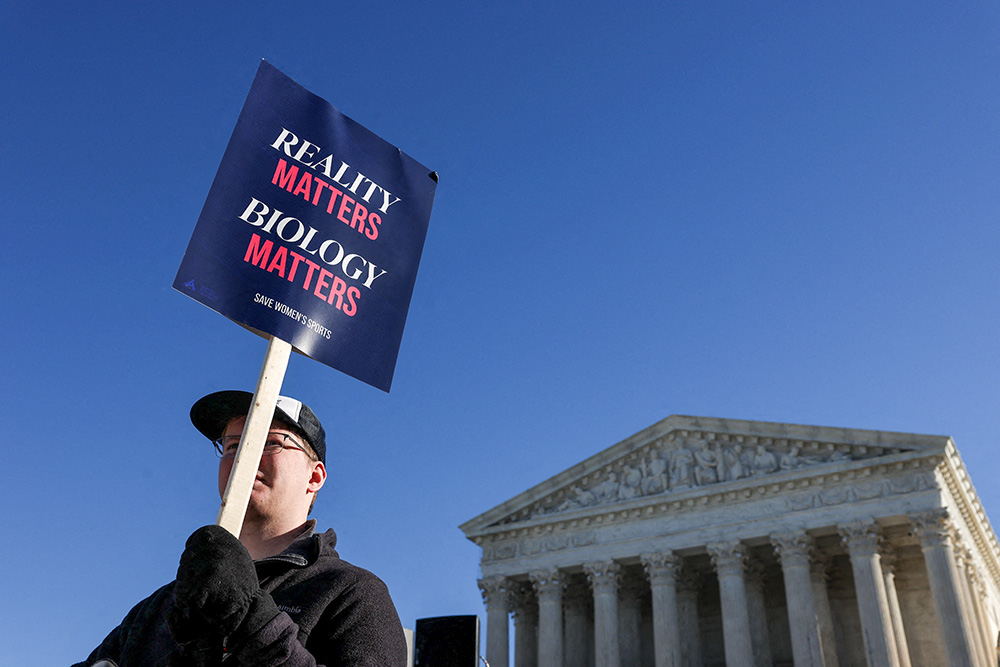
A supporter of keeping female sports based on biological sex holds a placard outside the U.S. Supreme Court in Washington Jan. 13, 2026, on the day justices heard oral arguments in two cases concerning efforts to enforce state laws banning transgender athletes from female sports teams at public schools. (OSV News/Reuters/Tyrone Siu)

by Brian Fraga
Staff Reporter
After more than three hours of spirited discussion on Jan. 13, the U.S. Supreme Court appeared poised to uphold state laws that ban transgender girls and women from participating in female school and college athletic teams.
The justices' questions indicated that a majority were reluctant to rule that the laws in West Virginia and Idaho violate either the Equal Protection Clause of the U.S. Constitution or Title IX of the Education Amendments of 1972, which prohibits discrimination in education on the basis of sex.
The high court heard oral arguments in the cases of two transgender students, Becky Pepper-Jackson of West Virginia and Lindsay Hecox of Idaho, who challenged the bans in their respective states. Both were allowed to compete on their schools' girls sports teams because of lower court injunctions.
Several justices noted that federal regulations enacted two years after Title IX, known as the Javits Amendment, specifically allows separate sports teams for biological males and females.
"Sports are different," said Justice Neil Gorsuch, one of the high court's six conservative justices.
Justice Amy Coney Barrett questioned whether the plaintiffs were opening the door to allow "boys who didn't make the [boys'] team because they are just not good enough" to play on their schools' girls teams instead.
Justice Brett Kavanaugh asked the attorney representing Hecox why the high court would "jump in and try to constitutionalize a rule for the whole country while there's still, as you say, uncertainty and debate, while there's still strong interest [on] the other side?"
Advertisement
A ruling, which is not expected until the end of the court's term in June, has the potential to shape athletic eligibility rules across the country.
West Virginia Solicitor General Michael Williams argued before the court that maintaining separate boys and girls teams ensures that girls "can safely and fairly compete in school sports." He added that Title IX permits sex-separated teams "because biological sex matters in athletics, in ways both obvious and undeniable."
Alan Hurst, Idaho's solicitor general, told the justices that a person's sex is important for the purpose of athletic competition.
"It correlates strongly with countless athletic advantages, like size, muscle mass, bone mass and heart and lung capacity," Hurst said.
Hashim Mooppan, deputy U.S. solicitor general, argued that federal law allows for sex-separated teams in schools, with sex understood in federal regulations as referring to biological sex.
But Joshua Block, an attorney with the American Civil Liberties Union who represented Pepper-Jackson, argued that West Virginia's law treated his client differently than other girls on the basis of sex, and that it in fact treated her "worse in a way that harms her."
"Title IX and the Equal Protection Clause protect everyone and if the evidence shows there are no relevant physiological differences between [Pepper-Jackson] and other girls, then there is no basis to exclude her," Block said.
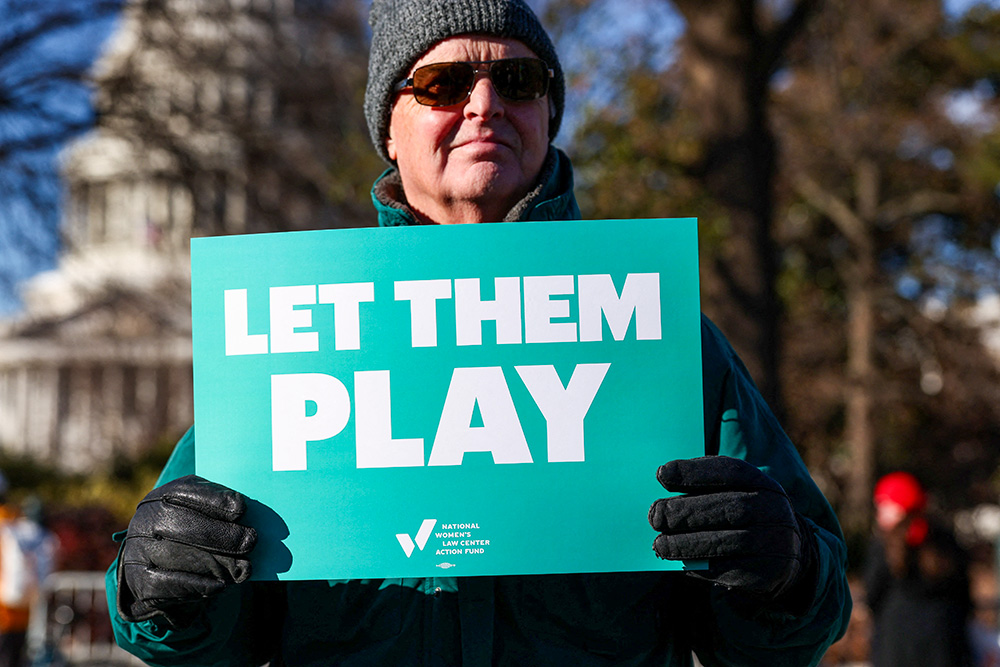
A transgender rights supporter holds a placard outside the U.S. Supreme Court in Washington Jan. 13, 2026. (OSV News/Reuters/Kevin Lamarque)
Legal observers say the two cases present the high court with an opportunity to clarify how Title IX applies to gender identity in athletics and to determine whether states can enact such laws on the grounds of protecting competitive fairness and safety for biological females.
In an amicus brief filed in the West Virginia case, the U.S. Conference of Catholic Bishops argued that neither the Equal Protection Clause nor Title IX forbids sex-segregated athletic teams. The conference added, "Catholic schools cannot allow males to compete on female-only teams."
"By allowing males to compete as girls and women on female-only athletic teams, the school would communicate a message at odds with Catholic doctrine," the conference said.
States are nearly evenly split on the issue. About 29 states have laws or regulations that restrict transgender athletes from participating in sports consistent with their gender identity, while 21 states, plus Washington D.C., allow them to play on teams that match their gender identity.
Though poised to issue a ruling with nationwide effect, some justices appeared reluctant to decide the case beyond the contours of the specific laws governing school sports in West Virginia and Idaho. Kavanaugh in particular noted that several states allow transgender athletes to compete on girls sports teams, and he asked Williams if, in his view, those states were violating the Title IX rights of biological females.