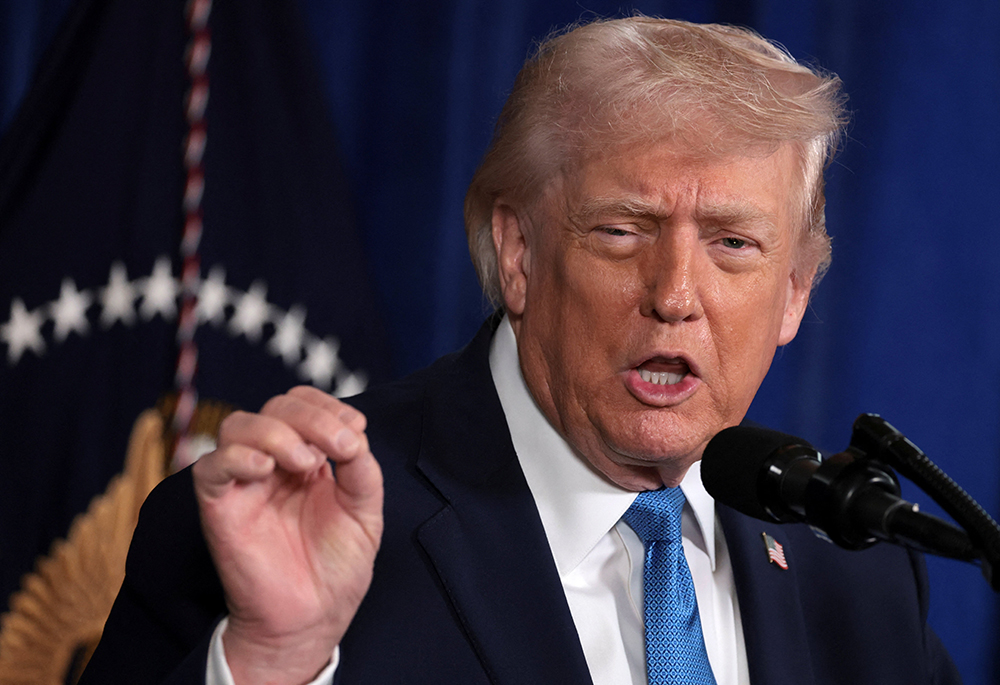
U.S. President Donald Trump speaks during a news conference at Trump's Mar-a-Lago club in Palm Beach, Florida, Jan. 3, 2026. (OSV News/Reuters/Jonathan Ernst)

by Michael J. O'Loughlin
NCR executive editor
With President Donald Trump ratcheting up economic threats against U.S. allies as part of his campaign to take Greenland, after the administration's comments that military action is "always an option," U.S. bishops are offering stark warnings against the administration's recent foreign policy actions and threats, including a rare joint statement from three senior church leaders.
On Monday, Jan. 19, three Catholic cardinals — Blase Cupich of Chicago, Robert McElroy of Washington, D.C., and Joseph Tobin of Newark, New Jersey — amplified an address given Jan. 9 by Pope Leo XIV to the Vatican's diplomatic corps.
"We renounce war as an instrument for narrow national interests and proclaim that military action must be seen only as a last resort in extreme situations, not a normal instrument of national policy," said the cardinals, each of whom were staunch allies of Pope Francis and were present at the conclave that elected Leo. "We seek a foreign policy that respects and advances the right to human life, religious liberty, and the enhancement of human dignity throughout the world, especially through economic assistance."
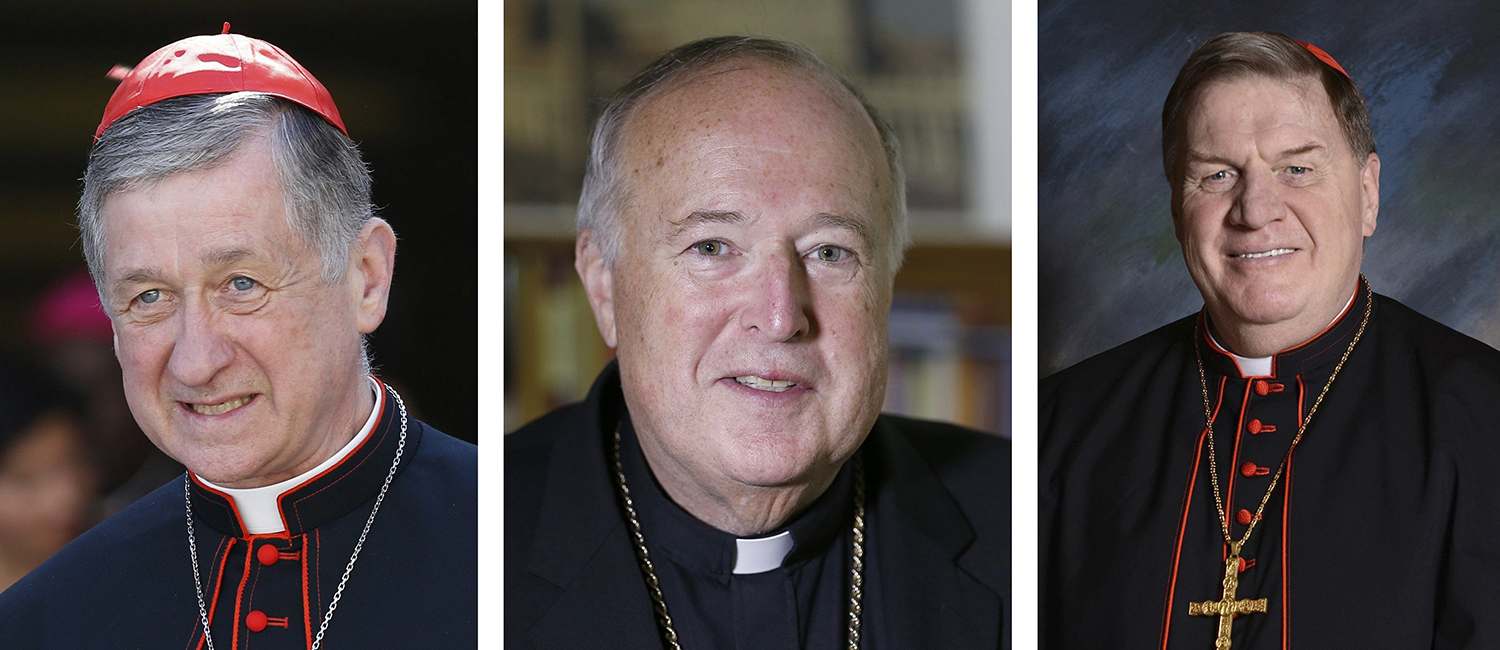
Cardinals Blase J. Cupich of Chicago, Robert W. McElroy of Washington and Joseph W. Tobin of Newark, New Jersey, are pictured in a combination photo. The three cardinals issued a joint statement Jan. 19, 2026, on the morality of U.S. foreign policy under the Trump administration. (OSV News files/Paul Haring, CNS/Archdiocese of Newark)
Though the cardinals did not specifically mention the recent U.S. incursion in Venezuela, or President Trump's increasingly bellicose rhetoric toward Greenland, they offered one of the stronger challenges to the president's second term foreign policy aims and promised to continue highlighting the issue.
Over the weekend, Trump said in a text to the leader of Norway that he no longer feels "an obligation to think purely of Peace" because he was not awarded the Nobel Peace Prize, adding, "The World is not secure unless we have Complete and Total Control of Greenland."
In their statement, the three U.S. cardinals targeted the self-interested foreign policy they said aims to upend efforts to bring about peace. [See below for the cardinals' full statement.]
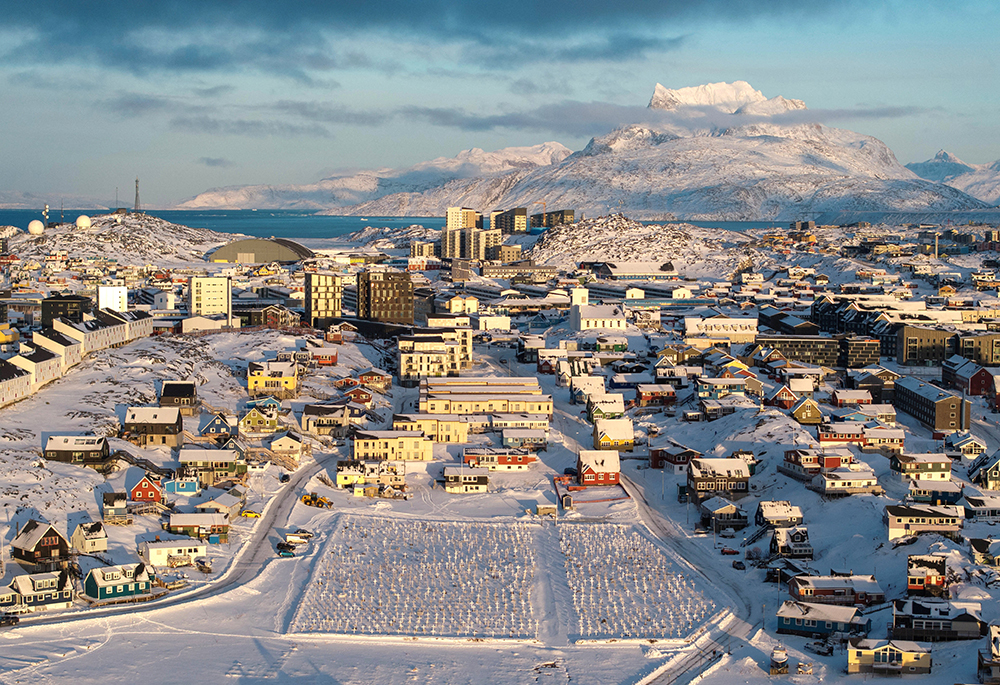
A drone view shows a general view of Nuuk, Greenland, Jan. 15, 2026. A top Danish official said Jan. 14 that a "fundamental disagreement" over Greenland remains with President Donald Trump after holding highly anticipated White House talks with Vice President JD Vance and Secretary of State Marco Rubio. (OSV News/Reuters/Marko Djurica)
"Our nation's debate on the moral foundation for American policy is beset by polarization, partisanship, and narrow economic and social interests," the cardinals said. "Pope Leo has given us the prism through which to raise it to a much higher level. We will preach, teach, and advocate in the coming months to make that higher level possible."
The cardinals' statement represents another step in the seemingly widening gap between U.S. bishops and Trump, who heavily courted and won over U.S. Catholics during his 2024 campaign.
Advertisement
In November, U.S. bishops took an unusually bold step in criticizing the Trump administration's signature domestic policy goal, the mass removal of migrants by federal authorities, saying that the brutality aimed at immigrant communities "disturbed" and "saddened" them. How much moral capital the bishops as a body are willing to spend on confronting the Trump administration is an open question.
Just last week (Jan. 14), the U.S. Conference of Catholic Bishops released a statement praising the administration for its decision to make it easier for foreign-born priests to continue their ministry in the United States. And while individual bishops have been critical of other Trump policies, Monday's statement represents a ratcheting up of tensions between the president and Catholic bishops.
But this weekend, another high-ranking church leader offered a more specific condemnation about the president's threats against Greenland and the danger facing U.S. troops in the wake of the capture of former Venezuelan President Nicolás Maduro.
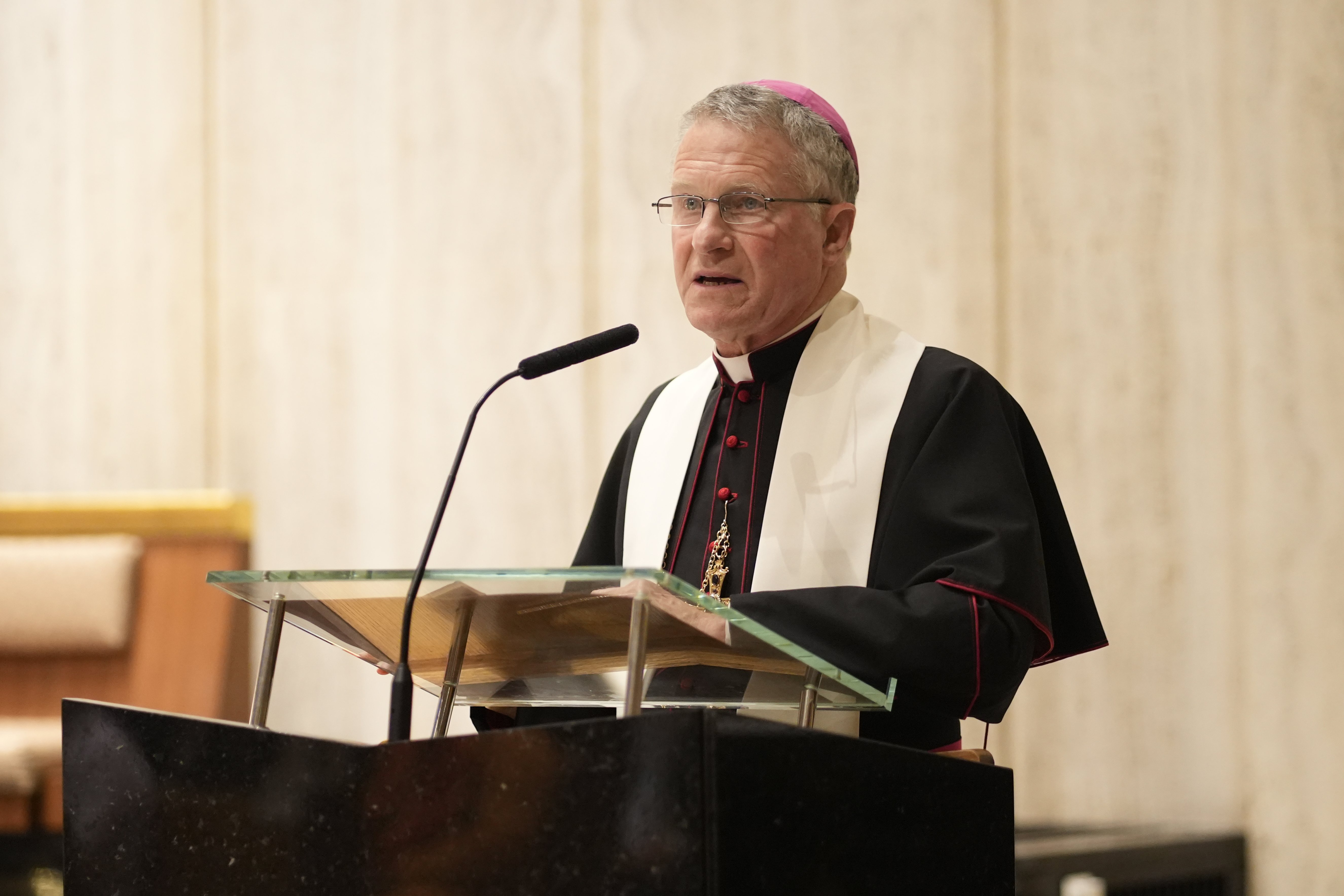
Archbishop Timothy P. Broglio of the U.S. Archdiocese for the Military Services, then-president of the U.S. Conference of Catholic Bishops, delivers his reflection during the annual prayer service for United Nations diplomats at Holy Family Church in New York City Sept. 8, 2025. (OSV News/Gregory A. Shemitz)
Archbishop Timothy Broglio, the most recent past president of the bishops' conference and head of the Archdiocese for Military Services, said yesterday (Jan. 18) that any U.S. invasion of Greenland would likely be morally unjust.
Asked on BBC's "Sunday" if such an invasion could be considered morally just, Broglio said: "I cannot see any circumstances that it would."
"Greenland is a territory of Denmark. Denmark is an ally. It's part of NATO. It does not seem really reasonable that the United States would attack and occupy a friendly nation," he continued, adding that threats of military action against a U.S. ally "tarnishes the image of the United States in our world."
Broglio, who in December criticized the administration's actions in the Caribbean, said he worries about soldiers being asked to carry out unjust orders — and said that they would be able to rely on their consciences to reject such commands.
"It would be very difficult for a soldier or a marine or a sailor by himself to disobey an order such as that," he said. "But strictly speaking, he or she would be within the realm of their own conscience, would be morally acceptable to disobey that order. But that's perhaps putting that individual in an untenable situation, and that's my concern."
Full text of statement by Chicago Cardinal Blase J. Cupich, Washington Cardinal Robert W. McElroy, and Newark Cardinal Joseph W. Tobin:
Charting A Moral Vision of American Foreign Policy
In 2026, the United States has entered into the most profound and searing debate about the moral foundation for America’s actions in the world since the end of the Cold War. The events in Venezuela, Ukraine and Greenland have raised basic questions about the use of military force and the meaning of peace. The sovereign rights of nations to self-determination appear all too fragile in a world of ever greater conflagrations. The balancing of national interest with the common good is being framed within starkly polarized terms. Our country’s moral role in confronting evil around the world, sustaining the right to life and human dignity, and supporting religious liberty are all under examination. And the building of just and sustainable peace, so crucial to humanity’s well-being now and in the future, is being reduced to partisan categories that encourage polarization and destructive policies.
For all of these reasons, the contribution of Pope Leo in outlining a truly moral foundation for international relations to the Vatican diplomatic corps this month has provided us an enduring ethical compass for establishing the pathway for American foreign policy in the coming years. He stated:
In our time, the weakness of multilateralism is a particular cause for concern at the international level. A diplomacy that promotes dialogue and seeks consensus among all parties is being replaced by a diplomacy based on force, by either individuals or groups of allies. War is back in vogue and a zeal for war is spreading. The principle established after the Second World War, which prohibited nations from using force to violate the borders of others, has been completely undermined. Peace is no longer sought as a gift and desirable good in itself, or in pursuit of "the establishment of the ordered universe willed by God with a more perfect form of justice among men and women." Instead, peace is sought through weapons as a condition for asserting one’s own dominion.
Pope Leo also reiterates Catholic teaching that "the protection of the right to life constitutes the indispensable foundation for every other human right" and that abortion and euthanasia are destructive of that right. He points to the need for international aid to safeguard the most central elements of human dignity, which are under assault because of the movement by wealthy nations to reduce or eliminate their contributions to humanitarian foreign assistance programs. Finally, the Holy Father points to the increasing violations of conscience and religious freedom in the name of an ideological or religious purity that crushes freedom itself.
As pastors and citizens, we embrace this vision for the establishment of a genuinely moral foreign policy for our nation. We seek to build a truly just and lasting peace, that peace which Jesus proclaimed in the Gospel. We renounce war as an instrument for narrow national interests and proclaim that military action must be seen only as a last resort in extreme situations, not a normal instrument of national policy. We seek a foreign policy that respects and advances the right to human life, religious liberty, and the enhancement of human dignity throughout the world, especially through economic assistance.
Our nation’s debate on the moral foundation for American policy is beset by polarization, partisanship, and narrow economic and social interests. Pope Leo has given us the prism through which to raise it to a much higher level. We will preach, teach, and advocate in the coming months to make that higher level possible.
Signed,
Cardinal Blase J. Cupich, Archbishop of Chicago
Cardinal Robert W. McElroy, Archbishop of Washington
Cardinal Joseph W. Tobin, C.Ss.R., Archbishop of Newark