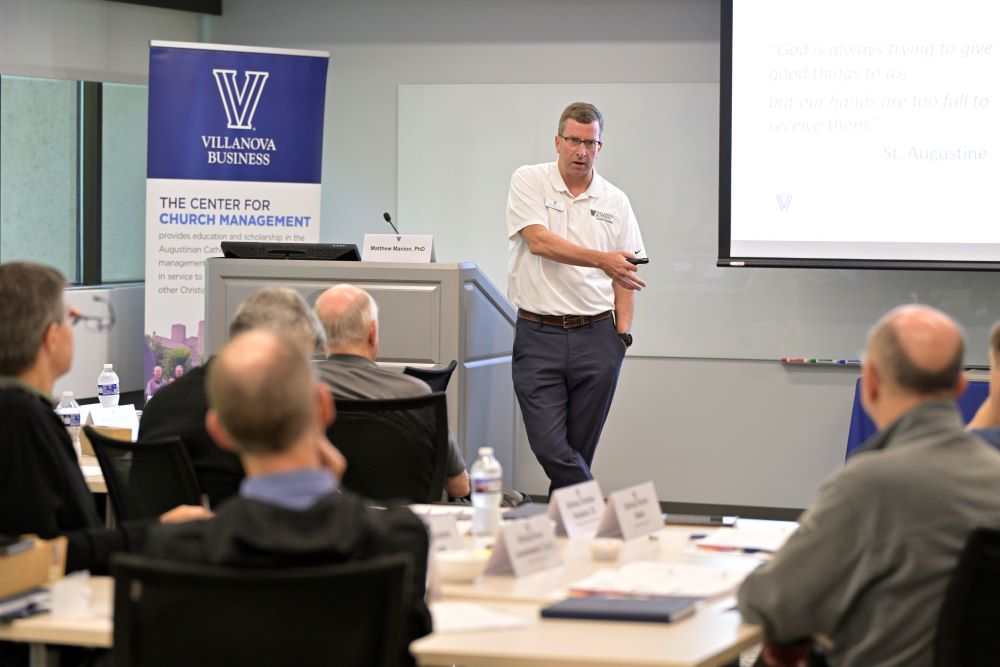
Matthew Manion, the Grenon Family Faculty Director of the Villanova Center for Church Management who directed the Villanova bishops training, teaches a management class during the summer training for U.S. bishops at Villanova University July 23. (Courtesy of David DeFalco)

When Pope Leo XIV pulled aside a group of American bishops in Rome last fall, his message was unusually direct. After delivering his formal address, the pope — once Villanova alumnus Robert Prevost — told them plainly that they should consider attending a new formation program for bishops taking shape at his former university.
Villanova's Center for Church Management, he said, was offering something the church urgently needed: practical training for the real-world leadership responsibilities that define modern bishop life.
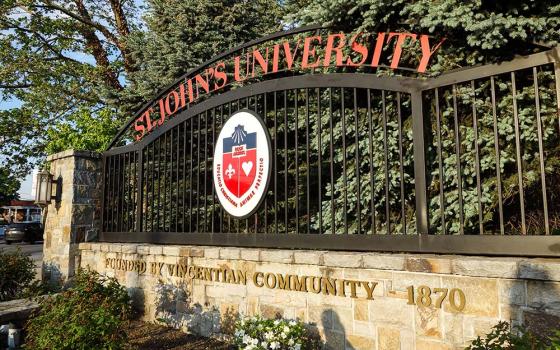
That papal nudge has turned into a powerful catalyst. This summer, 14 bishops from across the U.S. and Canada flew to Philadelphia for an intensive four-day program blending mission-driven management, leadership formation and spiritual grounding. It is a growing initiative and one rooted in Villanova's Augustinian tradition.
"We wouldn't have been able to do the pilot without Pope Leo's invitation and blessing," said Matthew Manion, the Grenon Family Faculty Director of Villanova's Center for Church Management, who led the program. "If he didn't give us the chance to address the American bishops, I don't think the program would have ever happened."
Manion said bishops themselves consistently identify the same gaps in their preparation.
"Like most leaders of any large organization, it's the people's issues, the financial issues and the strategic issues that keep them awake at night," he said. "They have excellent seminary and pastoral training, but not necessarily formation in those areas."
'Like most leaders of any large organization, it's the people's issues, the financial issues and the strategic issues that keep [bishops] awake at night.'
—Matthew Manion
Villanova's business faculty — many of them researchers specializing in organizational leadership, HR and nonprofit financial management — designed the curriculum by reframing business practices through a Catholic lens. The goal, Manion said, is to help bishops integrate both dimensions of their vocation, namely management and church life.
"Our graduates are bilingual," he said. "They can speak the language of the church and the language of business, but the language of business is informed by the teachings of the church. Your HR philosophy should be shaped by Catholic social teaching. Your budgeting practices and transparency should be shaped by Scripture and tradition."
What distinguishes Villanova's program, Manion said, is its method. Guided by the university's Augustinian identity — "we search for truth together" — the training is built around dialogue rather than lectures.
That collaborative approach may be one reason Cardinal Prevost, now Pope Leo, considered Villanova a fit for modern episcopal formation.
Manion said the Vatican had already seen the center's work abroad, including with the bishops' conferences of Ghana and the Philippines. Across continents, the same challenges surfaced: personnel management, financial governance and setting a coherent diocesan vision.
"The challenges are universal," he said. "My guess is Pope Leo invited us to do this because he saw the challenges and struggles that bishops around the globe had."
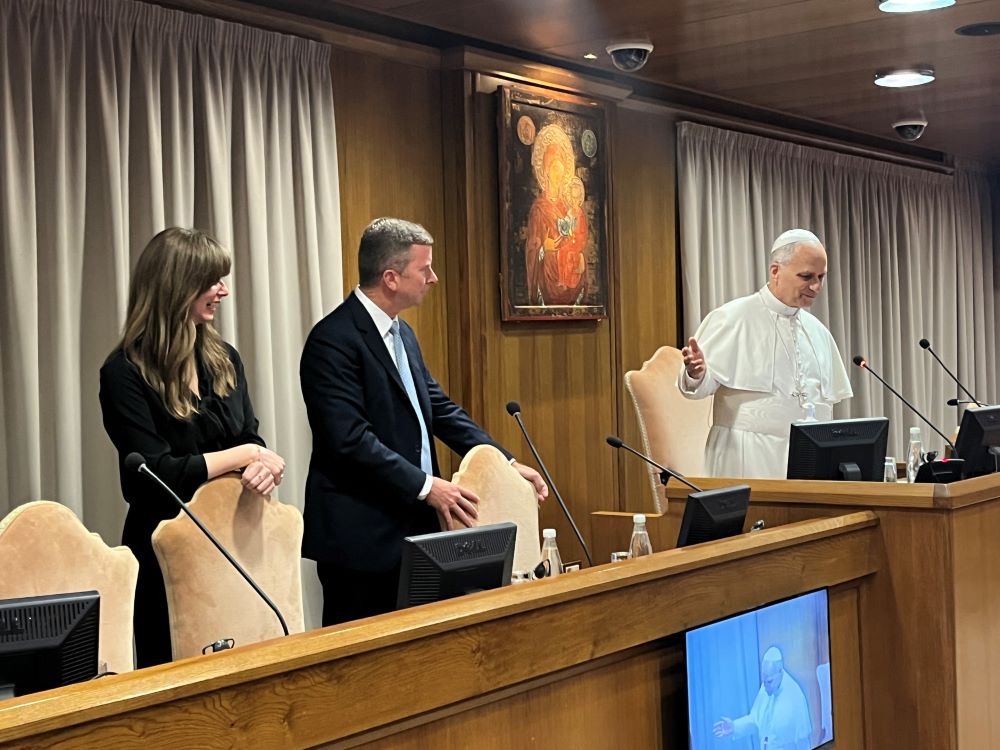
Pope Leo XIV introduces Chesley Turner (left), the director of the Center for Church Management at Villanova University, and Matthew Manion, the Grenon Family Faculty Director of the center, to the new American bishops in Rome on Sept. 11 at the Vatican. (Courtesy of Charles Cognata)
For Auxiliary Bishop Kevin Kenney of the St. Paul-Minneapolis Archdiocese, the invitation arrived at exactly the moment he needed it. Newly ordained and still serving simultaneously as pastor of a parish, he was trying to navigate a transition that felt bigger than anything seminary or parish life had prepared him for.
Many of the bishops arrived carrying similar anxieties. After decades in parish ministry, they suddenly found themselves responsible for diocesan budgets, HR decisions and thousands of employees. They also were discerning strategic pastoral priorities in polarized, economically strained communities, often navigating bankruptcies after decades of lawsuits to repair sexual abuse scandals.
Auxiliary Bishop Felipe Pulido of San Diego said he walked into the program with one fear most of all: understanding diocesan-level finances. "When I was in the Diocese of Yakima (Washington) as a priest, I had an idea about the parish finances," he told the National Catholic Reporter. "But now here as a bishop, at the diocesan level — it's bigger. Much bigger. Everything is bigger. My concern was: I need to understand the numbers, otherwise I'm not going to be able to ask the right questions."
Villanova's program is designed precisely for bishops in that situation. Through sessions on budgeting, HR, stewardship, conflict mediation and organizational leadership, presenters from the university's business school focus on what they call mission-driven management: building financial and administrative structures that can also directly serve the Gospel.
Kenney said that framing was transformative. "It was all mission-based, which was wonderful," he said. "How do you bridge the mission with diocesan management? How do you work with your budget using the mission rather than just the practical financial piece of it all?"
Pulido said he found the clarity he had been seeking. "One of the things I discovered was that at a diocesan level, you make priorities for pastoral care and the mission leads the budget," he said. "You direct the funds so that the mission leads the budget in a good way."
For Auxiliary Bishop Christopher Cooke of Philadelphia, the training week exceeded his expectations. "I attended because I knew there were things that I know that I don't even know that I need to learn about," he said.
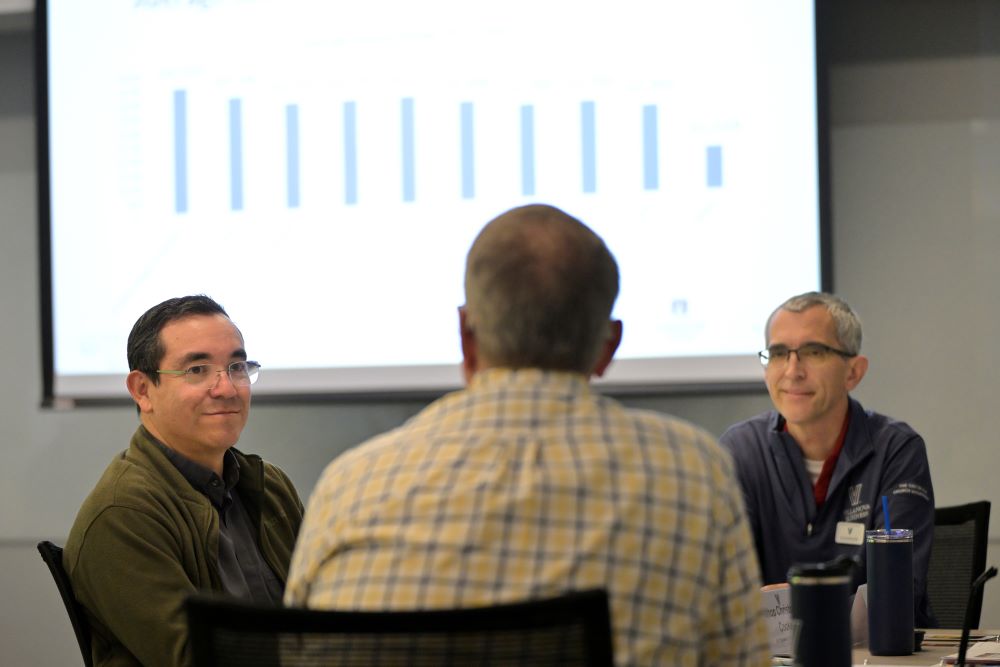
Auxiliary Bishop of San Diego Felipe Pulido, Auxiliary Bishop of Philadelphia Christopher Cooke and Bishop Mike Martin of Charlotte discuss a case study together during the summer training for U.S. bishops at Villanova University July 23. (Courtesy of David DeFalco)
Cooke, ordained in one of the nation's most complex and historically significant archdioceses, said his greatest concern was leadership at scale. "If you make a little mistake and you have a small scale, it's easy to correct," he said. "But if you have a very big scale, even a small mistake might get magnified." What he hoped for — and what he said he found — was formation for making good decisions in the face of competing opinions and high-stakes consequences.
One insight stuck with him: the idea that every pastoral meeting is, in a sense, a negotiation. "There's always going to be a need to listen well, to express what you're valuing and to realize you're probably going to meet somewhere in the middle," he said. The lesson helped him reframe difficult conversations with diocesan employees.
The program unfolded in a workshop style: short lectures, small-group work and scenario-based role-playing. Kenney said those exercises were unexpectedly calming. "We all came in nervous," he admitted. "We're all recently appointed bishops … A lot of questions. But talking to one another, it calmed us all down in our new roles."
"Just having a sense of fraternity among other bishops in a learning environment is very good," Cooke said.
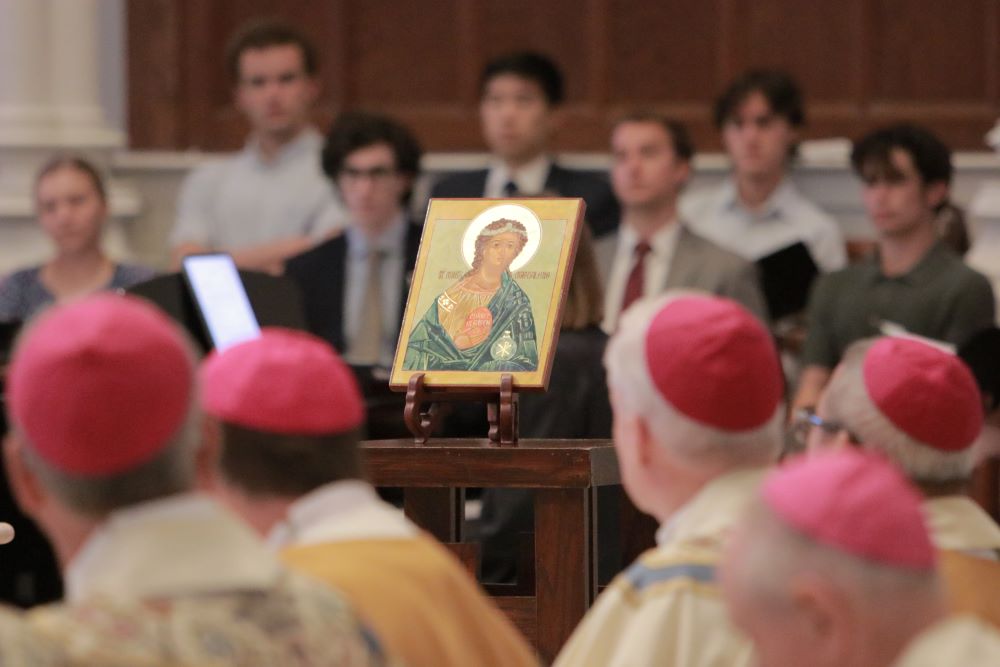
Some of the bishops in a training program at Villanova University and Villanova students from the Villanova Pastoral Musicians attend Mass together July 22. (Courtesy of Sarah Webb)
One presentation examined how dioceses structure the boards of their Catholic foundations — entities that manage large charitable and investment assets. A Villanova researcher compared three governance models: foundations chaired by the bishop, foundations where the bishop sits as a board member but not chair, and foundations where the bishop is not a board member at all.
The findings surprised some participants. The model where the bishop served as a member — but not chair — performed best financially over a five-year span.
"It led to a fascinating conversation about how you would structure if you were going to start a foundation in your diocese. For example, what governance structure would you use?" Manion said. "And now they have a little more information to consider and figure out which governance structure that may or may not be the best for them. They have some more data."
Other sessions dealt with issues bishops increasingly encountered firsthand, including diocesan bankruptcy. With more than three dozen U.S. dioceses filing for Chapter 11 in recent decades — often linked to settlements for clergy abuse survivors — several bishops in attendance were already navigating bankruptcy proceedings.
Manion said the program addressed strategic questions surrounding bankruptcy as a tool for restructuring, but emphasized that bishops widely shared a deeper priority.
"From what I heard, the first concern was doing whatever it takes to foster healing for victim-survivors," he said. "If we get that right, I think we'll figure out the other things we need to figure out."
The challenges bishops face today are not purely institutional. Kenney noted that working with diverse lay staff — often divided politically or culturally — requires both patience and clear mission alignment. "Wherever you go, you bump into people who don't like to see change," he said. "But to bring people further along in the mission of the Gospel — how do you implement that in a way that shows the decency of humanity to all people? That can be challenging."
Pulido, an international priest who immigrated from a small village in Mexico, highlighted another gap: Many bishops — especially those formed abroad — receive little formation in American institutional management. "It's a totally new ballgame for us," he said. "In the seminaries, we don't have a lot of training on finances. So to go to Villanova, it's a must do."
All the bishops interviewed by NCR said fellow U.S. bishops would benefit from further training to serve their missions and that they would recommend a training program like the one offered by Villanova.
Advertisement
Cooke said he sees it as a model for the synodal church Pope Francis envisioned — collaborative, discerning, mission-focused. "This training was designed by first talking to us as new bishops," he said. "It's workshop-style, adult learning. I would recommend it to everybody."
Asked where he sees the American church heading, Manion said the very willingness of bishops to attend a program like this was, for him, a major sign of hope.
"A group of bishops devoted a week of their lives to learning how to manage their dioceses more responsibly. That's huge," he said. "It shows a commitment to continuous formation."
"They were all working together to figure out how to do the role as best they can," he said. "Polarization exists in the church, but maybe something greater is starting to pull us out of that."