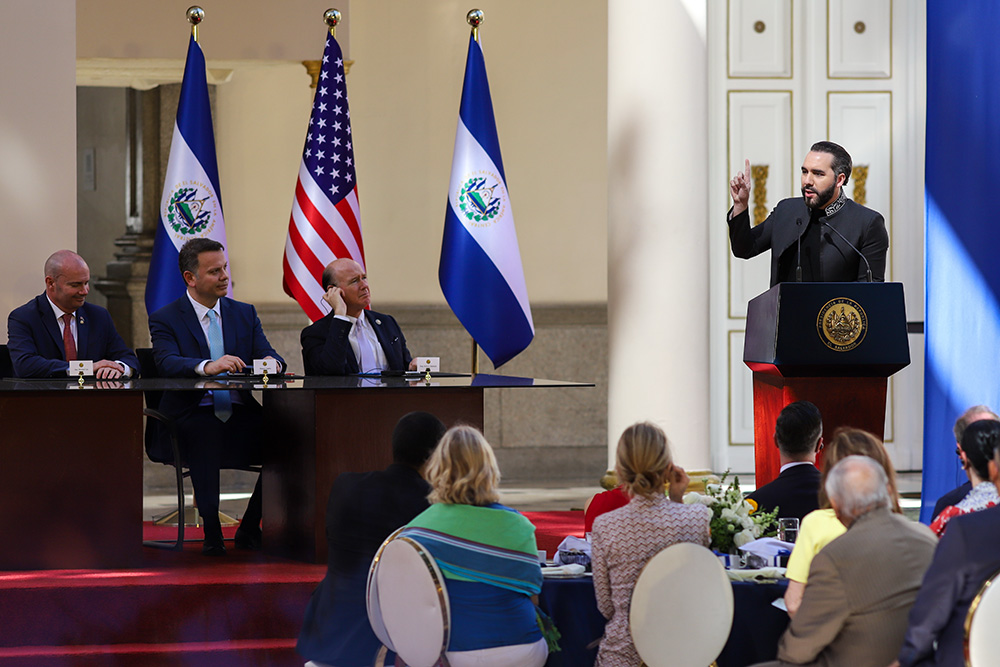
El Salvador's President Nayib Bukele speaks at the National Palace as he hosts the country's first National Prayer Breakfast in San Salvador Jan. 19, 2026. (AP/Salvador Melendez)
by Rhina Guidos
Catholic politicians from the U.S. took part in El Salvador's first National Prayer Breakfast Jan. 19, where they called the country's drastic reduction in crime — due in part to mass incarceration of gang members as well as innocent Salvadorans — a "miracle" from God.
Some Salvadoran Catholic bishops, evangelical clergy and other Christian leaders attended the event, modeled after a similar controversial prayer breakfast in the United States, which touts bipartisanship among Christian politicians. The one in El Salvador was said to be organized by the Próspera Foundation, which has hosted similar events in Guatemala. The investigative digital newspaper Plaza Publica in Guatemala has linked the organization to right-wing Christian groups with ties to the United States that have great political influence in the halls of Washington.
The aim, Plaza Publica said in a 2022 article, is to establish conservative Christian policy in the country with the help of those attending the prayer breakfasts. In 2022, the president of the Heritage Foundation spoke at Guatemala's prayer breakfast.
At this year's inaugural event in El Salvador, U.S. politicians lavished praise on the country's ruler, President Nayib Bukele, comparing him to U.S. President Dwight Eisenhower, the first U.S. commander-in-chief to join Congress for a prayer breakfast in 1953.
"We are so inspired by everything we've learned here in El Salvador. You've been through wars, the civil war, the war against the gangs, the war against crime, you've been through so much trauma, and you've achieved a miracle," Congressman Tom Suozzi, a Democrat and Catholic from Queens, New York, told the crowd gathered at the National Palace, a venue close to the Cathedral of San Salvador, where the country's St. Oscar Romero is buried.
The breakfast was nationally televised on prime time.
Suozzi spoke of how El Salvador's event brought together "so many people of different faiths and backgrounds and different political beliefs, all united in the spirit of prayer to make your country and our world a better place."
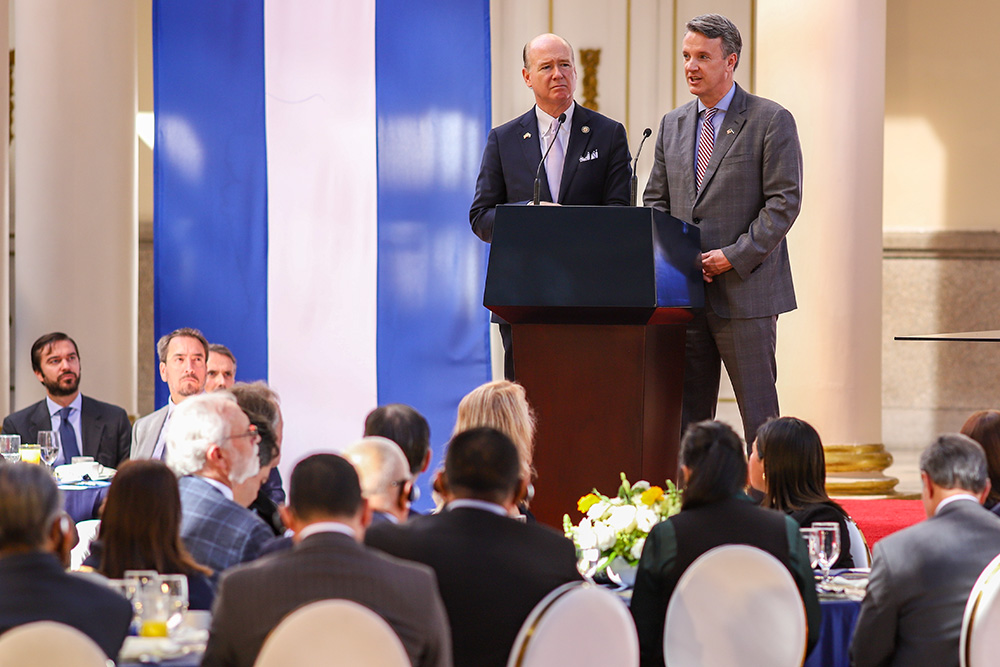
Rep. Tom Suozzi, right, a Democrat from New York, speaks during the National Prayer Breakfast hosted by Salvadoran President Nayib Bukele at the National Palace in San Salvador, El Salvador, Jan. 19, 2026. Standing next to Suozzi is Rep. John Moolenaar, R-Mich. (AP/Salvador Melendez)
But El Salvador is ruled by one political party called Nuevas Ideas, which had its leaders in the room as well as judges friendly to the party appointed to high legal positions in the country. El Salvador has a small Jewish and Muslim population, which at one point included the current president's father, but most at the breakfast seemed to be Catholics and Protestants.
It was hard to tell whether members of other parties were present. Politicians who oppose the ruling party and its policies are largely ignored and in some cases have been incarcerated, along with others who have called out human rights violations and spoken against the trampling of citizens' rights and basic liberties. Journalists have left the country en masse. Civil and human rights groups also have abandoned the country, fearing reprisal.
Lou Correa, a Catholic Democratic congressman from California's 46th Congressional District, also attended the gathering, and spoke alongside Utah Republican Mike Lee, a member of the Church of Jesus Christ of Latter-day Saints. Though a local digital newspaper said some of the U.S. politicians had met with civil society groups during their visit and heard their grievances, the men, during the breakfast, praised what they described as El Salvador's progress in getting rid of gang violence, saying it was the result of answered prayers.
"Here, people believe in God. Here, people can show what can happen when they have faith," said Lee.
For many years El Salvador ranked near or at the top of lists of most violent countries not at war. But in 2022, after a particularly bloody weekend when gangs went on a rampage killing innocent civilians, the government, under Bukele, began mass arrests and suspended personal freedoms as well as the right of those accused to defend themselves in court.
Though an unknown number of innocent people were arrested, polls have shown the Salvadoran public has largely approved of the actions because it stopped the terror by gangs they lived under for decades. For some neighborhoods, it gave them a chance at a peaceful life. Even those who don't like Bukele find it hard to deny that he was successful at something other ruling parties had not been able to do. Others argue that his government made pacts with the criminal organizations to stop the violence.
At the prayer breakfast, Bukele said 95% of Salvadorans still remember the terror and said gangs had been the real dictators of the country, an allusion to those who have called him a dictator because of his government's repressive measures.
"They [the gangs] were the real government of this country. They set in place curfews, controlled who could go from one place to another and they imposed taxes" in the form of extorsions, which sometimes ended in torture and death, he said.
Advertisement
Those who helped him set a plan to get rid of the gangs didn't know how they were going to stop the violence, but after they prayed, it finally came to an end, he said. A force of military might in March 2022 sent thousands of soldiers into the most gang-plagued neighborhoods as well as poor rural areas where there had been little crime. The soldiers' job was to capture anyone suspected of being a gang member, regardless of proof, a task made easy because the government suspended the right to due process. Tens of thousands were arrested. While a few have been released, many are still waiting in prison for a trial, and some organizations have said that about 350 have died in prison.
The government had initially said the country had an estimated 70,000 gangsters. In 2025, a member of the Nuevas Ideas party said more than 90,000 "terrorists" were under detention but the president seemed to couch the difference in the figure at the breakfast saying gang members also had collaborators. The suspension of rights that was supposed to last 30 days is still in place.
Some have asked the government, now that the violence has abated, to allow detainees legal representation, communication with families, and a trial, citing deaths that have taken place inside the prisons. But those who have called out the abuses, such as prominent human rights lawyer Ruth Eleonora López, have themselves been imprisoned; others have fled.
While admitting that some mistakes have been made, the government has defended its actions and said that there was no other way to stop the scourge of gangs. Those at the breakfast, including Bukele, explained it away as a miracle.
"I don't know how to explain it other than it was the hand of God. No one can doubt that," he said. "It's proof that God makes things happen when you ask with faith. There's no other way to explain it."
Though El Salvador's ruler is not known to attend services of any particular faith group, he said that even though he's had doubts in the past, "I absolutely no longer have them, for various reasons."
In neighboring Guatemala, various conservative-leaning presidents have attended similar prayer events, where Manuel Espina, a "successful Pentecostal activist" and president of Guatemala Próspera, was a presence, said an article from the Pulitzer Center. Espina, who has ties to prominent U.S. politicians, was also present at El Salvador's event.
"I hope that just as we remember Eisenhower, we will remember President Nayib Bukele for ... the many successes his administration has had," said Espina, who was Guatemala's ambassador to the U.S. from 2017 to 2019. "I am sure that you will be remembered because you started a movement around the spirit of Jesus. And I hope that today will not be just another day for us. I hope that today will be a challenge for us to put our differences at the center, at the feet of Jesus, because that will make our differences smaller and we will increasingly lift up his name."