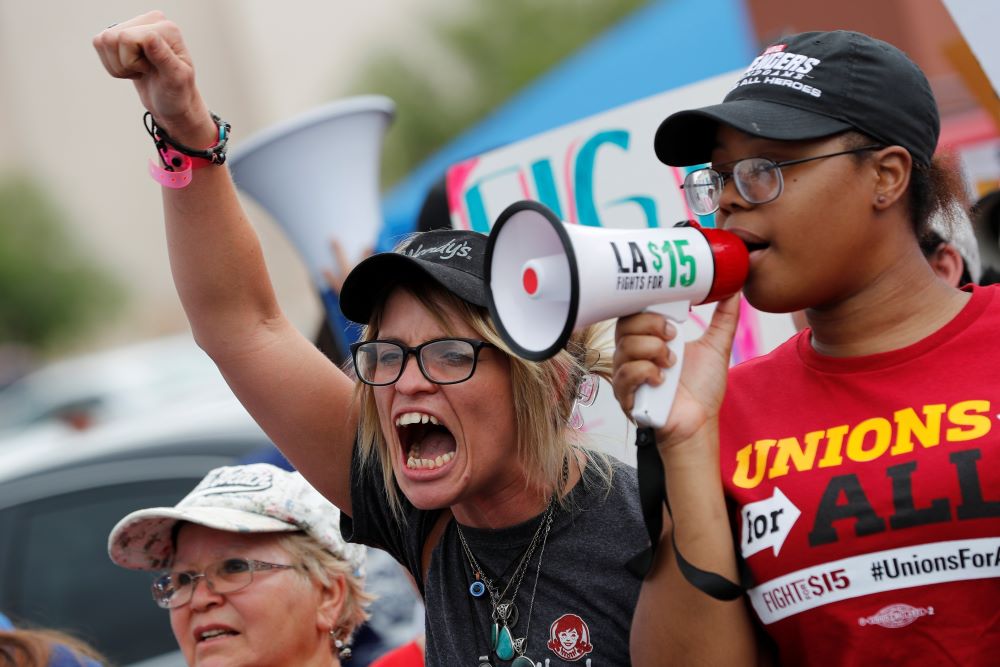
Striking McDonald's workers demanding a $15 minimum wage demonstrate in Las Vegas June 14, 2019. (OSV News/Reuters/Mike Segar)

The off-year elections saw two Democratic candidates win the governorships in their states, running as moderates, while Zohran Mamdani won the New York City mayor's race running as a democratic socialist. What united the campaigns was their singular focus on affordability.
Voters are tired of rising grocery prices, of astronomical rents, and the always fluctuating price of gasoline. President Donald Trump has been in denial about the problem for much of the year and, of course, blaming Democrats for "the highest inflation in the history of our country. I have it down now to a normal level and it's going down further."
People know how much they are spending so saying things are cheaper when they are not is not convincing. Earlier this year, Trump denied the obvious fact that tariffs will raise prices but he now has admitted they did raise prices and is rolling the tariffs back. The president is now rolling back some of the tariffs on key consumer goods, even while arguing this is nothing new, in light of the shellacking Republicans took earlier this month.
The Democrats, however, need to deepen and shift the conversation. It turns out no president — or governor or mayor — has a whole lot of policy tools for lowering prices. In fact, their ability to dictate economic policy generally is more limited than they admit. Politicians of both parties like taking credit when times are good and work to blame others when things go south.
Policymakers, and especially Democrats, need to approach affordability from the other angle: wages. Raising the minimum wage is not only wildly popular, it would allow millions of people making low wages to have a little more in their pocket. Not many workers make the minimum wage, but raising it would drive up wages for all those at the lower end of the pay scale according to the Center for Budget and Policy Priorities.
Supporting workers' efforts to unionize also has the potential to raise wages. A 2023 report by the Treasury Department stated:
Union membership peaked in the 1950s at one-third of the workforce. At that time, despite pervasive racial and gender discrimination, overall income inequality was close to its lowest level since its peak before the Great Depression, and was continuing to fall. Over the subsequent decades, union membership steadily declined, while income inequality began to steadily rise after a trough in the 1970s. In 2022, union membership plateaued at 10 percent of workers while the top one percent of income earners earned almost 20 percent of total income.
Workers at Starbucks are trying to unionize, recently holding a "Red Cup Day" to call attention to their effort. Amazon workers in North Carolina are trying to unionize but the company continues to fire workers who join a union. Why aren't Democrats leading the charge to call for boycotting these union-busting companies!
Advertisement
Democrats have a working-class problem and leading the boycott charge would help regain the support of those workers. It is only well-educated, upper middle-class people, including many "social justice Catholics," who make excuses for why they need to use union-busting companies.
In the last century, it was an axiom of politics that when voters thought of themselves as workers, they cast their ballots for Democrats and when they thought of themselves as taxpayers, they voted for the Republicans. Now, everybody sees themselves as a consumer. It does not speak well of the quality of civic education in this country that millions of Americans apparently were willing to tolerate Trump's attacks on our democracy so long as he kept the economy running smoothly. But this is the world in which we live.