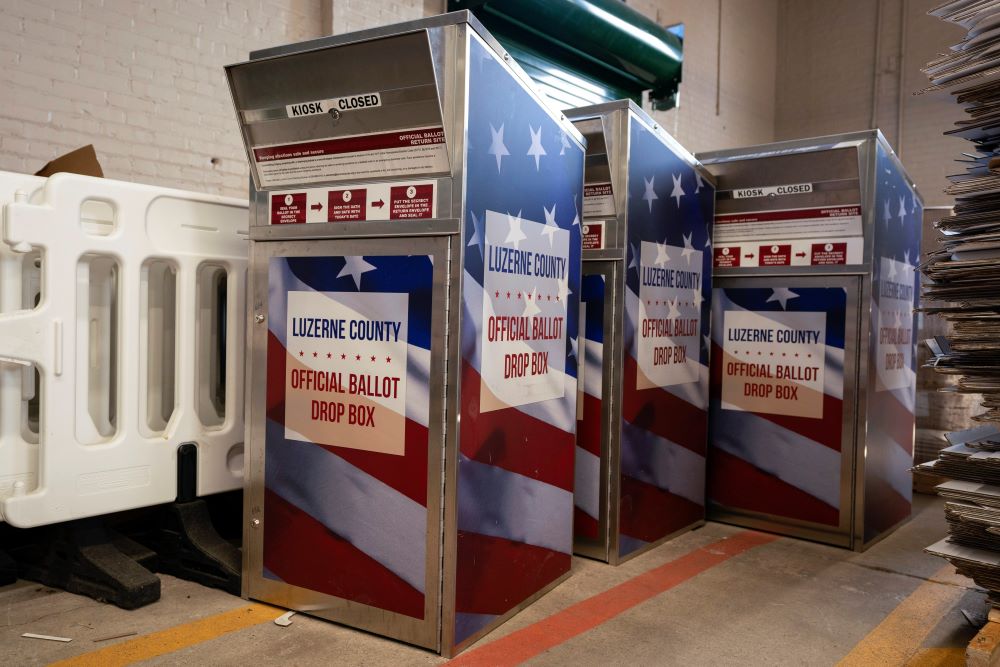
Luzerne County's ballot drop boxes are seen in the county's warehouse in Wilkes-Barre, Pa., Wednesday, Sept. 13, 2023. (AP/Sait Serkan Gurbuz)

Last week, Salena Zito, in The Washington Post, wrote a very smart analysis of politics in that most important swing state, the Commonwealth of Pennsylvania. The state's popular Governor Josh Shapiro and the Democratic Party Chair Eugene DePasquale both highlighted the importance of showing up in rural areas to listen to people's concerns.
They also suggested something that will anger or confuse a lot of people: Democrats need to stop demonizing Trump. It amounts to accepting the political fight on his terms, keeps him as the center of attention and, critically, prevents Democrats from stepping forward with policy solutions to people's actual problems.
One of the political strategists Zito interviewed is Mike Mikus, who supports the governor and the party chair in steering clear of simply calling Trump and his voters names. "One of the biggest problems I think the Democratic Party has had nationally, as well as here in Pennsylvania, is coming across as a party of scolds, where you're lecturing people, telling people, because in a previous election, you made the wrong choice, that you are somehow stupid or ill-informed," Mikus told Zito. "And when you do that to a voter, they're less inclined to like you, and if they don't like you, they're not going to vote for you."
The good news is that Democrats are finally recognizing they need to figure out how a thoughtful, experienced candidate like Harris nonetheless lost to a blowhard like Trump.
As if on cue, New York Times columnist Tressie McMillan Cottom penned an op-ed about the controversy surrounding Maine Senate candidate Graham Platner's tattoo, which is or resembled a Nazi symbol. Platner, an oyster farmer, had previously and quickly become a darling of the left in part because of his appeal to working class voters. Prominent Democrats like Sen. Bernie Sanders said the tattoo should not be disqualifying. Cottom displayed precisely the kind of scolding that most people hate. She said the tattoo and its apologists revealed the Democrats' biggest problem, that " 'working class' has become a powerful political totem of its own — a discursive sleight of hand used to separate out white voters' concerns as more legitimate, more materially grounded, more important than other voters' concerns." Ah, yes, discursive sleights of hand are the problem. Democrats: Stop listening to professors. Full stop.
Focusing exclusively on Trump also obscures the fact that Democrats started losing badly in rural Pennsylvania before Trump came on the political stage. Barack Obama won the state twice. In 2008, he carried 18 of the commonwealth's counties, but in 2012, he carried only 13.
Over the years, I have focused on Luzerne County to track the Democrats' fortunes in Pennsylvania. This county is centered on Wilkes-Barre in the northeastern part of the commonwealth. In 2008, Obama carried it with 53.3% of the vote to John McCain's 45%. Obama held on in 2012, winning 51.5% of Luzerne's voters to Mitt Romney's 46.8%. In 2016, Donald Trump clobbered Hillary Clinton, 57.9% to 41.7%. Joe Biden was not able to take the county in 2020, even though it adjoins his birthplace in Scranton, but he narrowed the margin, capturing 42.3% to Trump's 56.6%. Biden won the state by closing the gap with Trump in key districts. In 2024, Trump took 59.1% of the vote to Kamala Harris' 40% and he put the state back into the GOP column.
Each battleground state has counties like Luzerne that explain how the Democrats' ceased to be the party of working-class Americans. The party that wins these voters wins elections.
Advertisement
Another attempt to help the Democrats regain some momentum comes from the progressive group Welcome in a report called "Deciding to Win." The report's primary author, Simon Bazelon, shares commonsense ideas, but they do not go far enough. For example, the report states: "In comparison with the Democratic Party of 2012, today's Democratic Party is more focused on issues like climate change, democracy, abortion, and identity and cultural concerns and less focused on the economy and the middle class." Looking forward, the report affirms: "It will be critical for our party to reduce the gap between what voters want Democrats to focus on and what voters think we do focus on."
That is true, but insufficient. In a campaign, Democrats are not the only ones explaining who they are and what they care about. Republicans are telling people who the Democrats are and what they stand for. They ran ads of Kamala Harris explaining her support for taxpayer-funded gender-transition surgeries for prisoners. The problem for Democrats is not just what they focus on, but the fact that too many of them cling to ideas that most Americans find nutty or worse.
Other Democrats then get painted as extremists too, which is another reason non-extreme candidates need to go to Republican areas and speak with voters: It helps dispel any caricatures of them and their positions. That said, the "Deciding to Win" study is useful for its in-depth look at the role of special interest activists and the donor base in pulling the party further to the left.
The good news is that Democrats are finally recognizing they need to figure out how a thoughtful, experienced candidate like Harris nonetheless lost to a blowhard like Trump. Yes, he is a uniquely gifted politician in part because most people see him as a businessman, not a politician. But Harris never challenged a liberal establishment that has gone off the rails. The Democrats can focus on the economy, and they also need to shed their cultural extremism. The whole party needs a collective "Sister Souljah" moment if it wants to win elections again.