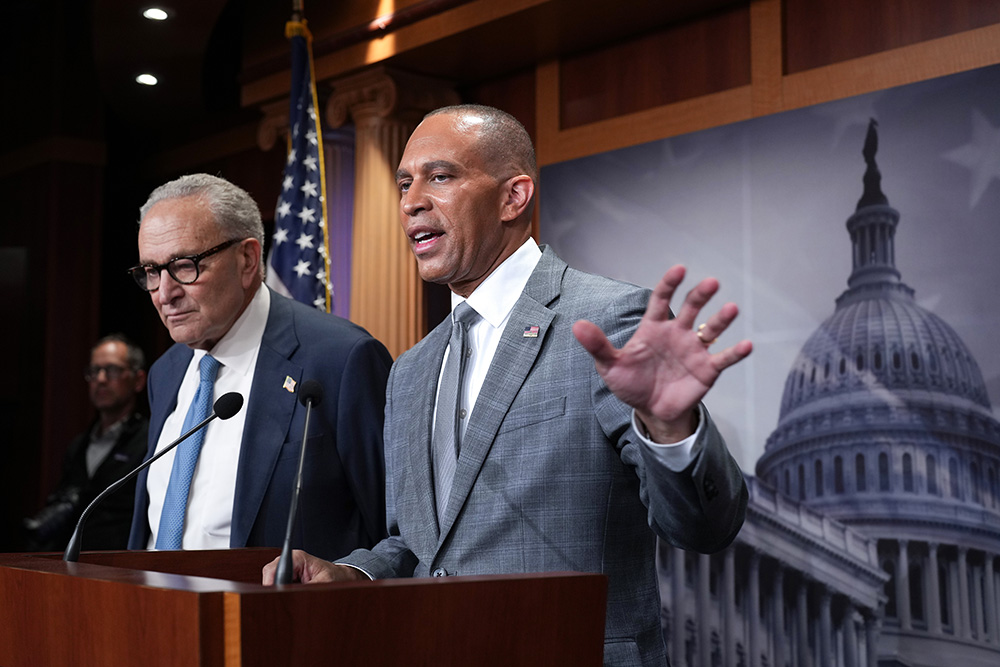
Senate Minority Leader Chuck Schumer, D-N.Y., and House Minority Leader Hakeem Jeffries, D-N.Y., right, talk with reporters following their meeting with President Donald Trump and Republican leaders on the government funding crisis, at the Capitol in Washington Sept. 29, 2025. (AP/J. Scott Applewhite)

The Democratic Party appears completely dysfunctional. Part of this is the price of being out of power. As I discussed in my newsletter yesterday, President Bill Clinton was able to win the shutdown fight against the GOP in 1995-96 in large part because he had the bully pulpit of the White House. He used that fight to redefine who he was and what he was for, which carried through to reelection.
Former Vice President Kamala Harris didn't do the party any favors by releasing a book about the 2024 campaign: Not only is it backward-looking, it involved a lot of score-settling. She complains about former President Joe Biden. She complains about her running mate, Minnesota Gov. Tim Walz. I did not blame Harris for her loss given the hand she was dealt. But, in politics, when you lose a bad hand, you shuffle the cards and play again. You don't relive the hand you lost.
Still, the more important problem identified by political scientist Lee Drutman in a recent Substack post is that the party is fighting on terrain chosen and dominated by Donald Trump. Applying a classic politics text, E.E. Schattschneider's The Semi-Sovereign People: A Realist's View of Democracy in America, Drutman argues that the Democrats need "a strategic theory of conflict which is about starting new fights, not accepting old ones."
Trump is "a middle finger to the entire political system" as Ryan Cooper explained way back in 2016. Enough Americans have been so turned off by politics, and so let down by their government, they overlook Trump's many faults because he is doing for them what they lack the power to do themselves: tell the establishment to take a hike, only in cruder terms than appropriate for a Catholic newspaper.
The Democrats have meekly accepted the role of defenders of an establishment a majority of the voters just rejected. It is a losing proposition. Trump has lured the Democrats into narrow waters he has chosen, and they run aground on rocks he knows are there, but which they can't seem to recognize. They need to change the terms of the debate by relocating to more friendly waters.
Advertisement
Drutman notes that the recent focus on the theory of attention, as explained by Ezra Klein, won't do it. Klein argued that the shutdown was an "attentional event" that allows the Democrats to garner the kind of attention Trump gets every day. Drutman is skeptical: "But what if Democrats' problem isn't that nobody's listening — but that they have nothing new and exciting to say?"
Health care is not the kind of issue that will change the political landscape, Drutman argues, unless the Democrats have something new to propose. Here I quibble a bit. Seniors care a lot about health care and they vote. Fighting for the Obamacare subsidies may not garner their attention but Medicare and Medicaid changes strike fear in the hearts of older Americans.
Drutman cites a couple of ways Democrats can flip the script. "When you're stuck fighting against the spin, you have two choices: keep pulling harder on a losing dimension, or grab the rails and shift the spin. Make politics rotate around corruption instead of immigration. Around oligarchy instead of bureaucracy. Around insider trading instead of insider pronouns."
The word "corruption" jumps off the page. Drutman spells corruption "E-P-S-T-E-I-N" and he is not wrong. That scandal may yet be the story that pierces Trump's Teflon. Still, the corruption charge starts with Jeffrey Epstein; It doesn't end there. Corruption is not incidental in this administration. It is the beating heart of Trump's second term.
"Many payments now flowing to Trump, his wife, and his children and their spouses would be unimaginable without his Presidencies: a two-billion-dollar investment from a fund controlled by the Saudi crown prince; a luxury jet from the Emir of Qatar; profits from at least five different ventures peddling crypto; fees from an exclusive club stocked with Cabinet officials and named Executive Branch," wrote David Kirkpatrick in the New Yorker. Americans do not begrudge people getting rich, but no one likes getting ripped off. If Trump is monetizing his office for private gain, shouldn't the public share in the wealth?
Trump has lured the Democrats into narrow waters he has chosen, and they run aground on rocks he knows are there, but which they can't seem to recognize. They need to change the terms of the debate by relocating to more friendly waters.
Democrats, reluctant to offend their donor class, have not embraced the kind of "eat-the-rich" populism suggested in The New York Times by Timothy Shenk on Monday. Every time I see a photo of what those horrible, pencil-thin skyscrapers have done to the New York skyline, each of them filled with luxury condos that sell for obscene amounts, my blood boils. This represents a corruption of the free market, not an apotheosis. I don't think I am alone in this. Democrats need to point people to their pitchforks.
Democrats should also unite behind the bipartisan proposal to ban members of Congress from trading stocks. This is a no-brainer.
Corruption also is a fine way to describe what Trump is doing to our judicial system. And to our alliances with fellow democracies. And to our electoral system. Becoming the anti-corruption party, with policies to enact clean government, is one way for Democrats to change the playing field.
Drutman skewers the current debate among pollsters about how to measure "moderation" and how much benefit a party gets for being perceived as "moderate." I have argued Democrats need to stop embracing ideas that are culturally extreme, but Drutman is making a different point. Like the theory of attention, a theory of moderation doesn't change the subject. "If we are concerned about America's slide into authoritarianism, as we well should be, the response isn't asking Democrats to fight harder or 'moderate,' " Drutman writes. "The answer is to stop accepting Republican conflicts and create new ones." The cultural extremism of the left is an example of Democrats fighting on losing turf that is chosen and dominated by Trump.
Back in February 2019, I flagged Drutman's analysis of voters' values for NCR readers. More than any contemporary analyst, he consistently frames politics in terms no one else is doing and that ring true. The leaders of the Democratic Party need to invite Drutman to help chart a way out of the wilderness where they have led themselves.