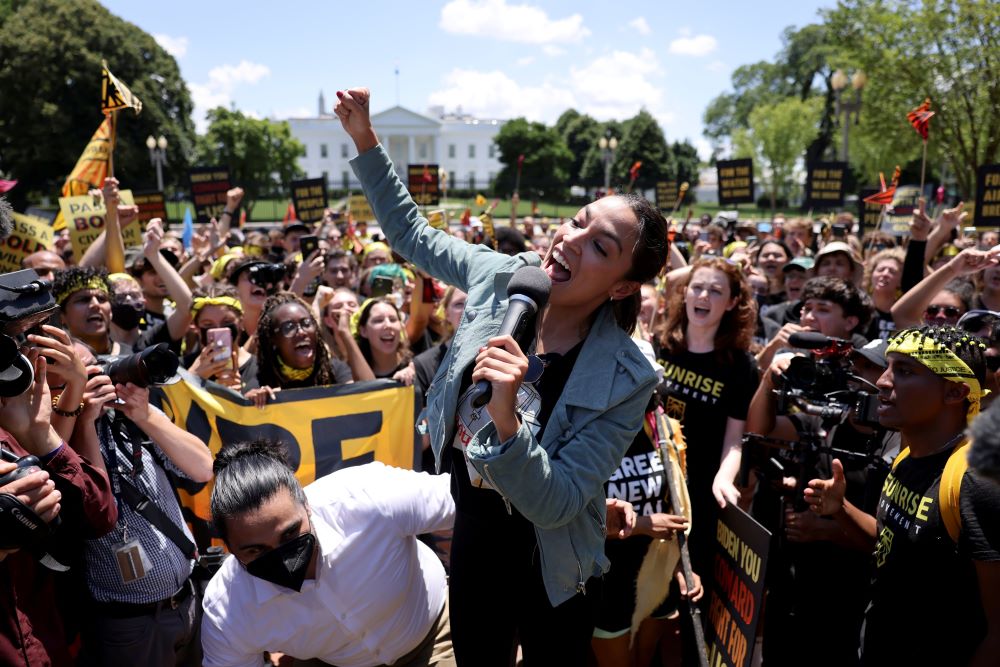
U.S. Rep. Alexandria Ocasio-Cortez, Democrat of N.Y., participates in a "No Climate, No Deal" demonstration outside the White House in Washington June 28, 2021. (CNS/Reuters/Evelyn Hockstein)

The fight for the soul of the Democratic Party continues to percolate, mostly beneath the surface, as Democratic leaders try and discern a way forward. The party must ask itself: How did we lose to Donald Trump? How can we win in rural states again, without which, we will never secure a majority in the Senate? Most immediately, Democrats need to figure out how to take back the House of Representatives in next year's midterms.
One group of centrist Democrats, the organization Third Way, recently published a very important and valuable white paper about one of the Democrats' major problems: They speak about issues in ways that turn voters off. The white paper, entitled "Was It Something I Said?" usefully collects a series of words or phrases that people on the left use and shouldn't.
"For a party that spends billions of dollars trying to find the perfect language to connect to voters, Democrats and their allies use an awful lot of words and phrases no ordinary person would ever dream of saying," the paper says. "The intent of this language is to include, broaden, empathize, accept, and embrace. The effect of this language is to sound like the extreme, divisive, elitist, and obfuscatory, enforcers of wokeness. To please the few, we have alienated the many — especially on culture issues, where our language sounds superior, haughty and arrogant."
If anyone wants to see an end to Trumpism, verbal discipline will be necessary.
So, for example, under the heading "The Shifting Language of Racial Constructs" the paper notes, "These words signal that talking about race is even more of a minefield. You will be called out as racist if you do not use the latest and correct terminology." The words they list are "Latinx," "BIPOC," "Allyship," "Intersectionality" and "Minoritized communities." The first time I read about then-Rep., now-Sen. Ruben Gallego of Arizona was when he announced on Twitter that he had barred his staff from using the term "Latinx."
Another heading is "Organizer Jargon" which, the paper states, "These words say 'we are beholden to groups, not individuals. People have no agency.' " The words under this heading are: "Radical transparency," "small 'd' democracy," Barriers to participation," "Stakeholders," "The unhoused," "Food insecurity," "Housing insecurity," and "Person who immigrated." I actually like "stakeholders" but you see their point: Average people do not use this language. Nor does it connect with linguistic traditions outside the realm of activists and academics who employ it. "Hungry" has biblical resonance. "Food insecurity" sounds odd and contrived.
Third Way looks at the reasons people employ such words. Democrats, they say, "use it because plain, authentic language that voters understand often rebounds badly among many activists and advocacy organizations. These activists and advocates may take on noble causes, but in doing so they often demand compliance with their preferred messages; that is how 'birthing person' became a stand-in for mother or mom." That hits one nail on the head, but there are other nails.
Most of this language ends up in the mouths of activists but it tends to start in university lecture halls. In recent decades, there has been an intense focus on semiotics and language. In the humanities, there has been a fascination with deconstructionism, about which I wrote a few weeks back. There is intense pressure for faculty to fit in, and to avoid bad student reviews. I have lost track of the number of times I visited a college campus and someone comes up to me and thanks me for challenging an orthodoxy on the left because, they say, "I could never say that here." Why the hell not? Isn't that why God invented tenure?
Advertisement
The employment of the latest catchword is not merely an instance of virtue signaling. It is also a marker of identity: Speaking in these terms identifies the speaker as part of a new priesthood of the elect, people with special capabilities for empathy or expression. No matter that this language actually excludes some at the same time that it includes others. No matter that it tends to obfuscate instead of enlighten. Its purpose is never to persuade others. It is to define who the speaker is, at least in their own eyes.
As Third Way points out, we all have used some of these words before. But Third Way is not an academic institution, it is a political one. If Democrats and the left want to win elections again, they need to learn how to speak to voters in language those voters understand, and in language that does not make voters feel bewildered or, worse, inferior. If anyone wants to see an end to Trumpism, verbal discipline will be necessary. And maybe, just maybe, candidates should listen to regular voters, not just to activists and academics.