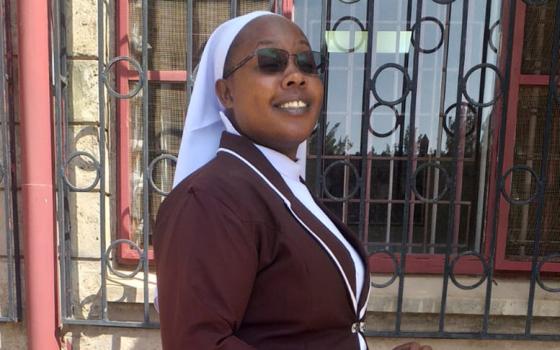

Texas Rep. James Talarico speaks at a rally Aug. 16, 2025, at Wrigley Square in Millennium Park in Chicago. (AP photo/Talia Sprague)

by Jude Barry
Religion and politics dramatically intertwined when thousands of people attended Turning Point USA founder Charlie Kirk's memorial service on Sept. 21. The loud gathering exemplified the rise of Christian nationalism within the Republican Party — and the call to a quasi-spiritual, quasi-political battle between good and evil.
In contrast, more quietly, days earlier, a 36-year-old Democrat studying to be a Presbyterian minister launched a bid for the U.S. Senate in Texas. State Rep. James Talarico's announcement was substantially different from the Kirk memorial's apocalyptic message.
"My granddad was a Baptist preacher in South Texas," he said. "He taught me that we follow a barefoot rabbi who gave two commandments: love God and love neighbor. Because there is no love of God without love of neighbor."
Talarico's speech, delivered while standing on a flatbed truck in front of a church, is inspiring, profound and unique for a Democrat. His message has the potential to transcend party lines — and perhaps even transform American politics. This three-minute clip offers one of the clearest, compelling examples in decades of a public official linking hopeful Christianity to our national public discourse.
Unlike Talarico, many Democratic candidates dodge the topic of religion in politics, while Republicans have embraced the religious right, politically benefitting from the modern reality that "all politics is influenced by identity [including religion]," as Ezra Klein writes in his excellent book, Why We're Polarized.
For decades, I worked in government and politics at all levels, including senior positions in three Democratic presidential campaigns. I've seen candidates and the party struggle to connect with religious voters, fearing that "God talk" only benefits Republicans and stirs culture war issues.
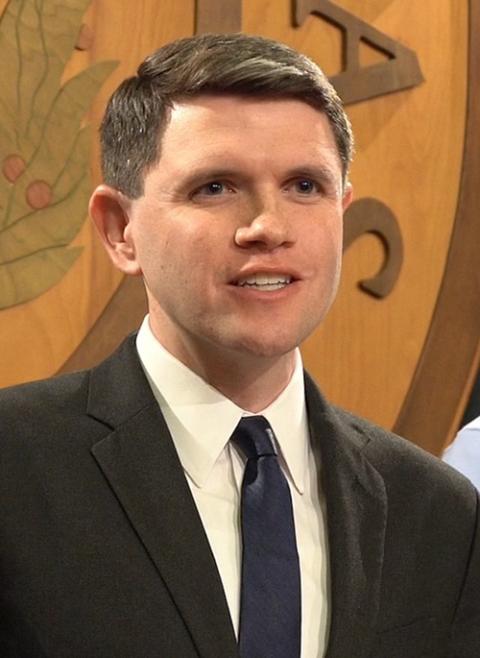
Texas state Rep. James Talarico speaks at a press conference at the Texas Capitol on Jan. 13, 2025. (Wikimedia Commons/Antonioaesparza, CC BY-SA 4.0)
Talarico masterfully accepts this challenge and isn't shy about sharing Christian teaching as a unifying message. "Every single person bears the image of the sacred," he said. "Every single person is holy, not just my neighbors who look like me, or pray like me, or vote like me."
But equally significant, Talarico understands that we live in combative times. A turn-the-other-cheek Christian candidate would appear too weak or out of touch to lead a party or a nation. But this candidate emphasizes how Jesus was not just a revolutionary figure but a true rebel in his time.
"Two thousand years ago, when the powerful few rigged the system, that barefoot rabbi walked into the seat of power and flipped over the tables of injustice," said Talarico. "To those who love this state, to those who love this country, to those who love our neighbors, it's time to start flipping tables."
And he is straightforward about what he means. His campaign video starts with a declaration: "The biggest divide in our country is not left versus right, it's top versus bottom." Billionaires, Talarico goes on to say, want people to look left and right at each other, "so that we're not looking up at them."
His understanding of justice and moral courage provides a lens through which he approaches real-world politics, shaping the decisions that have defined his short but impressive political career. Talarico is a relative newcomer to politics. He was elected to the Texas House of Representatives in 2018 and recently entered the U.S. Senate Democratic primary against a better-known candidate.
Advertisement
He attracted national attention earlier this year by leading the debate against a bill that required Texas public schools to display the Ten Commandments in classrooms. Talarico argued that the bill was not only unconstitutional and un-American but also "deeply un-Christian." He pointed out that the bill imposed one religious tradition over others, violating the principle of religious freedom. The bill eventually passed, but Talarico's calm, thoughtful arguments impressed people on both sides of the aisle, leading to some notable media attention.
In July, his message found a national platform on the popular Joe Rogan podcast. During that two-and-a-half-hour conversation, which has received over 1 million views so far, Talarico impressively discussed a wide range of political, religious and historical issues.
Talarico said that "this idea that there is a set Christian orthodoxy on the issue of abortion is just not rooted in Scripture." But he welcomed "honest debate." He said that if Pope Francis were to come back to life and express his pro-life, anti-abortion stance, Talarico would listen to and respect the pope's theological argument. Ultimately, Talarico said that he wanted pro-choice Christians who respect women's bodily autonomy to be given the space to make their theological arguments.
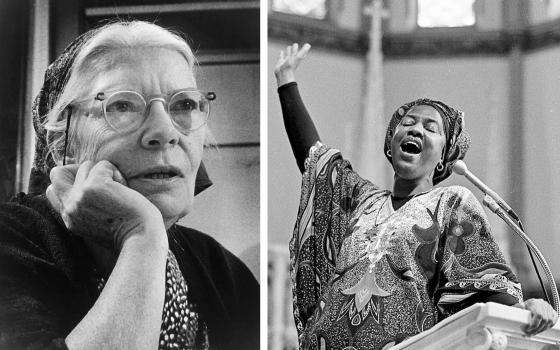
From memory, Talarico quoted Catholic Worker Movement co-founder Dorothy Day: "You really only love God as much as you love the person you love the least." Rogan told Talarico that he's the type of good person who should be in public office — and concluded that the Texan should run for president.
The Rogan conversation revealed Talarico's intellectual range. Then, in August, his appearance on Chris Cuomo's podcast clarified his political philosophy more precisely.
Talarico described himself as theologically conservative and politically progressive. "That's the long-term bet I'm making," he said. "That love and compassion are going to win in the long run." Cuomo likened Talarico to his late father, former New York Gov. Mario Cuomo, the last nationally prominent Catholic to openly discuss how religious faith influences public service.
Talarico's approach demonstrates that faith can drive politics without weaponizing it — a model that feels both urgent and overdue in our current moment. His vision stands in stark contrast to the rhetoric on display at Charlie Kirk's memorial service, where President Donald Trump declared: "I hate my opponent, and I don't want the best for them."
Where Trump and the Christian nationalist movement frame politics as spiritual warfare, demanding the defeat of enemies, Talarico invites Americans into a Christian tradition that sees the sacred in every person and justice as an expression of love.
Whether his Senate bid succeeds or not, his message represents the potential for transformative realignment. He's showing Democrats how to reclaim a moral vocabulary without compromising pluralism.
And he's reminding Christians that our tradition offers a pathway for healing rather than deepening our national divisions.