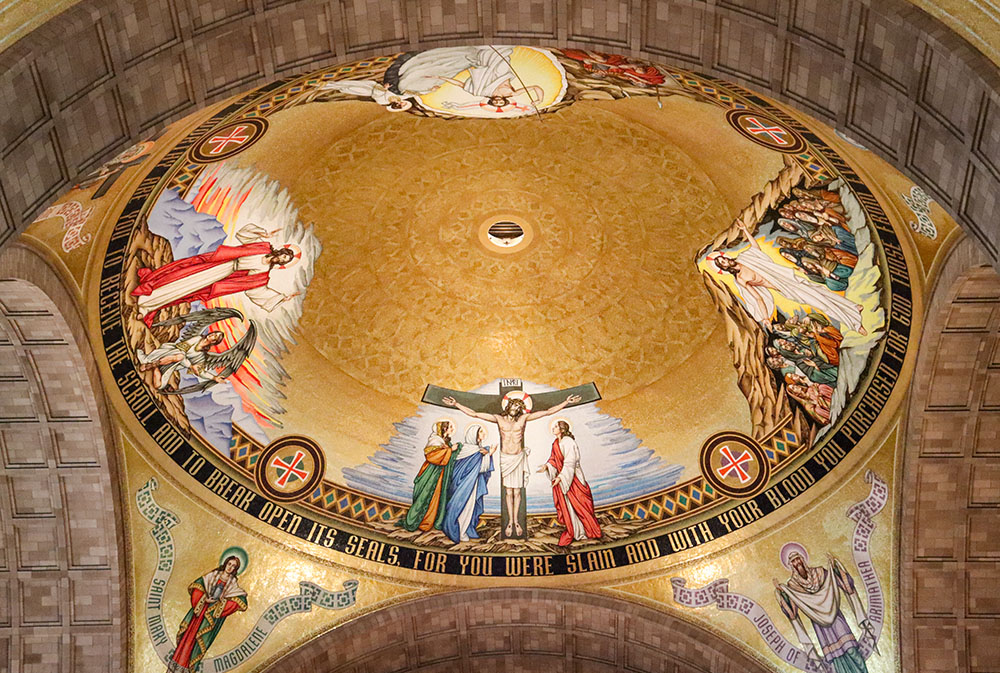
A view of the Redemption Dome in the Basilica of the National Shrine of the Immaculate Conception in Washington, D.C. (NCR photo/Teresa Malcolm)

Washington Cardinal Robert McElroy's recent sermon at the opening Mass for the Association of Catholic Colleges and Universities meeting illustrates the ecclesial, and eucharistic, understanding of Christian morality. He contrasted the "order of nature" with the "order of grace." I thought he was a bit hard on the order of nature. But his call to place the order of grace at the heart of Catholic education is spot on, as is his assertion that the Beatitudes are the content of that order. McElroy's sermons always have one foot in this world and one in the heavenly banquet of which the Mass is a foretaste and a promise.
Not all Christians possess this ecclesial understanding that shapes Catholicism. In 1980, the Rev. Jerry Falwell's Moral Majority was in full swing. The fundamentalist Baptist minister was trekking across the country urging fundamentalist Christians to register to vote and to back candidates who supported traditional values, most especially in favor of pro-life candidates.
That June, the Fundamental Baptist Fellowship passed a resolution condemning the Moral Majority. The fellowship did not support abortion rights nor was its opposition to the Moral Majority rooted in the traditional strict separationist stance of Baptists when it came to politics. No, the fellowship objected because "moral reformation is not the mission of the Church but instead the preaching of the saving grace of Jesus Christ."
This is not the Catholic view. With our intellectual preference for both/and approaches to the Christian life and Catholic theology, we believe that the church should engage in moral reformation precisely as a means of preaching the saving grace of Jesus Christ. We do not believe our good works will get us to heaven. That would be Pelagianism. But we do believe in the Christian obligation to improve this world as well as to hope for the next.
In our day, the tendency in Catholic circles is to overprioritize moral reformation, not seeing it as a consequence of, or a means to, proclaiming the saving grace of Christ, but reducing religion to morals. This happens on both the left and the right. The left tends to think the fight for social justice is the essence of the Christian faith — it isn't — and the right tends to think sexual purity is the essence of the Christian faith — it also isn't. Non-Christians can struggle for social justice and sexual purity, can they not? No, the essence of the Christian faith is the belief in the redemptive passion, death and resurrection of Jesus Christ. The primary dispute is not which set of morals flow from that belief but the relationship of any morality to that belief.
Advertisement
In a 2007 essay titled "Religion Is Not a Preference" at The Journal of Politics, Georgetown University's Joshua Mitchell explained how different religious experience was from much of the language social scientists use to describe it. Acknowledging that his focus is on "the territory in which Western Christianity came to prevail, and Liberal and Continental thought subsequently gained currency" he writes:
Biblical religion, so circumscribed, is not a preference. It is not a choice. It is not a value. It is, above all, not an identity. ... The terms "preference," "choice," "value," and "identity," if they are used at all in the New Testament or in the Hebrew Bible, are used incidentally, never systematically. These terms, moreover, have no bearing on what the New Testament and Hebrew Bible record, or seek to convey. Rapture, suffering, awe, obedience, faith, love — these pervade the religious books of Christianity and Judaism. They are terms concerned with the majesty of God, the wonder of creation, the errancy of man.
We have paid a heavy, rarely acknowledged price, for looking at religion through the lens of the social sciences in recent decades. For Christian theology, theories rooted in "choice" or "identity" are rotten, and rotten to the foundation because they are alien to the canonical texts that form the foundation. You can study religion the way you study other human phenomena, but religion is, to those who adhere to it, not merely a human experience, and so the religious studies lens will always, to the believer, distort as much as it enlightens. And as one friend put it to me, all religions look strange from the outside.
Theology can only happen within a religious community, one that recognizes the data of revelation is just that, revealed, not manufactured or invented. For Catholics, not every voice has the same weight. The teachings of councils and popes have greater claims to our adherence than the arguments of a theologian or the experience of any individual Catholic. The word itself means universal or everywhere, and so popes and councils consult the faithful throughout the world, but they do so through the lens of revelation. Then, the whole judges the part, that is, the one Catholic Church resolves controversies and difficulties of any given issue in light of the experience of the universal church stretched not only across the continents but across the centuries.
Look back at the list of words Mitchell rightly notes pervade the scriptural canon: rapture, suffering, awe, obedience, faith, love. He goes on to detail the character of humility and exaltation, and how these also differ from so much modern jargon that finds its way into discussions of religion. All have profound implications for Christian morality, but they also transcend morality. And modernity.