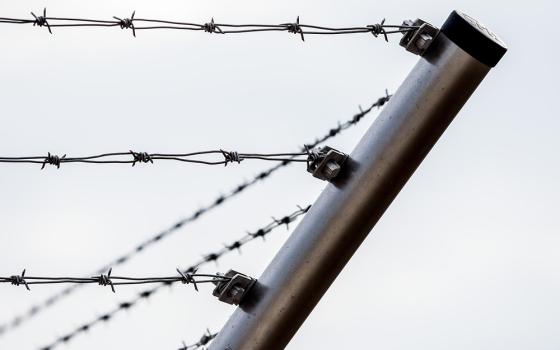
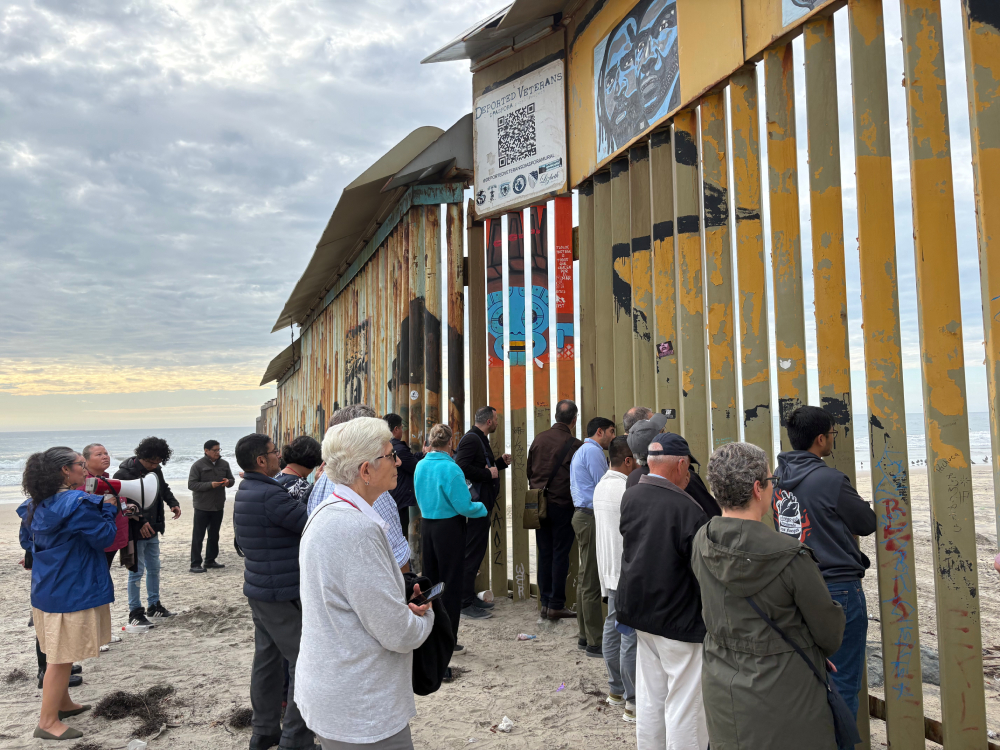
Attendees of the Colloquium on Migration and Theology reflect and pray at the border wall between Tijuana, Mexico, and San Diego, CA. (Luis Donaldo González)
by Luis Donaldo González
Catholic theologians and ministers cannot be quiet when people are suffering due to social injustice, war, climate change or extreme poverty. Indeed, we cannot remain indifferent when people are forced to flee their home countries, facing formidable challenges on the way or criminalized or persecuted by governments.
This is what a group of around 40 people — among them bishops, theologians, sociologists, psychologists, historians, pastoral ministers and migrants — at the U.S.-Mexico border considered during a Oct. 9-11 gathering. We discussed what we can do together to address pastorally and heal the social wound that global migration is inflicting now in Mexico and the United States.
"As scholars and ministers, we need to find ways to change narratives about migration, particularly when migrants are seen as a threat and an enemy," said Jesuit Fr. Alejandro Olayo-Méndez, author of Humanitarianism from Below. "There is a need to deepen our understanding of the principles of Catholic social teaching, especially when governments are cruel and unjust when controlling their borders."
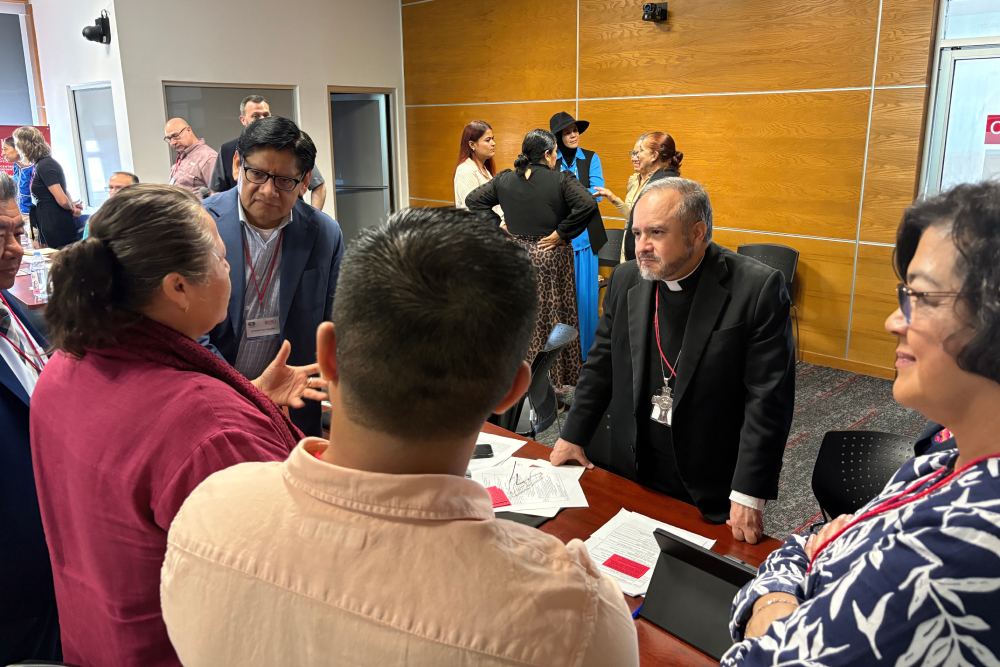
Theologians, ministers, activists, and bishops participated in dialogue and communal reflection at the Colloquium on Migration and Theology held in Tijuana, Mexico. (Luis Donaldo González)
This Colloquium on Migration and Theology, entitled "Challenges of Human Mobility in the Face of the New Political Horizons of Mexico and the United States from the Christian Perspective," was convoked by the Catholic Theological Ethics in the World Church (CTEWC) Virtual Table on Migration and Borders in the Americas and the Universidad Iberoamericana (IBERO).
There, we reflected that today is the time to shift responses to migrants "from fear-based nationalism to reparative justice toward a hemispheric common good," as argued by Kristin Heyer, CTEWC co-chair and Boston College professor. Indeed, causes of forced migration, the militarization of the borders and the growing hostile and xenophobic narratives show us that it is urgent to restore the value of human dignity and improve ways to achieve social justice — as an authentic Christian faith requires.
"Relational elements of Christian ethics — social anthropology, the universal destination of created goods, social sin, structural justice — illuminate the complex causes of displacement and the responsibilities that transit and receiving communities bear," Heyer said.
I am aware that we may be unable to change policy overnight. Still, we understand the necessity of advocating that governments, society and Christians understand that every single person has "the right to have rights," as philosopher Hannah Arendt wrote. To me, theological reflection should have a voice in the public conversation to shape our political context. No Christian should be comfortable when ICE uses merciless methods to intimidate and arrest immigrants, when the U.S. government makes fun of raids and persecution on its official mass media channels, or when Mexico's National Institute of Migration chases and imprisons migrants in inhumane conditions.
One of the main goals of this conference was to bring actual migrants to the conversation. Around a third of the attendants, including bishops, scholars, philanthropists and pastoral agents, had experienced migration firsthand. In addition, we listened virtually to immigrants living in the U.S. This allowed us to use their own migrant experiences as a starting point for theological reflection.
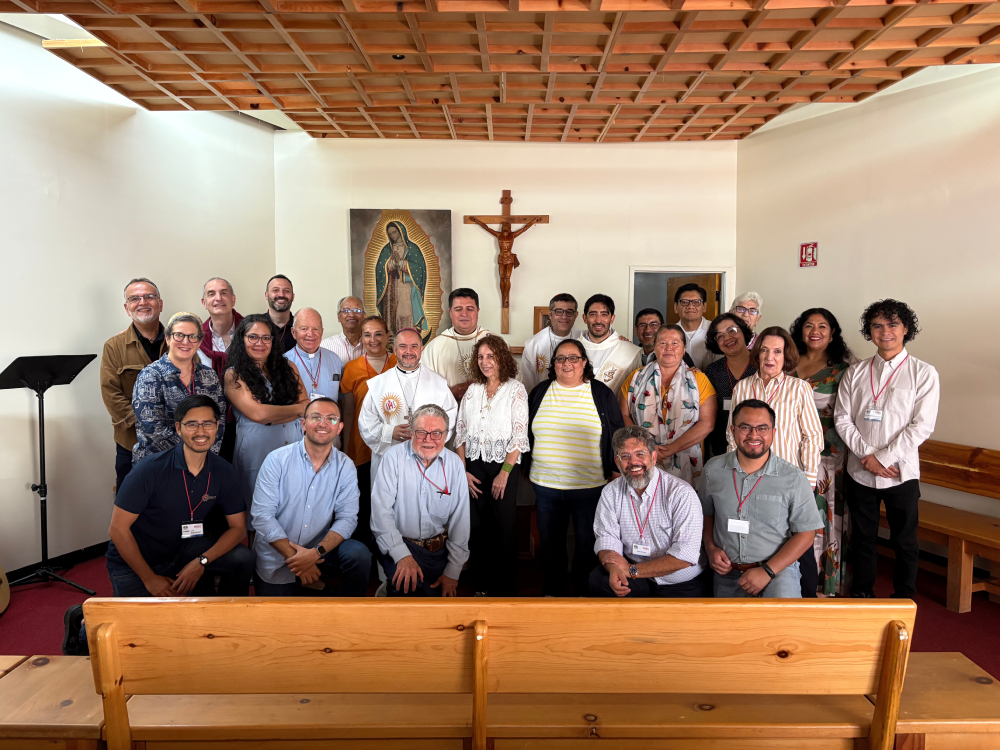
Salvadoran-American Auxiliary Bishop Evelio Menjívar-Ayala of Washington, D.C., presided over the closing mass at the Colloquium on Migration and Theology held at the Universidad Iberoamericana in the border town of Tijuana, Mexico. (Luis Donaldo González)
"Theologians can provide ethical frameworks necessary for understanding the complexities of migration," said Salvadoran-American minister Lía García, Hispanic ministry director of the Archdiocese of Baltimore. "Pastors and pastoral ministers are positioned to offer compassionate accompaniment and advocacy, and immigrants show us how to face this challenging situation."
"It is essential to learn from another, to develop shared perspectives and deepen friendships across borders in order to proclaim the Gospel credibly in the broader context of the Americas," said Dylan Corbett, Hope Border Institute executive director.
We planned this colloquium to place academia, pastoral ministry and the vulnerabilities of the human heart at the same table — as equals. By doing so, we were able to connect with the social reality of migration and illuminate that with the Gospel.
We were looking to find a way "to bring society a different understanding of migrant people," as suggested by border Bishop Eugenio Lira Rugarcía of Matamoros-Reynosa, head of the Mexico Bishops' Conference Human Mobility Ministry. "Migrants are not only people in need, they are generators of culture, spirituality, and contributors to economic and social growth."
One of the crucial steps to achieving this holistic understanding of migrants and changing the negative narrative is to educate societies in Christian hospitality — which goes beyond a mere recommendation. Our Christian communities and parishes, schools, colleges and universities, and Catholic seminaries should be starting points to reflect and form a culture of welcoming. It is easy to say we recognize Jesus Christ in the migrants; however, sometimes it is hard to avoid influence by the official narratives that criminalize them. If we educate society on Christian hospitality, there will be room for migrants to flourish.
Advertisement
Catholic theology does not advocate an open-border policy, but it does advocate for solidarity and subsidiarity. The Catholic Church stands with the right to remain at home. However, our social responsibility to care for the poor and suffering is as significant as the situations that force people to emigrate. Beyond the nation state's right to sovereignty, it is the human right to live with dignity — sí, the dignity of every single human being, regardless of the lands they or we come from. Borders are important, but not absolute.
"Borders delimit territories but also raise ethical responsibilities," said Mexican theologian Luz Elena Arozqueta.
Standing with the most vulnerable people is a duty for Catholics — that is why Pope Leo XIV wrote his first apostolic exhortation, Dilexi Te, on love for the poor. Sí, again, poor migrants are among the most vulnerable because they are rejected and persecuted today worldwide, especially in this country, where mass deportation is sowing terror and hate against foreigners, or people who look like one. Global migration is more than a security or economic affair; it is about humanity.
In the times we live in, here in the United States and in Mexico — my two home countries — I want to remind my fellow Christians, especially the Catholic ones, that how we respond to this humanitarian crisis will shape the future of humanity. As for my colleagues, scholars and ministers, let's continue building bridges between our countries and pastoral efforts to address global migration together. And to both of my presidents, we already have enough hatred and polarization in our countries and societies. Let's remember those words of Proverbs, "Those who oppress the poor revile their Maker."