(Unsplash/Aerps.com)

by Scott Hurd
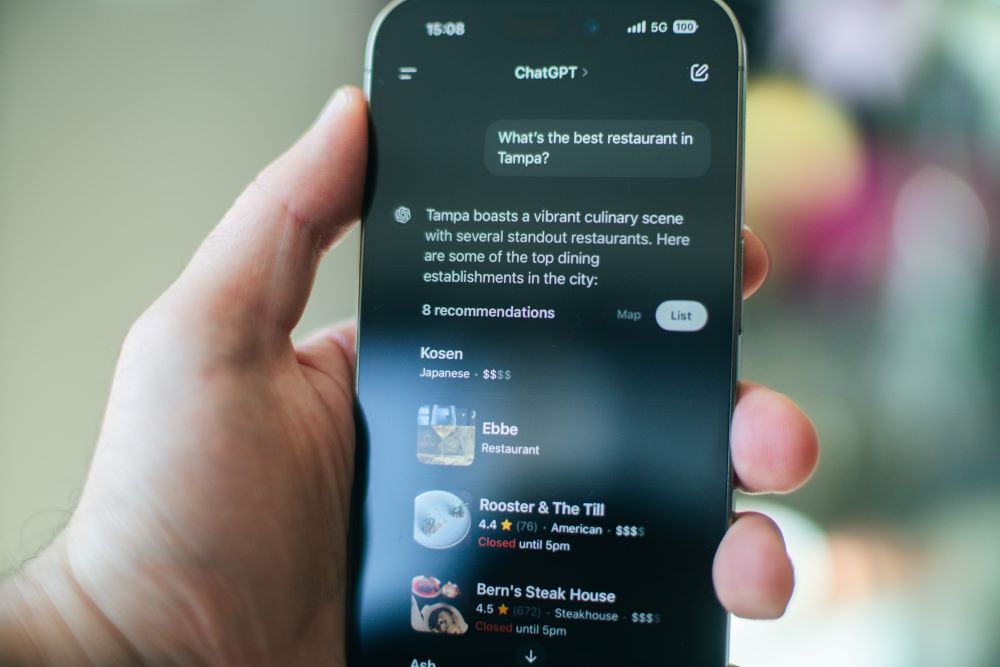
It's been three years this month since ChatGPT was foisted on a largely unsuspecting world. Since then, there's been no escaping the tsunami of AI-focused products and promotions.
It seems like artificial intelligence is everywhere and in everything, in vacuum cleaners and toothbrushes, children's plushies and sex toys. People are falling in love with chatbots and deferring to AI for critical decisions.
For better or for worse, I concede that AI is here to stay. We are, in the words of Pope Francis, witnessing an "epochal change." AI is a powerful expression of our God-given human creativity and, I am repeatedly assured, holds promising applications across a variety of disciplines. But I'm deeply concerned about how these technologies can go terribly wrong, and I have grave reservations about the oligarchs and organizations behind them. And I won't lie to you: The supercharged hype is driving me nuts.
At times I feel like the character in Dr. Seuss' Green Eggs and Ham who is hounded by the relentless Sam-I-Am. In fact, my frustration has prompted me to pen a little spoof on this children's classic that references another Sam who is omnipresent these days: OpenAI's Sam Altman, ChatGPT's breathless huckster.
I do not want AI, Sam-Alt-man!
Not in an app,
Not on my phone.
Not in the classroom
Or when I'm alone.
Not in smart glasses
Or chatting companions.
Not on a screen
Or in any machine.
Not at my work,
not in my play,
I don't want AI, Sam,
so please GO AWAY!
But AI is not going away, and the task before us now is to ensure these new technologies benefit humanity, and not diminish it. That's why I'm grateful that my frustrations and fears appear to be shared by Pope Leo XIV, who Time included in its AI 100 list of "the most influential people in artificial intelligence" while describing him as a "formidable — and unexpected — spiritual counterweight" to Silicon Valley's techno-optimists.
In an interview with Elise Ann Allen of Crux, Leo expressed concerns about AI's "worrisome" rapid development and fears that we're creating a "fake world" in which we lose sight of humanity's value and find it difficult to encounter God. He says the church needs to "speak up" so the "digital world" won't make us "pawns" or leave us "by the wayside."
AI is not going away, and the task before us now is to ensure these new technologies benefit humanity, and not diminish it.
Some might dismiss folks like Leo and me as out-of-touch aging doomers, hopelessly raging against the machine, wearily protesting an AI-dominated future that should be welcomed and accelerated. "Resistance is futile!" they might mock, pinching a trademark phrase from "Star Trek: the Next Generation" about the inevitability of assimilation into the Borg, an all-controlling techno-hivemind.
But futile or not, it's not just old guys offering resistance or, at least, eyeing AI with deep suspicion. Just 31% of Americans think companies will use AI responsibly, and a majority intend to put off using it as long as they can. Alongside this, AI disillusionment is growing: The more people use it, the less they trust it, and the more they learn about it, the less they want to use it.
Why? One reason, as Leo recently stressed, is that AI has created a "crisis" in which we mistake "the false for the true and the authentic for the artificial." He's well aware of AI-generated videos of him falling down stairs and making controversial pronouncements — all of them deceptive fabrications that, in his words, create a "post-truth" world which, he warns by quoting political philosopher Hannah Arendt, is a breeding ground for totalitarianism.
Leo has also repeatedly expressed concerns about AI's impact on work. It would be "a big problem," he said in his Crux interview, "if we automate the whole world" so that few people can enjoy "meaningful lives."
Today, job seekers submit AI-drafted resumes that are processed by prospective employers' AI filters to possibly be interviewed by AI avatars in hope of being hired somewhere that won't later replace them with AI (which AI promoters insist is inevitable).
Meanwhile, those with jobs feel compelled to adopt AI out of fear. Even if doing so leads to burnout and anxiety or, in the case of certain AI applications, seared consciences and moral injury.
AI also threatens education. "Everyone is cheating their way through college" announced an essay in New York magazine, while one high schooler complained in The Atlantic that "AI is demolishing my education." All of higher ed is depressed, I heard at an AI conference, as profs assume students write papers with AI while students suspect that profs use AI to grade them.
In addition, AI is disrupting psychology, journalism and the arts, triggering mental illness, flooding cyberspace with "slop," threatening privacy through surveillance, reinforcing biases and stereotypes, baking the planet with its data centers and, according to Archbishop John Wester of Santa Fe, increasing the risk of nuclear war when it's embedded in military systems, because "AI doesn't have a conscience."
So far, AI's greatest beneficiaries are tech oligarchs forming, in Leo's words from Dilexi Te, "a wealthy elite, living in a bubble of comfort and luxury, almost in another world compared to ordinary people." Many of them are building doomsday bunker compounds to protect themselves from those "ordinary people" should they come calling with torches and pitchforks if the AI bubble bursts and takes down the economy.

This is an undated AI-generated image of computers. (OSV News illustration/Pixabay)
Some tech oligarchs threaten democracy by accruing power for themselves to construct alternative social systems described as "technofeudalism" or even "techno-fascism." Leo is not unaware. "We must be vigilant," he insists, "that the information and algorithms that govern (today's technology) are not in the hands of a few."
To be fair, not all tech titans operate from the same playbook. Some voices call for guardrails, while Palantir's Peter Thiel — PayPal co-founder with Elon Musk and mentor to Altman, Meta's Mark Zuckerberg and Catholic Vice President JD Vance — insists that those who wish to regulate AI are "legionnaires of the Antichrist."
If Thiel is right, this would "out" Francis, Leo, me and plenty of others as Satan's Henchmen for Responsible AI, which is a laughably crazy assertion if it weren't made by one with so much money and influence.
Advertisement
Given all this, I'm often deeply distressed by AI's threats. And that's when I need to remember that, as a church, we're still celebrating a Jubilee Year of Hope. Because I need to hold fast to the anchor of hope when I'm unsettled about AI.
In his bull proclaiming the Jubilee, Francis acknowledged that "uncertainty about the future" can trigger apprehensiveness, anxiety and doubt, creating "people who are discouraged, pessimistic, and cynical." That's how I can feel about an AI-filled future. When I do, I'm buoyed by Francis' invitation in that bull to "discover hope in the signs of the times that the Lord gives us."
One sign that gives me a great deal of hope, three years into the ChatGPT era, is Leo's leadership on AI. In referencing positive applications in medicine and scientific discovery, Leo is clear that he's "not at all against artificial intelligence." And neither am I. I've been pleased to help pilot AI tools connecting hurting people to helpful services — and the human beings that provide them.
Yet Leo voices concerns that echo mine, and I'm encouraged that, as the chief shepherd of 1.4 billion Catholics, he seeks to guide AI's development so that it upholds human dignity, promotes a just distribution of wealth, uplifts the marginalized, and fosters genuine human communion instead of conflict.
Is it possible? That, as we conclude this Jubilee, is my most sincere and fervent hope.