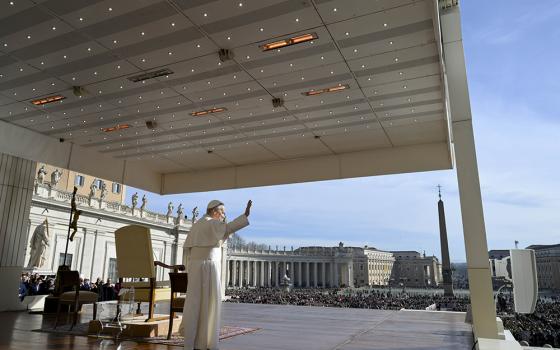
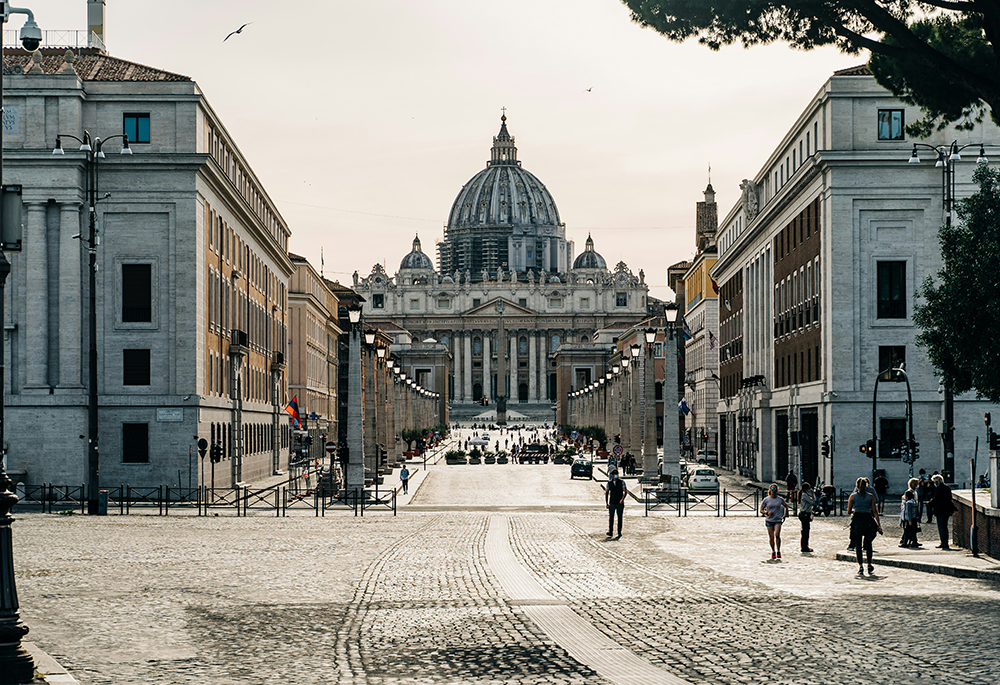
A view shows St Peter's Basilica and St Peter's Square, in Vatican City. (Unsplash/Gabriella Clare Marino)

by Renée Roden
A lewd joke shared in the deluge of the Epstein files summarizes Jeffrey Epstein's fascination with religious power.
The joke's set up: "four Catholic men and a Catholic woman" are sitting around bragging about their children. The first man starts: "My son is a priest, when he walks into a room, everyone calls him 'Father.' " The second man one-ups him: his son is a bishop and people address him as "Your Grace." Next, of course, comes the son who is a cardinal, called, "Your Eminence," and the last man's son is the pope. When he walks into a room people call him "Your Holiness."
Then, of course, it is the woman's turn. How can she possibly top that? "I have a daughter," she says, proudly, and then she recites the physical measurements of her daughter in the language no mother would ever use — the language of the pornified male gaze, of the connoisseur of buying female bodies. And when she walks into the room people say, "Oh My God."
This joke is a crass and jejune mass-emailed joke, one of many clogging up servers all over the world with the unfunny frat-bro id of powerful men. But what makes it worth examining is the logic of religious power in Epstein's imagination. Religious power is an unassailable authority that commands respect. Yet all that power falls limp — a drooling, bug-eyed teenager — in the face of sexual drive. Sex, in Epstein's imagination, is the ultimate power; the desire to possess another human's body is "my God."
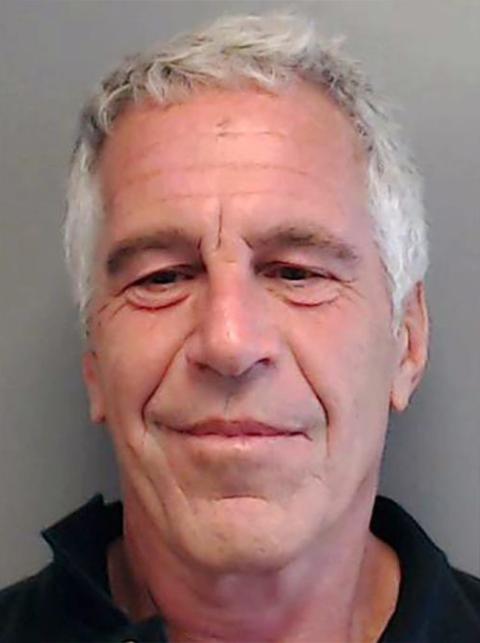
2013 mug shot of Jeffrey Epstein (Wikimedia Commons/State of Florida, public domain)
In the deluge that is the Epstein files, journalists have found threads of the divine. Reporters like Claire Giangravé at Religion News Service have found mentions of the Vatican and the church, including indications the convicted sex offender Jeffrey Epstein was in conversations with Steve Bannon, discussing ways to undermine Pope Francis.
Epstein seemed fascinated by religious power, particularly the pope. "You're probably smart enough to get out of town when the pope is here," Epstein's brother Mark told him when Pope Francis visited Manhattan in September 2015. And Epstein did leave town, but followed the news stories around the visit. Epstein's former piano tuner told Business Insider that there was a portrait of Epstein and a pope (the piano tuner wasn't sure which one) in his "music pavilion" on Epstein's private island.
"Well Jeffrey after this week you could run for Pope and win," someone told Epstein in an email in 2011. And Epstein, the files reveal, was the dark pope of a realm that infected seemingly most spheres of influence in our world.
Although no priests have been found on the Epstein files list, his dark magisterium of sex and power have their own mirror in the Catholic Church's chronic clergy sex abuse crisis. On Feb. 6, the Guardian reported that Mark Francis Ford, a former priest in the Diocese of New Orleans, was indicted on sex abuse charges for raping a disabled boy. In 2024, Daniel Balizan, former priest of the Archdiocese of Santa Fe, took his own life before a hearing in a child sex abuse case. The 61-year-old Balizan was accused of coercing and enticing an underage child into sexual acts via text messages between 2012 and 2022. In 2023, the 30-year-old priest Alexander Crow absconded to Italy with an 18-year-old woman who had just graduated from the Catholic high school in the Archdiocese of Mobile, where he gave pastoral ministry to students. In 2022, Robert McWilliams, who had not even been a priest for five years in the Diocese of Cleveland, died by what was believed to be suicide in federal custody, where he was serving a life sentence for child sex trafficking, child pornography and sexual exploitation of children.
Is this not a church Epstein recognizes? This is the religion as Epstein would understand it: transcendence above the plebeian lot of subservience and manual labor through a slow accumulation of money, privilege and worldly power. No matter how much power one accumulates, one can never overcome the dark god of domination — sexual desire not as an avenue of communion with a "thou" but of consumption of the other.
No matter how much power one accumulates, one can never overcome the dark god of domination — sexual desire not as an avenue of communion with a "thou" but of consumption of the other.
So, imagine this scene. On the surface, it seems like a scene Epstein would understand: in an underground room, 60 years ago, a group of bishops gathered on a November night on the outskirts of Rome. The children of all those bragging Catholic parents in his joke. In low lighting, in the catacombs outside the city of Rome, these bishops sign a common pact. So far, Epstein would think this is just another cabana on his island.
But what the bishops were signing on Nov. 16, 1965 — now this would be news to Epstein. Several dozen bishops gathered together at the ending of the Second Vatican Council to celebrate a Mass in the chapel of the Domitilla Catacombs on the Via Appia and to sign the Pact of the Catacombs. Together, they vowed to be a "poor servant church."
The project was the brainchild of Dom Hélder Câmara, the Brazilian archbishop of Olinda and Recife, who is perhaps most famous in the U.S. church for the often-misattributed quote, "If I give bread to the poor, everyone calls me a saint. If I show why the poor have no bread, they call me a communist and a subversive."
Advertisement
In their 11-point pact, these bishops vowed to renounce the "appearance and the reality of wealth," private real estate, courting the favor of the rich in order to earn donations, and the ecclesial titles Eminence, Excellency and Monsignor "which signify prestige and power." Instead, they committed themselves to the "workers and the economically weak and underdeveloped."
"How I would like a church that is poor and for the poor," Pope Francis said in March 2013, during the first week of his pontificate. Francis' call reawakened the echoes of the Domitilla Catacombs, the bishops who prophetically renounced power and privilege. Francis' papacy drank from the same well of tradition of the Pact of the Catacombs. Over the course of a dozen years, Francis preached the Gospel to the poor, to the marginalized — the migrants in Lampedusa, the Catholics in Iraq, the exploited Amazonians. And he consistently reminded the wealthy West that the real power of the Gospel — the true path of transcendence that Christ calls us to — is the ability to give away everything and follow Jesus. We can divest ourselves from the exploitation and domination of technocratic capitalism and create something better. "No to an economy of exclusion … no to the new idolatry of money," Francis wrote in his 2013 exhortation Evangelii Gaudium ("Joy of the Gospel"). "Such an economy kills."
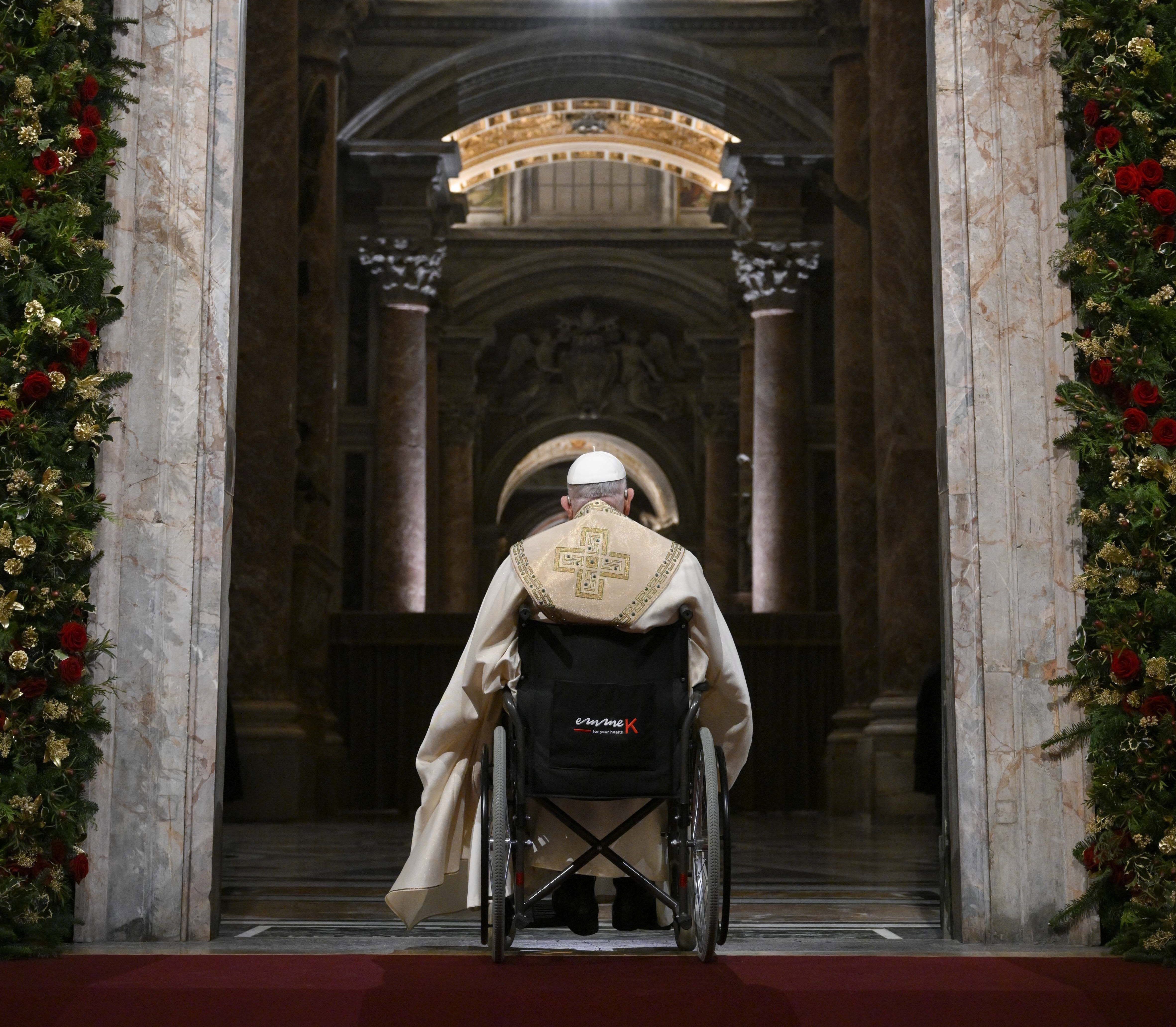
Pope Francis, after knocking on the Holy Door of St. Peter's Basilica in the Vatican on Dec. 24, 2024, waits for his aides to open it as he inaugurates the Holy Year 2025. (CNS/Vatican Media)
"The Pope loves everyone, rich and poor alike, but he is obliged in the name of Christ to remind all that the rich must help, respect and promote the poor," Francis wrote. Francis preached against the "spiritual worldliness," self-centered appetites and seeking after vain accolades that Epstein embodied. He reminded the church that the cure for this sickness was "by making the Church constantly go out from herself, keeping her mission focused on Jesus Christ, and her commitment to the poor."
Francis reminded us that in order for the church to be a field hospital to a world suffering from Epstein's sickness, the church has to be bold, has to be the shepherd leaving the 99 to go search for the lost one.
In the United States, today, the lost sheep, the poor to whom the Good News of the Gospel is addressed, the person the rich and privileged are required to commit themselves to, are the homeless person at risk of being imprisoned, the undocumented neighbor terrified to leave their home to get groceries or take their children to school and the unnamed migrant languishing in an ICE detention facility.
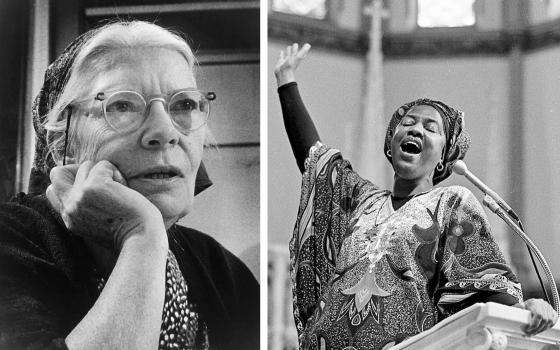
The Catholic Church, as Servant of God Dorothy Day observed, is the church of the poor. The majority of immigrants vulnerable to deportation are Catholic — 61% according to a 2025 joint report from World Relief, the U.S. bishops, the Center for the Study of Global Christianity, and the National Association of Evangelicals. Across the country, Catholic laity are organizing to protect their fellow parishioners, neighbors, caring for the basic needs of strangers, housing the vulnerable and marching for their rights. But the poor church that Francis dreamed of will not be complete until the hierarchy in the United States commits itself to the same pact that the council fathers gathered in the Domitilla Catacombs signed: to be a church that is willing to incur the scorn of state power, is willing to lose the favor — and checks — of well-heeled donors, that is willing to challenge the comfortable and wealthy for the sake of the poor.