(Unsplash/Zbynek Burival)

by Michael Wright
The IRS recently decided to allow houses of worship to endorse political candidates. Almost 300 people are dead or missing after flash flooding in Texas. More than half the nation has been under heat advisories this summer, which has become normal. These recent events might not seem related, but are in fact linked since elected officials decide how climate change is (or is not) addressed through policies and funding. And that, in turn, has long-term impacts on the future of the climate and thus on life itself.
The new IRS allowance states that houses of worship may speak to their congregations "concerning electoral politics viewed through the lens of religious faith." In effect, this allows faith communities to endorse candidates without fear of losing their tax-exempt status. Given there are more than 50 million U.S. Catholics, the church's "bully pulpit" could now have an even greater influence on election outcomes than in the past.
Unfortunately, the church's assessment of candidates is based primarily on their positions regarding what the bishops' have deemed the "pre-eminent priority" issue of abortion. Case in point, its opposition to President Joe Biden for his support of reproductive rights, while turning a blind eye to President Donald Trump's abuse of women, attacks on immigrant families and felony conviction for influencing the 2016 election through porn-star hush money. I've heard elections-year homilies — some using veiled references and others explicit — saying to vote for a democrat who supports reproductive rights is a grave sin.
This position, however, is based on only a single moral issue — an approach that, ironically, the U.S. bishops' conference itself counsels against. Because of this, church leaders have implicitly endorsed candidates who favor capital punishment, oppose bans on assault weapons, gut life-saving health and environmental regulations, and support tax breaks for the wealthy at the expense of the poor.
Advertisement
The existential threat of climate change, which has killed millions from drought, flooding, famine and disease, is not considered a preeminent issue by the U.S. Catholic Church. As a result, most U.S. Catholics are unfamiliar with Pope Francis' encyclical Laudato Si' and church teaching regarding the environment.
As a Catholic voter, I consider myself pro-life in the fullest sense: I vote pro-life when it comes to caring for God's creation that sustains all life. When our environment is harmed, including through climate-changing greenhouse gas emissions, it primarily impacts the poor and vulnerable — those who contribute least to the problem.
Due in part to the church's myopic endorsements, Trump and the GOP won control of all branches of government. Most of the policies enacted in the first six months of this term will have drastic and long-lasting impacts, both here and abroad.
One only need look at the numbers:
- The recently passed GOP bill eliminates $500 billion for Medicare and $1 trillion for Medicaid, while increasing the Defense Department budget to more than $1 trillion and making permanent tax cuts that mostly benefit the rich;
- The abolishment of USAID will likely lead to an estimated 14 million preventable deaths over the next five years, including more than four million children under five;
- Nearly 12 million people may lose their health insurance, according to the Congressional Budget Office;
- Millions more people are at risk of losing food assistance;
- Hundreds of people have died and thousands of acres have been destroyed from flooding and wildfires in the past month alone, due not only to cuts in weather forecasting and warning, but also to climate change — something Trump and the GOP have dismissed as a "hoax" and a "scam."
Any of these should be enough to outrage someone who is compassionate toward the least of us, but the latter may be the most serious. Indeed, if climate change driven by carbon emissions were the only threat to human life imposed by Trump and his followers, that would be tragic enough. Unfortunately, there's more:
- Subsidies for renewable energy have been cut, while those for fossil fuels are increasing, meaning more heat-trapping emissions at a time when they must be drastically reduced to avoid irreversible climate change;
- Trump withdrew the U.S., again, from the Paris Agreement on climate change, which abrogates our international commitments to reduce emissions;
- Billions of dollars have been poured into AI infrastructure that is rapidly increasing its carbon footprint, something even the bishops have decried;
- Fossil fuel lobbyists have been appointed to the Environmental Projection Agency, while expert scientists have been laid off;
- Electric vehicle tax credits, which are driving innovation and emissions reductions, have been eliminated;
- References to climate change itself have been removed from federal government websites, further impeding climate awareness and thus action;
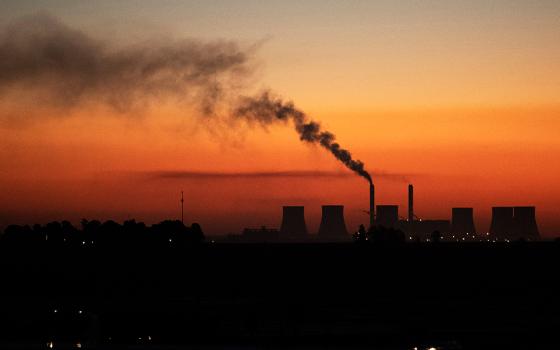
- The EPA recently proposed repealing rules limiting pollution, including greenhouse gas emissions, from power plants;
- Grants have been cut for climate change research and forecasting that is critical to better understand mitigations, responses and adaptations;
- The administration rejected the recent ruling by the International Court of Justice, which concluded that nations that do not reduce emissions and alleviate climate change will be liable for damages incurred by vulnerable nations.
These and other anti-climate policies of the Trump Administration mean that the climate-saving momentum coming out of the Inflation Reduction Act is lost. Given that we are decades behind where we should be in reducing emissions, it is difficult to conceive of being able to avoid a climate tipping point.
All of this incriminates Trump and the GOP when it comes to climate-induced tragedies like the one in Texas, as well as future disasters that could be alleviated if climate action is advanced rather than reversed. Moreover, climate change will — not may — result in millions more deaths by the end of this century, making the tragedies of this past month seem incidental. Therefore, policies that exacerbate climate change are in essence facilitating a culture of death, and can even be considered crimes against humanity.
It follows that supporting candidates or elected officials who oppose climate action and thus, by extension, do not protect God's creation that supports life can be considered a sin of commission. Conversely, the church's relative silence when it comes to climate change and policies that exacerbate it can be interpreted as a sin of omission. Indeed, if one fully understands the implications of climate change, and its impacts to human and other life, there is no other way to look at it.
Consistent with this argument is the recent message from the global south bishops, "A Call for Climate Justice and the Common Home." In this timely and compelling document, the bishops "demand" ecological equity and justice, an end to a fossil fuel-based economy, and protection of those most affected by climate change. This is a message that the U.S. Catholic Church must act upon if we, as a society and a community of faith, are to defend life, care for creation and protect the unborn and born alike.
The new IRS decision is just one more example of how Church and State are becoming less separated under the GOP-controlled government. Given the death and destruction from climate-induced disasters, it's time for the U.S. Catholic Church to make climate change its "preeminent priority," denounce politicians who dismiss climate change and oppose solutions, and endorse those who take climate change seriously.
Michael Wright is a freelance writer on the environment and faith, and a licensed social worker in Pennsylvania. His articles have appeared in national publications, including Liguorian and U.S. Catholic magazines, and National Catholic Reporter. He is author of “Catholic Update: Pope Francis and the Environment,” and the booklet “10 Things Pope Francis Wants You to Know About the Environment,” both from Liguori Publications. He has also served as editor of Catholic Climate Covenant's online resource Homily Helps.