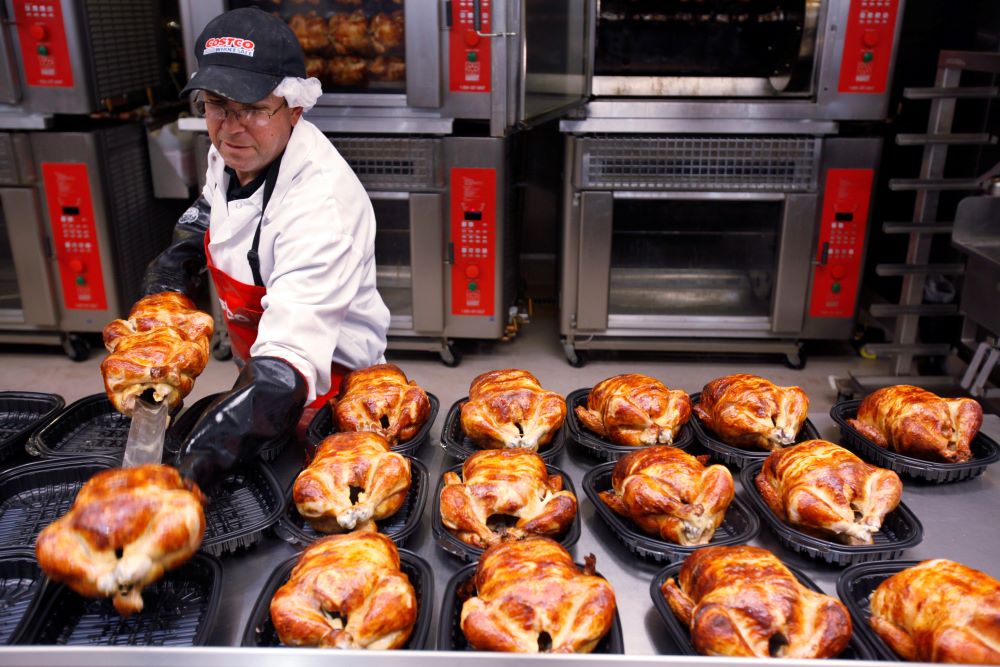
A Costco employee cooks chicken at Costco in Mountain View, Calif., March 3, 2010. The company has sold its rotisserie chicken for $4.99 since 2009. (AP/Paul Sakuma, file)

by David Drury
I was navigating my way through the megagrocery labyrinth Costco recently when I was struck by the visual of how different we shoppers were from one another, indicated by age, dress, hairstyle, even T-shirt messaging. And we clearly were shopping from different lists; no two carts resembled the other.
There was a traffic jam at the long display counter at the back of the store, where a crowd had gathered, waiting. In spite of our dissimilarities, we shared a common anticipation. Sure enough, the bell rang and here they came: fire-roasted rotisserie chickens passing from the hands of Costco staff through the warming tray and into our own. Enough for everyone and plenty more.
Costco's $4.99 chickens have become a cultural icon, not because they are extraordinary but because they are so ordinary: cooked on site, bagged and delivered to the multitudes. The price has remained the same since 2009, in spite of inflation that should have doubled it. In online discourse, Costco chickens are treated with humor and affection, described by some as an "act of love" in an era of rising food insecurity. The company built their own massive chicken processing plant in Nebraska, which saves them tens of millions in costs, but it's not nearly enough: The chickens cost the retailer tens of millions of dollars every year. Still, they keep the chickens coming. They don't give a cluck.
There is a business strategy here, which is that the chickens are what's called a "loss-leader." Costco sells them at a loss for the trade-off they get: Cheap chicken draws people into the store, where they tend to shop for other things. No one leaves Costco with only a rotisserie chicken. Believe me, I've tried.
Costco's $4.99 rotisserie chickens have become a small but telling sign of what we long for: grace that shows up wherever our weary eyes can manage to look.
And yet, standing there with strangers, bonded in the waves of heat coming off the ovens, the smell of seasonings in the air, it was hard to shake the feeling that something else was happening. People seemed to feel cared for. In the coming together, the receiving, the going away changed, the appreciation of the sacrifices involved and the anticipation of shared tables, there was a sense that the chickens mattered because they were going to end up on real tables, in real kitchens. It says less about Costco's business strategy and more about our collective hunger for connection. Grace is communal. It happens where people eat together, depend on one another, and are fed.
Christian theology has a name for the way of seeing the world in which the sacred does not arrive dressed as spectacle: eucharistic imagination.
A table full of people, for example, are unlikely to applaud when bread is served, and yet it is the primary biblical metaphor for the way God shows up on behalf of humanity. Ordinary elements (bread, wine, rotisserie chickens) are the kinds of vehicles grace prefers, if we can choose to see it. When Jesus fed Gospel crowds, the miracle was never about a magic show or culinary flair. It was about sufficiency. The people were fed, not necessarily impressed.
Costco chickens are not optimized for prestige, but meant to end up on ordinary tables, pulled apart by hand, stretched across multiple meals. Shared. This does not make Costco a church, neither does it redeem capitalism. Costco is still a corporation, and the story of the chickens includes uncomfortable realities like industrial farming, labor concerns and animal welfare critiques. Eucharistic imagination does not deny these tensions; it holds them honestly.
Advertisement
Still, Costco's willingness to eat margin echoes a logic people recognize instinctively as care. That recognition matters, because we live in a time when economic life often feels isolating and adversarial. Politics has turned tables into battlefields. Institutions feel untrustworthy. Food insecurity spreads. Families and relationships are strained. At this moment, where can we turn?
Five-dollar chickens, for starters. Not because they are magical, but because they signal something increasingly rare: that someone, somewhere, chose giving over taking, sufficiency over maximizing. That someone decided not to charge what the market would bear.
Eucharistic imagination listens before it declares. It pays attention to where meaning is already emerging. It looks for God in the ordinary. Grace is not always abstract; it happens where people eat.
The kingdom of heaven, Jesus said, arrives quietly, like yeast in dough, like bread passed from one hand to another. Where there is enough for all of us, grace has arrived. Likewise, this everyday food item has come to function symbolically as shared bread offered at a cost, meant to be eaten together, not optimized for profit or prestige.
Costco's $4.99 rotisserie chickens have become a small but telling sign of what we long for: grace that shows up wherever our weary eyes can manage to look.