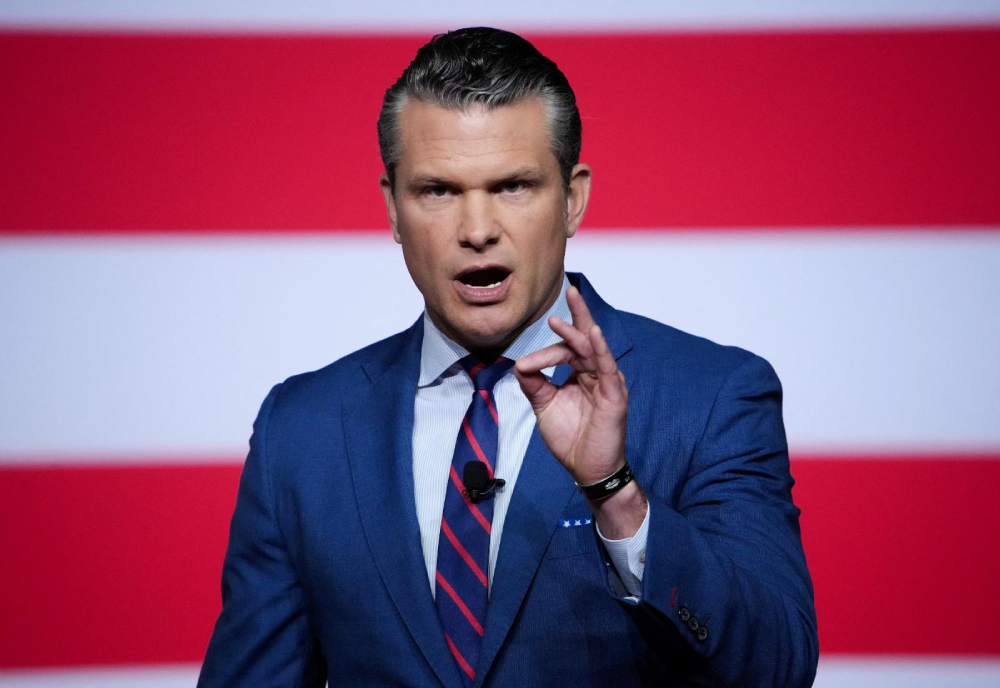
U.S. Secretary of Defense Pete Hegseth speaks to senior military leaders at Marine Corps Base Quantico in Virginia Sept. 30, 2025. In an unprecedented gathering, almost 800 generals, admirals and their senior enlisted leaders have been ordered into one location from around the world on short notice. (OSV News/Reuters/Andrew Harnik, pool)

by Tobias Winright
"The order was to kill everybody." This order, reportedly given by U.S. Defense Secretary Pete Hegseth, contrasts starkly with what I was taught decades ago when I was in the Army Reserve Officers' Training Corps, or ROTC, and when I was a law enforcement officer in both corrections and policing.
That order, moreover, is incongruent with the U.S. Catholic bishops' teaching, in their 1983 pastoral letter on war and peace, "The Challenge of Peace: God's Promise and Our Response," that "the possibility of taking even one human life is a prospect we should consider in fear and trembling."
After all, according to the bishops, each and every human person is the "reflection of God's presence in the world," which is why human dignity is at "the center of the Church's teaching" on peace and war. Indeed, respect for the inherent dignity of the human person informs church teaching on other uses of deadly force, including the death penalty. "Not even a murderer loses his personal dignity, and God himself pledges to guarantee this," wrote Pope St. John Paul II in his 1995 encyclical, Evangelium Vitae ("The Gospel of Life").
For approximately 30 years, I have studied and taught the ethics of the use of force to prison guards and police officers, as well as just war theory, upon which the laws of war are anchored, to ROTC students, other undergraduate and graduate students, and to parishioners. It is clear to me that Hegseth's no-holds-barred, take-no-prisoners, might-makes-right approach to the use of armed force is both unethical and unlawful.
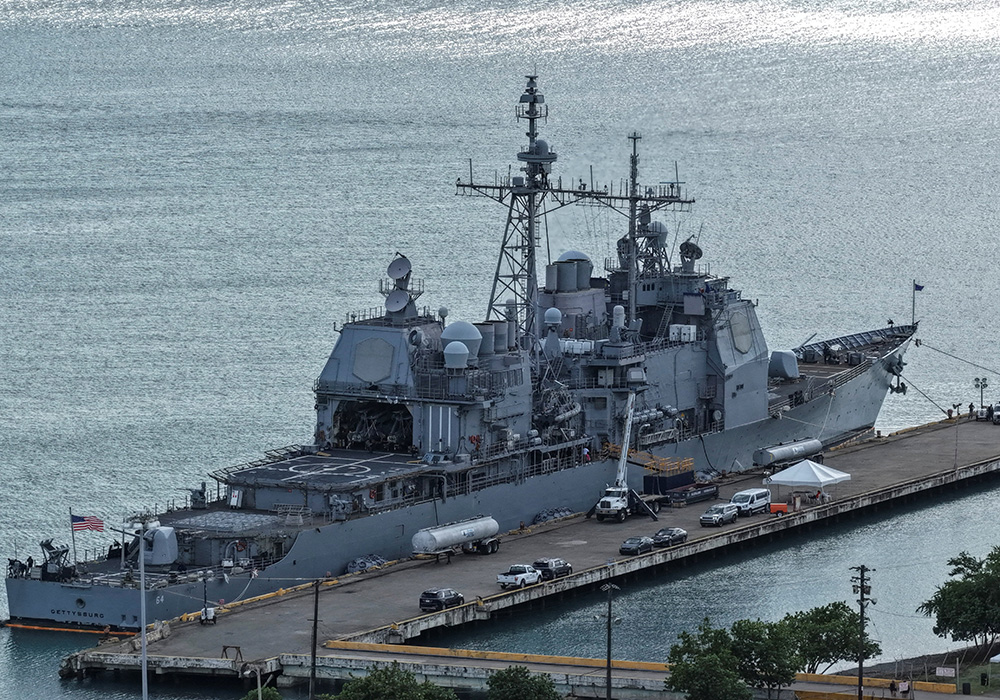
A drone view shows the U.S. Navy guided-missile cruiser USS Gettysburg (CG-64) docked at the port of Ponce, Puerto Rico, Nov. 4, 2025. Amid multiple crises in the Caribbean — including hurricanes, humanitarian crises, unrest and U.S. strikes on Venezuelan vessels — Caribbean bishops have issued calls for calm, unity and peace. (OSV News/Reuters/Ricardo Arduengo)
The Washington Post reported Nov. 28 that Hegseth gave the spoken order on Sept. 2, "according to two people with direct knowledge of the operation." The U.S. military, led by the elite SEAL Team 6, targeted and destroyed a boat suspected of ferrying drugs in the Caribbean Sea, killing 9 persons on board. According to the Post, when two survivors were seen clinging to the burning vessel, Adm. Frank Bradley, "the Special Operations commander overseeing the Sept. 2 attack … ordered a second strike to comply with Hegseth's instructions, two people familiar with the matter said. The two men were blown apart in the water."
The Post reported that on Nov. 30 President Donald Trump said Hegseth denied giving the spoken directive to kill everyone on board and Trump believed him. According to The Hill, White House press secretary Karoline Leavitt later confirmed that Hegseth authorized the strikes on the boat, "while saying it was Adm. Frank Bradley who specifically ordered a second strike that killed survivors."
The Associated Press and other media reported Dec. 4 that Bradley, speaking to lawmakers, said there was no "kill them all" order given by Hegseth.
Trump previously claimed at the U.N. General Assembly in New York City on Sept. 23 that he is "using the supreme power of the United States military to destroy Venezuelan terrorists and trafficking networks led by [Venezuela President] Nicolás Maduro."
Echoing this narrative, Hegseth posted on X: "We will track them, kill them and dismantle their networks throughout our hemisphere." His reported order to "kill everyone" reflects the "warrior ethos" he enjoined to the approximately 800 generals and admirals called from around the world to gather in Quantico, Virginia: "We fight to win. We unleash overwhelming and punishing violence on the enemy. We don't fight with stupid rules of engagement. We untie the hands of our warfighters to intimidate, demoralize, hunt and kill the enemies of our country."
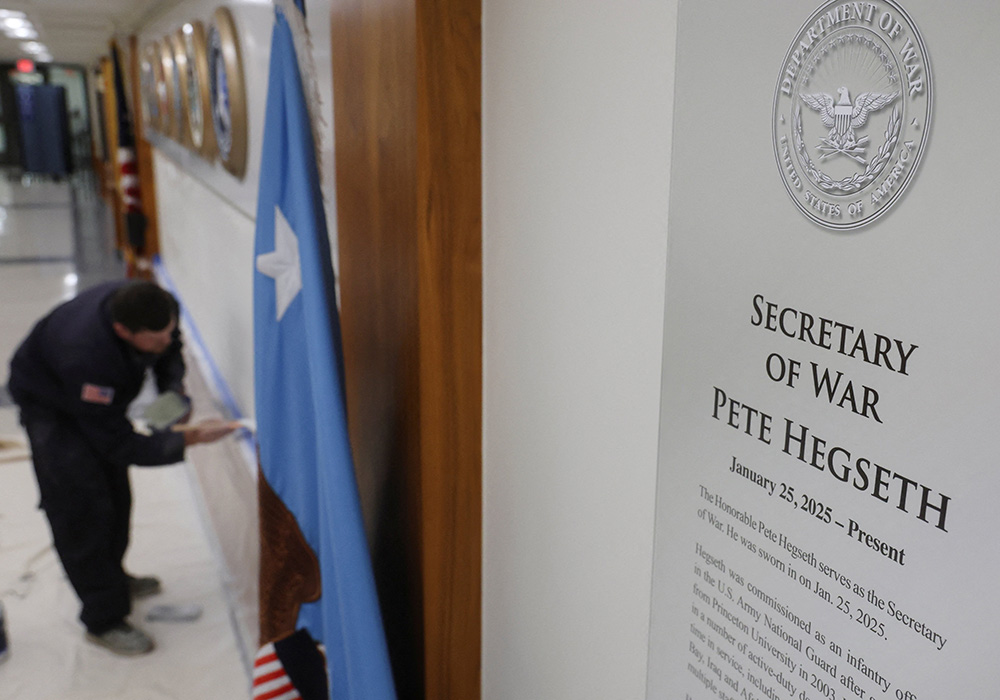
A sign that reads "Pete Hegseth - Secretary of War" hangs as a worker prepares a wall for new signs after U.S. President Donald Trump ordered the Department of Defense to be renamed as the "Department of War," at the Pentagon in Arlington, Virginia, Sept. 5, 2025. (OSV News/Reuters/Jonathan Ernst)
Let me focus here, as a moral theologian, on the ethics of the use of lethal force on these boats; for the legal considerations on the rules of engagement in international law, including the Geneva Conventions, and in the U.S.'s own Law of War Manual, I recommend these two recent pieces published by Just Security.
From a moral standpoint, one problem at the outset is the administration's invocation of "war" and related words like "enemy" and "invasion." To be sure, in the 1970s and 1980s, there was the "war on drugs," and after 9/11 there was the "war on terrorism." This use of the "war" metaphor can be dangerous, because, as James F. Childress cautions, it colors "how we think, what we experience, and what we do," and it "often fails to recognize the moral constraints on waging war." To invoke, without qualification, the language of "war" opens the door for unnecessary, excessive, and indiscriminate force — exactly what Hegseth's "warrior ethos" promotes.
Instead, Msgr. Stuart Swetland rightly noted that intercepting these boats "should be treated like a police action – which means that we don't preemptively kill people; rather, we attempt to arrest people and to give them proper trials and procedures." Otherwise, killing these suspects is morally equivalent to extrajudicial, or summary, execution, as some human rights experts at the U.N. have alleged.
For example, the Coast Guard, in a law enforcement capacity, typically intercepts, warns (sometimes with warning shots or disabling shots — but never directly firing on the crew or destroying the boat), and boards such vessels suspected of smuggling drugs. If illegal drugs are found, then the boat's crew is taken into custody.
Advertisement
Because Article I of the Constitution grants Congress the responsibility to declare war, Trump has invoked Article II authorizing the commander in chief to undertake military actions short of war. Such armed force fits somewhere between policing and warfare.
Christian Nikolaus Braun, director of the Institute for Theology and Peace in Hamburg, Germany, calls it "limited force," which includes targeted killings, drone strikes, cruise missile strikes, no-fly zone enforcement, and special forces operations. For criteria to limit such armed force, he suggests jus ad vim (justice for the use of force), which can be traced back to the Roman statesman and philosopher Cicero (106-43 BCE) and contributed to the just war tradition. Still, Braun concludes that limited force, or vis, raises "moral problems that need to be addressed, but such thinking can unfold within the inherited just war framework." I agree. Morally, the use of force — military or otherwise — requires criteria for both its justification and its implementation.
The Catechism of the Catholic Church refers to the "strict conditions for legitimate defense by military force," which it notes are "the traditional elements enumerated in what is called the ‘just war' doctrine." Among these are legitimate authority, just cause, last resort, the probability of success, noncombatant immunity, and proportionality. The catechism adds that the prudential evaluation of these criteria "require rigorous consideration."
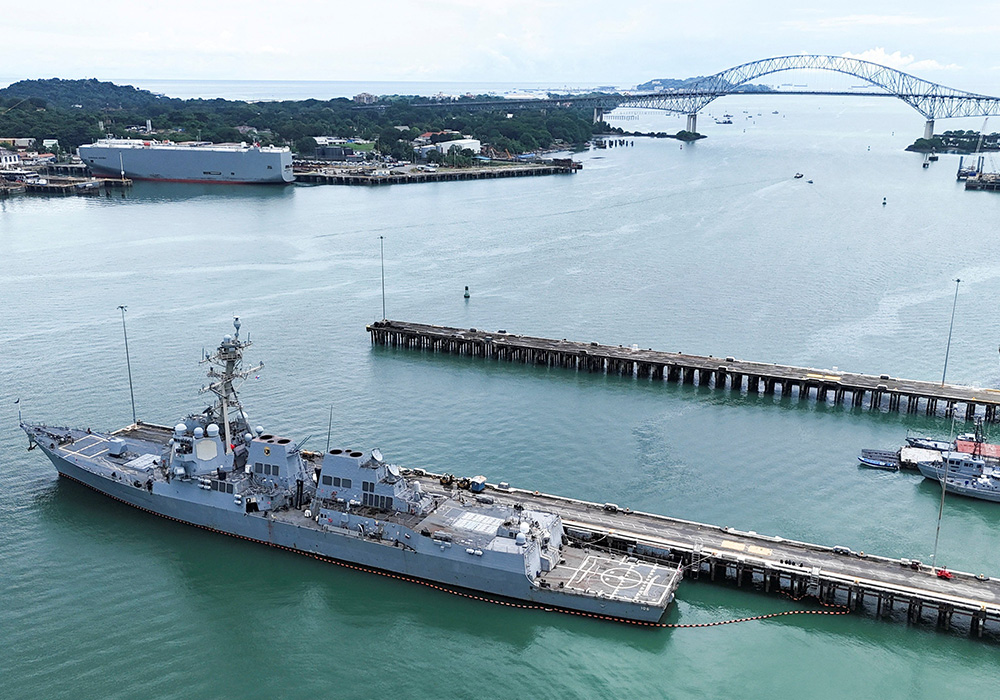
Navy guided missile destroyer USS Stockdale DDG-106 docks at the Frigate Captain Noel Antonio Rodriguez Justavino Naval Base near the entrance to the Panama Canal, in Panama City, Sept. 21, 2025. The United States struck another small boat accused of carrying drugs in the waters off Venezuela, killing six people, President Donald Trump said Oct. 15. (OSV News/Reuters/Enea Lebrun)
Several Catholic ethicists and scholars — including Matthew Shadle, David Cochran and Swetland— appraise the military strikes on the alleged drug-transporting boats as violating these principles. For his part, Cochran thought that drug smuggling did not count as just cause to use military force on the boats or as a basis to go to war against Venezuela. According to OSV News, "Cochran also noted drug smugglers are not armed combatants in the traditional sense."
Against people suspected of committing a crime, Cochran said, "it's not permitted to use military force to summarily execute them." Plus, with regard to the criterion of the likelihood of success, in Cochran's estimation, "You can blow up lots and lots and lots of boats and kill lots and lots and lots of people — and it's almost certainly not going to stop the drug problem in the United States."
And, as Pope Leo XIV has said, the U.S. still has "another way" to address drug-trafficking in Venezuela, which means that the criterion of last resort has not been satisfied.
One of my teachers, a pacifist who respected those who rigorously adhered to just-war principles, identified another approach to war. He called it the "Rambo" position, which esteems masculinity and approves of excessive violence — in which "neither other parties in the conflict nor any principles above the fray have any moral standing" — as proof of virility. This "warrior ethos" that Hegseth is promoting is diametrically opposed to the just warrior that the Christian moral tradition expects.