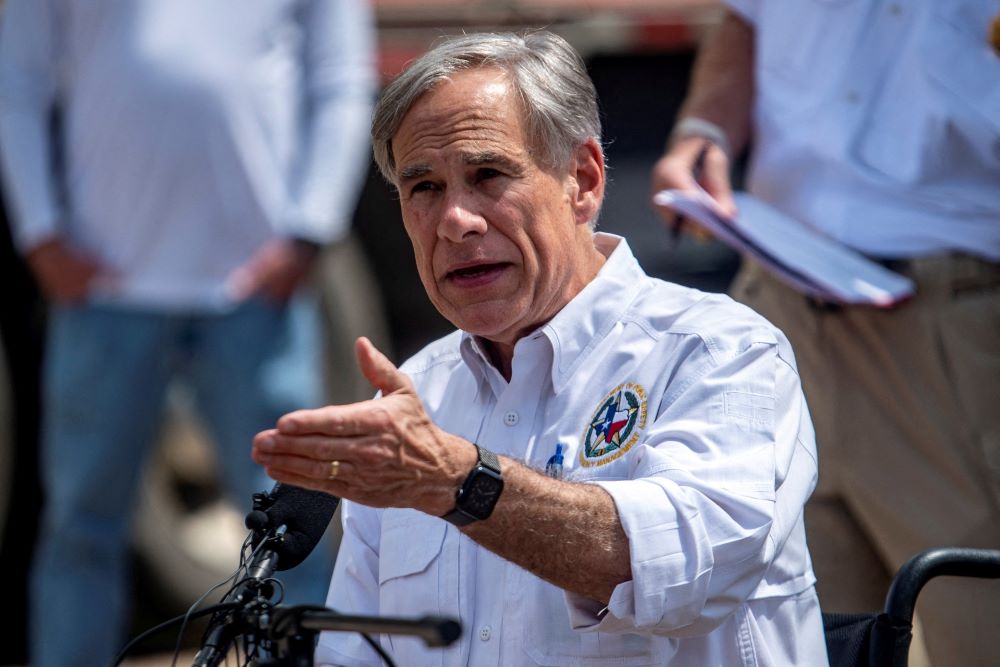
Texas Gov. Greg Abbott, a Republican, speaks to the media at a press conference in the aftermath of deadly flooding in Hunt, Texas, July 8. Abbott has threatened to arrest the Democrats who fled the state to avoid allowing a quorum to vote on a GOP redistricting map. (OSV News/Sergio Flores)

The standoff over redistricting in Texas has gone into its second week as Democrats, unable to stop the GOP plan, fled the state to deny the legislature the quorum needed to conduct business. Soon, something will have to give.
One thing already has: The Democrats have abandoned, at least for now, their commitment to nonpartisan redistricting efforts. Former Speaker Nancy Pelosi was right when she said in 2021: "The people should choose their politicians. Politicians should not be choosing their voters."
Pelosi is also right to now say: "Democrats cannot and will not unilaterally disarm."
This is not the first time Texas has caused trouble with redistricting. In 2003, the GOP-controlled legislature broke the unwritten rule that redistricting occurs only once a decade. The U.S. Constitution requires that district lines be redrawn after each census, conducted every 10 years. So, for more than 200 years, that is how it was done. Then, the GOP noticed that the Constitution did not say anything about prohibiting a state legislature from redrawing lines more often than once a decade. They redrafted district lines that had been drawn two years prior.
The only founder to whom Texas Republicans like Gov. Gregg Abbott and Attorney General Ken Paxton bear a resemblance is Aaron Burr.
The dissembling of democratic norms, things not written into the Constitution but honored to allow the Constitution to function, did not start with Donald Trump. He has merely enlarged the project. The 2003 Texas redistricting, like Sen. Mitch McConnell's refusal to hold a hearing or vote on the nomination of Merrick Garland to the U.S. Supreme Court in 2016, were early, and successful, attempts to remove guardrails that protect democracy in favor of power grabs.
The American Redistricting Project offers a brief history of where redistricting stood after each census since 1960. There has been a lot of flux. For example, after the Democrats got shellacked in 2010, the GOP controlled the redrawing of maps in 20 states with 187 districts compared to the Democrats' control of seven states with only 49 seats.
One positive development throughout that period was the growth of states which enacted laws entrusting the process to a nonpartisan commission. By 2011, there were 11 states with nonpartisan commissions drawing district lines, accounting for 147 seats. That was real progress, but that progress will disappear, at least for the time being.
Gerrymandering is not new. Patrick "Give me liberty or give me death" Henry tried to cut James Madison out of a congressional district in the first Congress. In fact, the word we use, gerrymander, was originally rendered as "Gerry-mander" after Elbridge Gerry, a signer of the Declaration of Independence, who in 1812, signed a politically motivated redistricting of state senate districts into law in Massachusetts. His name has been attached to the procedure ever since. The "mander" part of the word comes from the fact that one of the newly drawn districts resembled a salamander as it curved around Boston.
2025 is not 1812 and the only founder to whom Texas Republicans like Gov. Gregg Abbott and Attorney General Ken Paxton bear a resemblance is Aaron Burr. And computers now allow state legislators to draw district lines with partisan precision unimaginable in earlier times.
The Democrats could lose five seats in Texas under the proposed redistricting plan. That's a lot when control of the Congress hinges on only a handful of votes.
Advertisement
Still, it is not hard to see how this GOP effort could backfire. Democrats need to focus relentlessly on what is at work here. Pelosi's mantra — "The people should choose their politicians. Politicians should not be choosing their voters" — sounds to me like the start of Democrats recapturing the populist mantle. What is more elitist than politicians choosing their own electorates? What is more populist than running, as a party, from presidential nominee to dog catcher, on the pledge to "return power to the people"? Throw in some ads highlighting just who benefits from the tax cuts the GOP enacted, and the Democrats might, just might, be able to speak to ordinary citizens effectively again.
Good government messages only get one so far. If the economy is soaring, voters tend to overlook a host of abuses of the democratic process. But if the Democrats embrace the effort to enact nationwide nonpartisan commissions, they can recapture some of the populism they have lost in recent years. And if they win, they could actually deliver a more responsive government. Those are big ifs for a party still dominated by special interests and corporate money.
Our democratic system is being challenged in ways it has not been since the Civil War. The challenge for Democrats, and for those Republicans who have not entirely lost their moral compass, is to maintain a commitment to better government, while not unilaterally disarming in the face of Trumpian power grabs. It is a steep challenge, but there is no alternative if democracy is to be preserved.