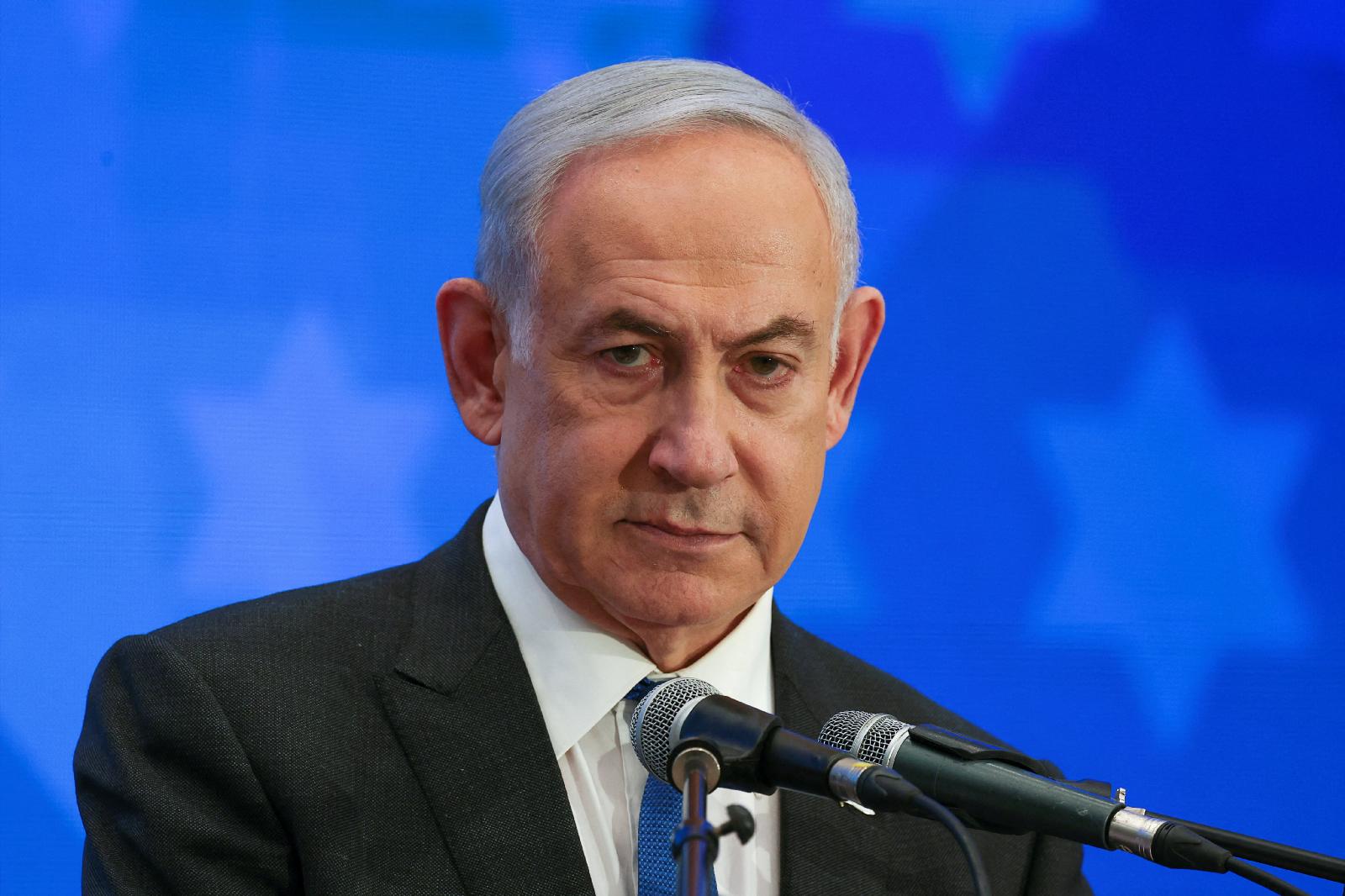
Israeli Prime Minister Benjamin Netanyahu addresses the Conference of Presidents of Major American Jewish Organizations in Jerusalem Feb. 18, 2024, amid the ongoing conflict between Israel and Hamas. (OSV News/Reuters/Ronen Zvulun)
Nearly two years into a war that has claimed more than 60,000 Palestinian lives and left the land in ruins, Israel has neither defeated Hamas — its stated goal — nor offered a true vision for peace. Instead, Prime Minister Benjamin Netanyahu has signaled his intent to take over Gaza and expand Israeli settlements there.
The world watches in grief as Gaza reaches yet another breaking point.
Netanyahu dangles the notion of handing Gaza to unnamed Arab forces, even as Israeli troops are mobilized and his cabinet advances a plan for Israel to seize Gaza City — rejecting not only Hamas, but also the Palestinian Authority as potential rulers.
The irony is sharp. The Palestinian Authority, established in 1994 through the Oslo Accords as a temporary governing body for Palestinians in Gaza and the West Bank, was meant to pave the way toward a just resolution of the conflict. Three decades later, it remains the primary civil authority in the West Bank, even as Gaza is reduced to rubble and its people to starvation and dispossession.
Peace and justice cannot be planted on scorched earth. They cannot grow from the soil of occupation.
To dismiss both Hamas and the Palestinian Authority is to refuse not only the present but also the possibility of a political future for Palestinians — a refusal that points toward permanent occupation rather than peace. The larger picture becomes even clearer, perhaps, with the recent Israeli approval of a West Bank settlement plan that would essentially end any possibility for a Palestinian state.
The gravity of Netanyahu’s plans to seize Gaza City cannot be ignored. Military and security experts, including retired Israeli Maj. Gen. Gadi Shamni, caution that placing Gaza under direct Israeli control is not only strategically reckless but morally devastating. Such a move would constitute a clear violation of international law. The Fourth Geneva Convention explicitly prohibits the transfer of civilian populations into occupied territory, the destruction or seizure of property not justified by military necessity, and the collective punishment of occupied peoples are all defined as war crimes. To seize Gaza by force is to perpetuate a long history of uprooting and erasure, of reducing both people and land to pieces on an imperial chessboard.
At the same time, Arab governments have signaled that their willingness to help stabilize Gaza depends on two conditions: that governance be returned to the Palestinian Authority, and that there be a credible path toward Palestinian statehood. Netanyahu’s coalition has rejected both outright.
And so, the deadlock hardens. While leaders maneuver and power is bartered, the people of Gaza are left to bear the cost — starving, displaced and exhausted under the weight of an unrelenting siege.
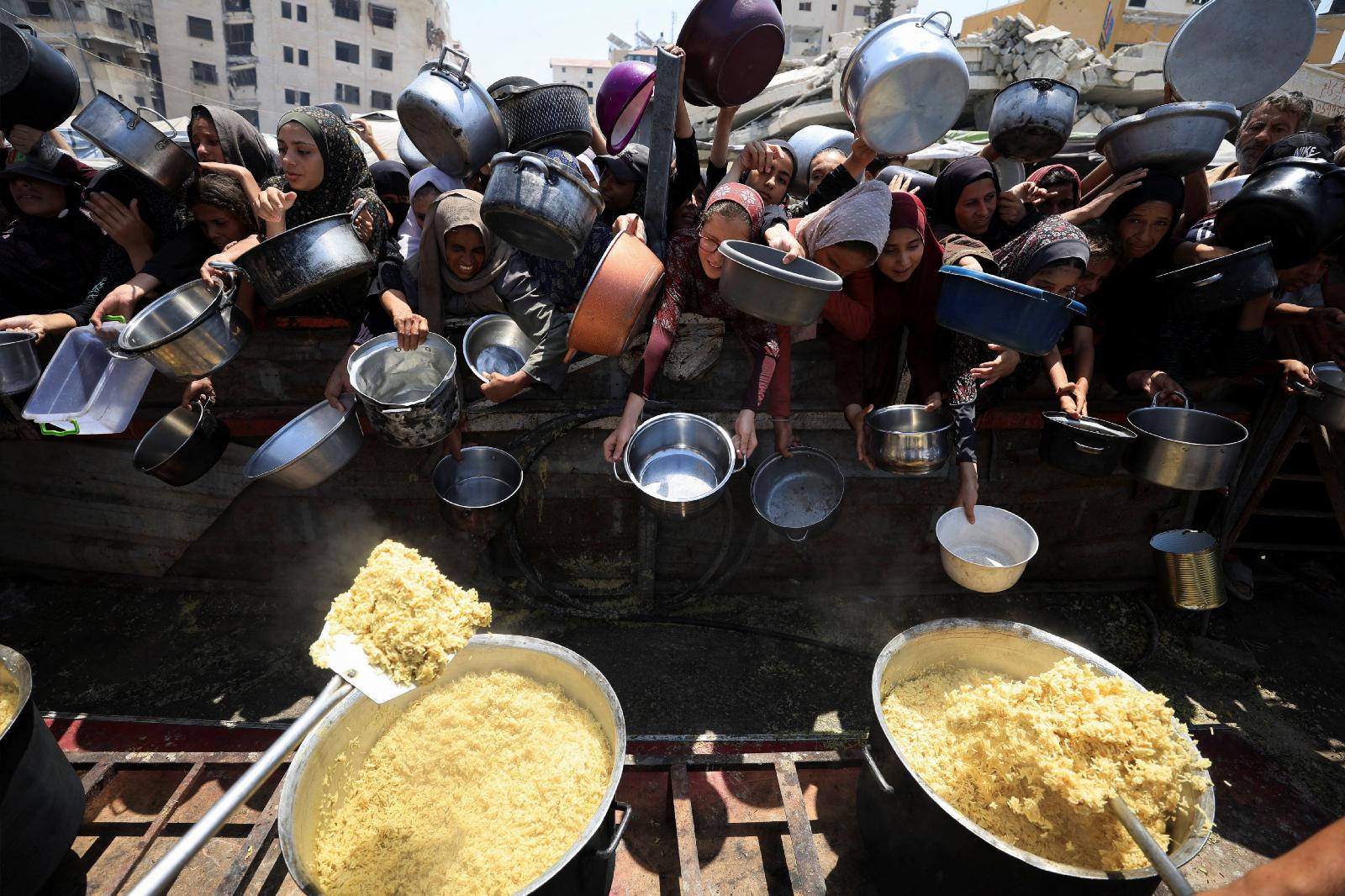
Palestinians wait to receive food from a charity kitchen in the Gaza Strip's Gaza City Aug. 15, 2025. (OSV News/Reuters/Dawoud Abu Alkas)
We must recognize this as more than a humanitarian failure — it is a moral crisis. More than 500,000 Gazans — nearly 1 in 5 — are now living in famine-like conditions, and acute malnutrition has surged. In July alone, nearly 12,000 children under age 5 required urgent treatment for malnutrition, the highest monthly toll on record. On Aug. 22, the United Nations-backed body that monitors hunger crises globally said in a report that Gaza City and the surrounding area are experiencing famine.
Averting mass death is not the same as averting disaster: Even if aid arrives, an entire generation will still live with the irreversible consequences of being denied enough to eat. Catholic social teaching reminds us that the preferential option for the poor demands we act on behalf of those who suffer most urgently — and in Gaza, the least among us are perishing before our eyes.
And yet, even in this moment of deep stalemate, mediators hold out a fragile thread of hope. International negotiators remain cautiously optimistic after Hamas agreed to a ceasefire deal nearly identical to one Israel had previously approved. Israel is now reviewing Hamas’ response, and while the Israeli government has not officially announced a decision, on Aug. 21, Netanyahu approved plans for the IDF to "take control of Gaza City and defeat Hamas." He also ordered negotiations for the release of all hostages and the end of the war "on conditions that are acceptable for Israel." Under the ceasefire proposal Hamas agreed to, a 60-day truce would be established, roughly 50 Israeli hostages would be released in exchange for hundreds of Palestinian prisoners, and Israel would begin a partial military withdrawal from Gaza.
Advertisement
Netanyahu’s maneuvering cannot be disentangled from his need to appease far-right factions at home, even as military leaders caution that tightening Israel’s grip on Gaza achieves nothing but more bloodshed. The default outcome, a full Israeli occupation of Gaza, would be catastrophic. For Palestinians, it would mean continued siege, displacement and likely famine. For Israelis, it would mean an endless and costly military entanglement, heightened insecurity and deepening political and moral isolation.
Peace and justice cannot be planted on scorched earth. They cannot grow from the soil of occupation. If the prophetic tradition teaches us anything, it is that lament must give way to vision: A vision that refuses the permanence of occupation and settlement, and reaffirms Gaza’s status under international law. A vision that insists on Palestinian self-determination alongside real security for Israelis. A vision that opens corridors for food and aid, protects civilians and resists the politics of fear in favor of compassion and dignity.
To conquer it is to desecrate not only soil and stone, but the image of God carried in its people. Our calling, then, is to labor for reconciliation, justice and the healing of both land and people — because anything less is complicity in their destruction.