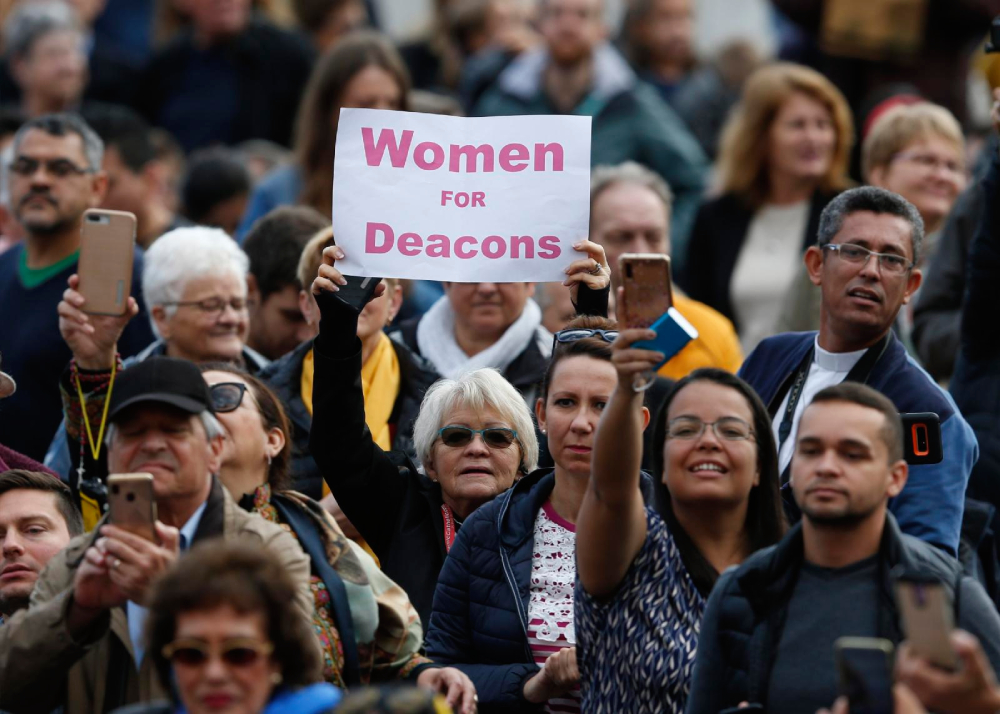
A woman holds a sign in support of women deacons as Pope Francis leads his general audience in St. Peter's Square at the Vatican Nov. 6, 2019. (CNS/Paul Haring)
One more study on the possibility of women deacons and yet another "not-quite-no-but-certainly-not-yes" conclusion. That this most recent verdict should surprise no one doesn't mean that a great many are not once again deeply disappointed.
Beyond the disappointment exists a sense that the ongoing denials of that possibility — based on ancient, persistent and incorrect ideas about gender, as well as the skimpiest possible readings of our sacred texts — is a disingenuous and cynical tease of women called to ordination and to the men who support them.
The stop-and-go nature of the discussion of women deacons has gone on since 2016, when Pope Francis appointed the first commission to consider the question. A second commission appointed in 2020 returned the most recent judgement. Along the way both Francis and his successor, Pope Leo XIV, have given off positive and negative responses to the possibility.
This is the body of Christ trying to move forward into history with one foot tethered to a Bernini column. No matter how generous the tether, the resultant journey is in endless circles.

Deacons lie prostrate during ordination Mass in St. Peter's Basilica during the Jubilee of Deacons at the Vatican Feb. 23. A Vatican commission has voted against allowing women to serve as deacons. (CNS/Pablo Esparza)
Frustration notwithstanding, two considerations are pertinent to both the enduring wish of many women for the possibility of ordination as deacons and to the culture that insistently impedes that wish.
First, women are not going to suddenly disappear from the face of the earth. That fact, however apparent, seems to elude those intent on restricting ordination to that portion of the species with certain genitalia. Lost also is the fact that women will not suddenly become ignorant of the way the church has regarded them as secondary — despite Mary's courageous "yes" and that moment women announced the risen Lord to their late-to-the-tomb male companions.
Second, a deeper issue must be considered by those who make the reasonable request for full participation of women in ministry and decision making. That issue: Into what culture do women expect to be ordained? Will the desire for ordination come at the cost of acquiescence (we've certainly seen it among male permanent deacons) to the still-unreformed clericalism, critiqued repeatedly by Pope Francis, that has resulted in devastating scandal?
The ordination of women to the permanent diaconate would certainly constitute a welcome step that would enlarge our understanding of God. It would, as well, require an overdue adjustment of what, for too long, has been an anthropology stuck behind the wall of an all-male clerical culture desperate to preserve its status.
Centuries of the current tradition demonstrate that ordination seeds its own undoing when it presumes superiority, privilege and power — indeed, even an ontological difference from the rest of humanity. The mere presence of women might itself be a transformative element or indicate that a transformation is finally underway.
The sense of the faithful at recent synods and that of women religious, who advocated for the first study commission, would certainly indicate a consensus exists for moving forward.
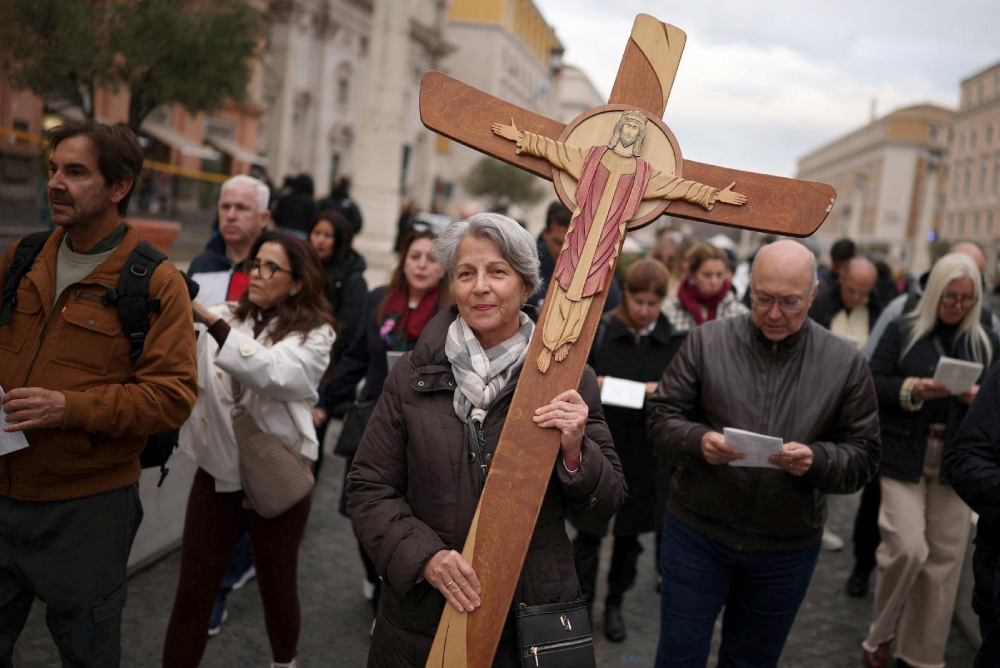
A pilgrim carries a crucifix in Rome near the Vatican's St. Peter's Square Dec. 4, 2025, after a high-level Vatican commission voted against ordaining Catholic women to serve as deacons while also supporting more study on the issue, according to a report addressed to Pope Leo XIV and released by the Vatican that day. (OSV News/Reuters/Guglielmo Mangiapane)
Further, as scholar and expert Phyllis Zagano has argued at great length — and she is hardly an outlier — the evidence from tradition and scripture are far more persuasive in the direction of ordaining women as deacons than are the arguments for continuing to resist that possibility. In the current moment, she seems to be banking on Leo's fondness for synodality.
The thinnest hope is kept alive in the most recent episode by Cardinal Giuseppe Petrocchi, president of the commission, who said, "Ultimately, the question must be decided on a doctrinal level. Therefore, issues relating to the ordination of women as deacons remain open to further theological and pastoral study."
Exactly how that will occur is yet unknown. Meanwhile, what we know is that the number of priestly ordinations continues to drop. While that was once a phenomenon in Europe and the United States, the trend now is global. According to a Sept. 22 report in The Wall Street Journal, "A sharp, decadelong decline in the number of young men who want to become priests has only accelerated since the pandemic. The lure of other career options and a growing wariness about a lifelong — and celibate — commitment is leading Catholics to turn away from a once honored path, even in the faithful global south."
That trend has significant implications for the local church, not only in the global south, but also in the United States. For years, priests from other countries have propped up parochial structures here. What happens when that supply line diminishes? What will parishes look like in the not-too-distant future? Will demographics, beyond the control of bishops and papal commissions, be a driving force behind significant changes to ordination, its very meaning, and who will be eligible?
Advertisement
Will necessity finally move the matter of ordaining women to the diaconate from a topic for endless discussion to a saving grace?
Pope Leo has been intriguing (maybe slyly intriguing?) on the point. He has said, "Perhaps we need to look at a new understanding or different understanding of leadership, power, authority, and service — above all service — in the church from the different perspectives that can be brought to the life of the church, by women and men, so there are conversations going on; there is an official study going on."
The Vatican II document Lumen Gentium contains a guileless and engaging description — one sentence, mind you — regarding ordination. Though there follows pages on priesthood limited to males, the line in the opening document is simple: "Those of the faithful who are consecrated by holy orders are appointed to feed the Church in Christ's name with the Word and the grace of God."
No mention of gender boundaries, pompous rituals, no distinction other than those willing to feed — nourish others — with "the Word and grace of God." Not a bad starting point for Leo's "new understanding," maybe even transformation.