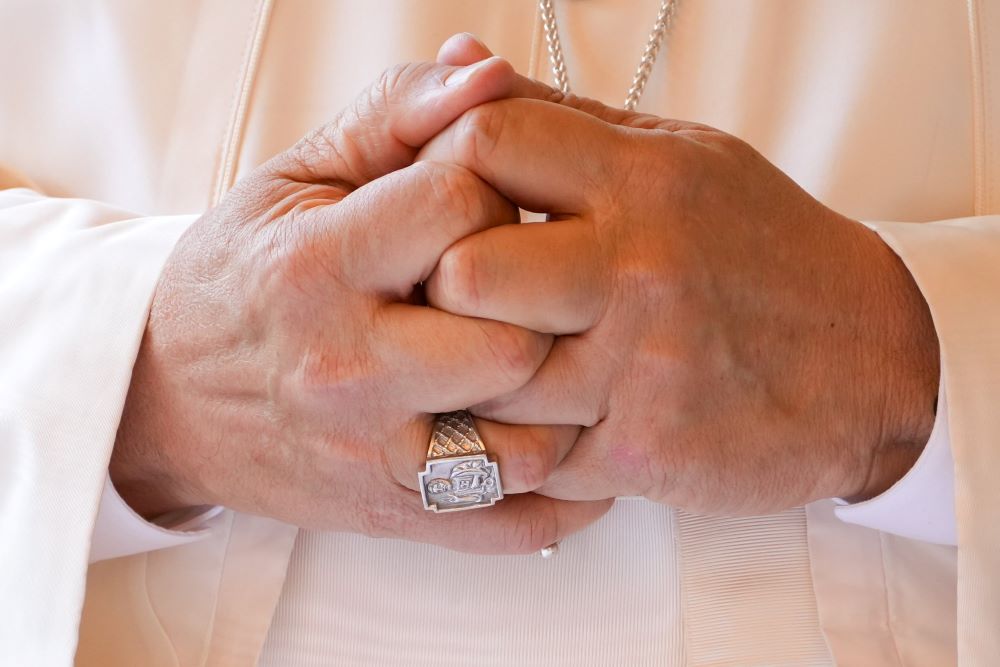
Pope Leo XIV interlaces his fingers while speaking to guests at a luncheon for people assisted by Caritas and volunteers at the Borgo Laudato Si' in Castel Gandolfo, Italy, Aug. 17. (CNS/Lola Gomez)
In the first major document of his pontificate, Leo XIV minced no words. He punctured "the bubble of comfort and luxury" that distorts the Christian Gospel and isolates believers from a "fundamental way of encountering the Lord" through the world's most vulnerable.
Dilexi Te ("I Have Loved You") is a profound and yet deeply disturbing document. Prophetic in the truest sense, it is an uncompromising assessment of how wealth and faith in contemporary economic ideologies and markets have misshapen Christianity. They have, Leo asserts, turned it away from the mission to the poor that has been at its core since Jesus walked the earth.
It was courageous and risky in equal measure, given current conditions in the church and society.
One of the most pressing tasks facing the Catholic Church in the 21st century, given the self-inflicted wounds that have seriously diminished its stature, is finding a way to reestablish its credibility and authority within its own borders and in the wider world.
Leo certainly understands how debilitating these wounds are and how important it is to repair and rebuild. All the more remarkable, then, that he chose as the topic for his first major pronouncement the plight of the poor and their place as the fundamental focus of Christianity.
If the words are a challenge to those of us in the United States, they are also a challenge to the church itself. … What would it mean to take on the structures that create poverty?
One might reasonably expect the head of an institution that has been humiliated by decades of sexual abuse and financial scandals to seek restored influence with help from the very powerful. It would almost be understandable that a pope might turn the richest and most influential, leveraging their clout to right the Barque of Peter.
But no. His gaze, instead, fell on the poor. In language that turns certain expectations upside down, he distanced the church in significant ways from such sources of power and influence.
In fact, as NCR Vatican correspondent Justin McLellan summed it up, the pope "condemned a view of the church which caters to the elite by arguing that the church is most effective by building relationships with those in society who carry the greatest influence."
That is a breathtakingly bold position to take and one which, while aimed at those associations that exist anywhere, has a particular resonance in the United States. And it comes from someone very familiar with church dynamics here. Leo knows the stakes. He is, no doubt, well aware of the influence money has on the Catholic Church in the United States — where it too often serves as a veneer, a kind of sanctifying cover for rapacious versions of libertarian economics. God rewards the good with piles of cash.
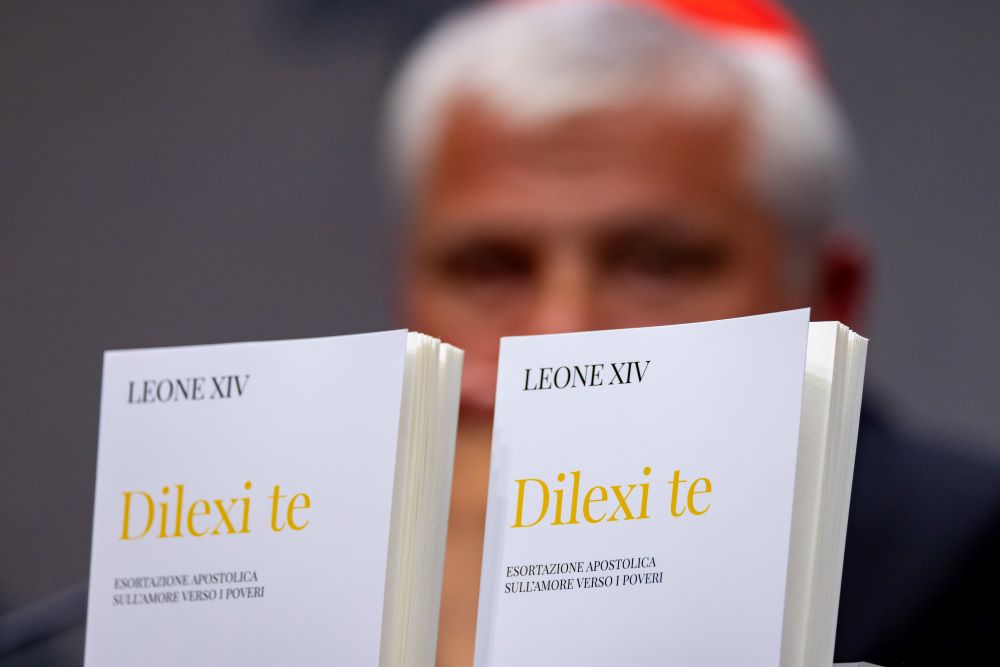
Copies of the Italian translation of "Dilexi Te" ("I Have Loved You"), Pope Leo XIV's apostolic exhortation, are seen in front of Cardinal Konrad Krajewski, prefect of the Dicastery for the Service of Charity, at a Vatican news conference Oct. 9. (CNS/Pablo Esparza)
Leo elaborated on the point: "It is easy to perceive the worldliness behind these positions, which would lead us to view reality through superficial lenses, lacking any light from above, and to cultivate relationships that bring us security and a position of privilege."
But such security, says Leo, is deceptive.
"[T]he illusion of happiness derived from a comfortable life pushes many people towards a vision of life centered on the accumulation of wealth and social success at all costs, even at the expense of others and by taking advantage of unjust social ideals and political-economic systems that favor the strongest," he wrote. "Thus, in a world where the poor are increasingly numerous, we paradoxically see the growth of an elite, living in a bubble of comfort and luxury, almost in another world compared to ordinary people."
An unintended symmetry exists within the document, which is a product of two popes. Pope Francis started the exhortation, but died before its completion, and Leo finished it, making it his own — but also making it clear that it was both in solidarity with and a continuation of Francis' approach.
Neither came to the papacy via any normal or previously taken route. Francis, the first to ascend to the papacy from the Global South, perceived his ministry and the rest of the world through the lens of the crushing poverty that was, in part, the result of exploitation by the rich and powerful in the Global North.
Leo spent his formative years in the Global North, as a middle-class child of Chicago and a student at the Villanova University, in the tony suburbs outside Philadelphia. But his American views of what made for "the good life" were influenced and altered by his decades as a missionary and bishop in Peru.
The document is continuous with Francis in more ways than points of interest and topic. It has, as did many of Francis' works, more a tone of contemporary urgency than a treatise carefully calculated to balance out effects on differing quarters of the church. Perhaps, writing about poverty and the Catholic position on it left less room for subtlety.
The sweep of the relatively short (for a Vatican pronouncement) document captures millennia of Catholic thought and action grounded in service to the poor and most vulnerable. It could easily serve as a teaching document for anyone interested in the insistence with which attending to the poor has broken through as a central concern for the church throughout the ages. The teaching, unvarnished and uncompromised, has not only survived but has also been enhanced and revitalized time and again, through eras of corruption and scandal, war and disruption.
The certainty of Leo's words don't hide the complexity of the matter, nor is it a naïve assurance. Quite the opposite. The questions raised by the history and the understanding of how wealth can pervert the Gospel are monumental. That is especially the case for Catholics living in the wealthiest culture on earth, where the business schools at some Catholic universities unabashedly herald the goodness of extreme capitalism unfettered by any government regulation.
Leo's words are especially challenging when Catholics and some of their leaders either openly support or look askance at the dehumanizing treatment of the poorest and most vulnerable among us.
If the words are a challenge to those of us in the United States, they are also a challenge to the church itself. What does it do with its wealth? How is its money used? Will a true and unrelenting focus on the poor and those otherwise on the margins change the nature of church itself? What would such a focus mean for our parochial structures? For our involvement in politics?
What would it mean to take on the structures that create poverty?

Sisters Poor of Jesus Christ distribute food and talk with people experiencing homelessness on the streets of downtown Baltimore May 3, 2023. (OSV News/Kevin J. Parks, Catholic Review)
The church itself may also have to contend with the unintended consequences of Leo's words. "Let us not forget," he wrote, quoting from Francis' 2013 apostolic exhortation Evangelii Gaudium, "that 'doubly poor are those women who endure situations of exclusion, mistreatment and violence, since they are frequently less able to defend their rights. Even so, we constantly witness among them impressive examples of daily heroism in defending and protecting their vulnerable families.' "
"While significant changes are under way in some countries," Leo continues, quoting Francis in Fratelli Tutti, " 'the organization of societies worldwide is still far from reflecting clearly that women possess the same dignity and identical rights as men," " 'We say one thing with our words, but our decisions and reality tell another story,' especially if we consider the numbers of women who are in fact destitute."
To what degree is Leo willing to take up the thought that the church is one of those organizations that "is still far from reflecting clearly that women possess the same dignity and identical rights as men"?
Leo has expressed, in a fresh and compelling way, the challenge that has been at the heart of Christianity since its beginnings. This will not be the last time we'll be dealing in this space with this document and its implications. It is a welcome new step toward not only understanding the issue, but making the essential human connections, opening the door to what the poor and the most vulnerable can teach us.
Advertisement