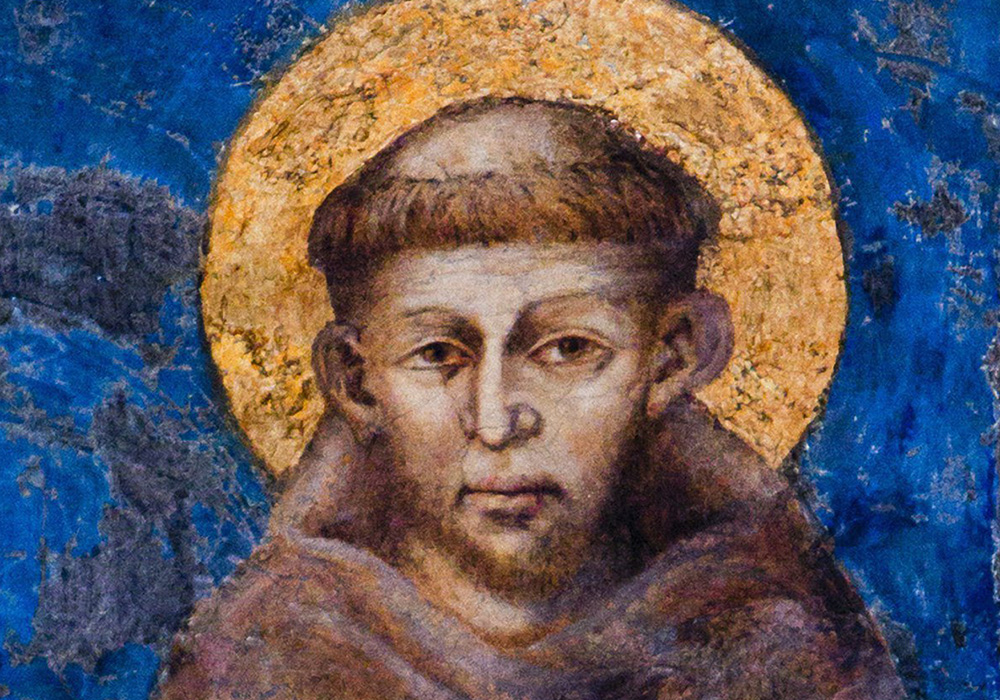
St. Francis of Assisi is depicted in this detail from a fresco in the Basilica of St. Francis in Assisi, Italy, in this 2013 file photo. (CNS/Octavio Duran)

by Daniel P. Horan
This year marks the 800th anniversary of St. Francis of Assisi's composition of the "Canticle of the Creatures." The poetic and theologically rich prayer, which language historians consider to be one of the earliest poems written in vernacular Italian (technically it's composed in an Umbrian dialect) and the predecessor of works like Dante Alighieri's The Divine Comedy, is undoubtedly the most famous of Francis' writings.
Early sources tell us that Francis himself, or perhaps with the help of musician Brother Pacifico, designed the text to be sung. It is no surprise then, that centuries later this medieval masterpiece continues to inspire musical compositions such as Marty Haugen's 1980 "Canticle of the Sun," Angelo Branduardi's 2000 "Il Cantico delle Creature" and of course William Henry Draper's early twentieth-century classic "All Creatures of our God and King."
For as popular as the "Canticle" is, it is striking how little attention is paid to what it conveys of St. Francis's radical theological vision of creation. This is partly due to what I jokingly refer to as the "birdbath industrial complex," the tendency to romanticize and domesticate the "Canticle" by depicting Francis as merely a "lover of animals" who preached to birds, relocated vulnerable earthworms by the side of the road and made peace with a menacing wolf in the town of Gubbio.
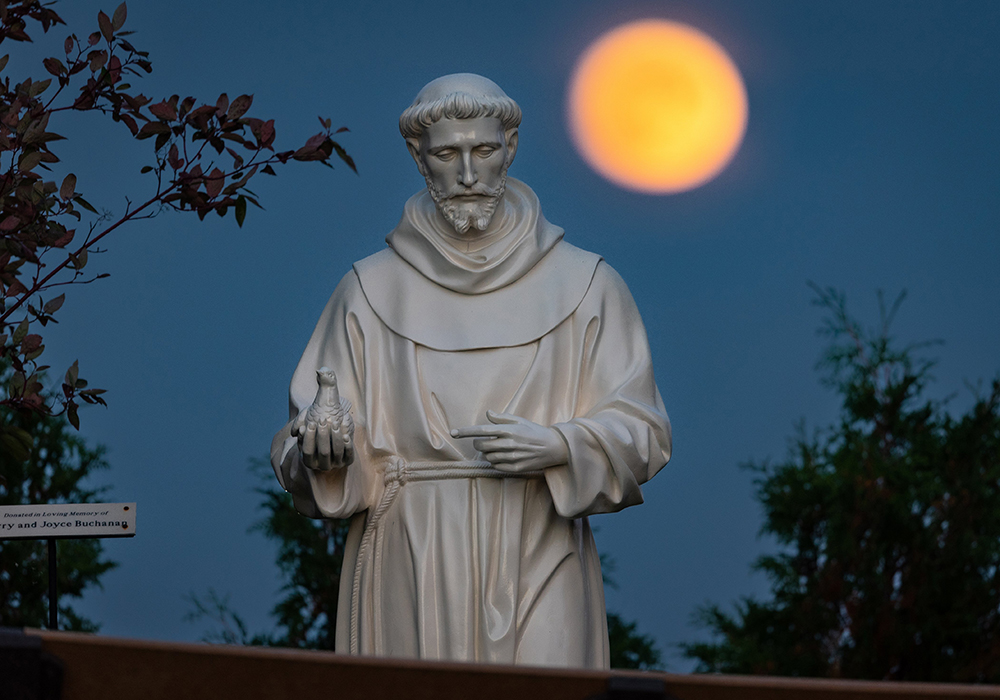
A hunter's moon rises behind a statue of St. Francis of Assisi on the grounds of the National Shrine of Our Lady of Champion in Champion, Wisconsin, Oct 8, 2022. (OSV News/CNSSam Lucero)
But the "Canticle" was never intended to be a cartoonish commercial for petting zoos and animal adoptions. Written in three parts over more than a year, the "Canticle" conveys powerful insights worth pondering during this commemorative year.
First, it's important to recall that Francis was seriously ill at the time he wrote this beautiful text. Contemporaneous sources and medieval hagiographies alike tell us that Francis suffered from a terrible eye infection, which caused him to be in incredible pain and nearly blind in the last years of his life. It is within this context that he proclaims: "Praise be You, my Lord, with all Your creatures, especially Sir Brother Sun, Who is the day and through whom you give us light. And he is beautiful and radiant with great splendor; and bears a likeness of You, Most High One."
The fact that exposure to sunlight almost certainly pained Francis raises a question for contemplation: What allowed him to recognize and celebrate the inherent goodness of creation, his interdependence with it and its intrinsic relationship with the Creator with such joy amid suffering?
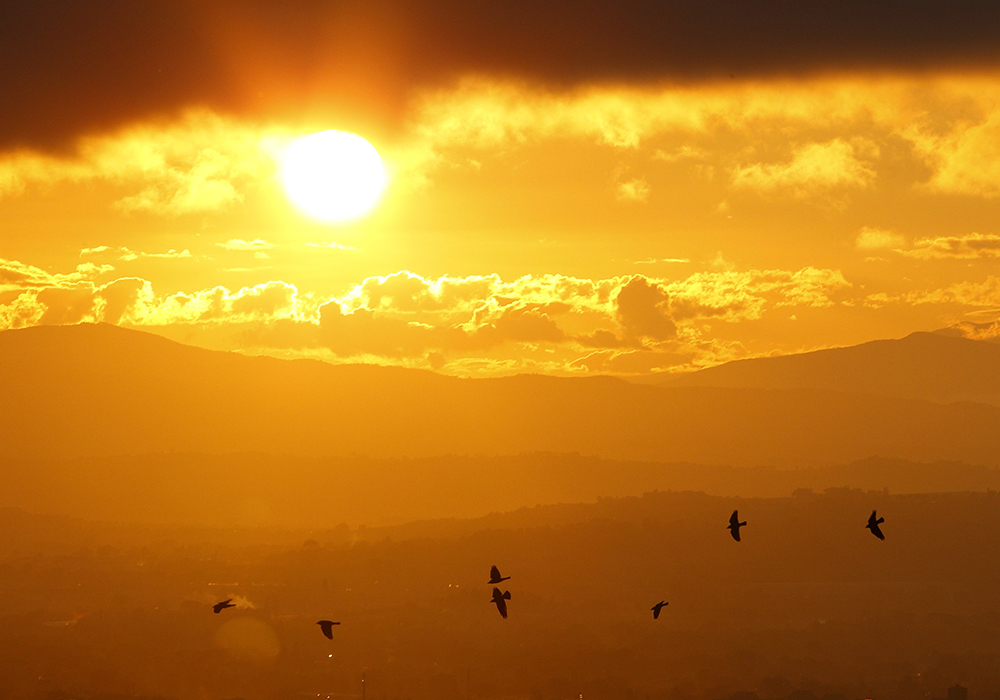
Birds fly as the sun sets over the mountains near Assisi, Italy, in this Oct. 26, 2011, file photo. St. Francis, who was born in Assisi in the 12th century, is the patron saint of ecology and his feast day is Oct. 4. (CNS/Paul Haring)
The late British theologian Franciscan Fr. Eric Doyle wrote, "All beautiful words and music come from the mystery of personhood, welling up from the inner depths. It is therefore not so remarkable that Francis, though blind, was able to write a song about the beauty and unity of creation."
It wasn't necessarily about seeing the visual beauty of creation, but about recognizing the intrinsic goodness of God's community of which he was (and we are) already a part. Reflecting further, Doyle adds:
He was already one with himself and with the world, and the world was one in him. By the unity which he experienced, Francis found himself endowed with the sixth sense of heartsight, or what he himself once described as "the eyes of the spirit." … The sun, the moon and the stars, the wind and the earth, the fire and the water were within him. And by the light of the inner sun, he saw the loveliness of everything.
This sense of unity and interdependence led Francis to call each element of the created world — sentient or otherwise — his "brother," "sister" and "mother." He understood in an intuitive, mystical way the truth of creaturely kinship. He did not see himself as a steward or landlord of nonhuman creation, but rather as a family member who cared for his siblings as they too cared for him.
He did not see himself as a steward or landlord of nonhuman creation, but rather as a family member who cared for his siblings as they too cared for him.
Despite the mistaken interpretation of the "Canticle" as some kind of poetic "thank you note" to the Creator for a gift given to humanity to do with as we please, Francis was intentional about the way he referred to aspects of creation and respected their individual agency.
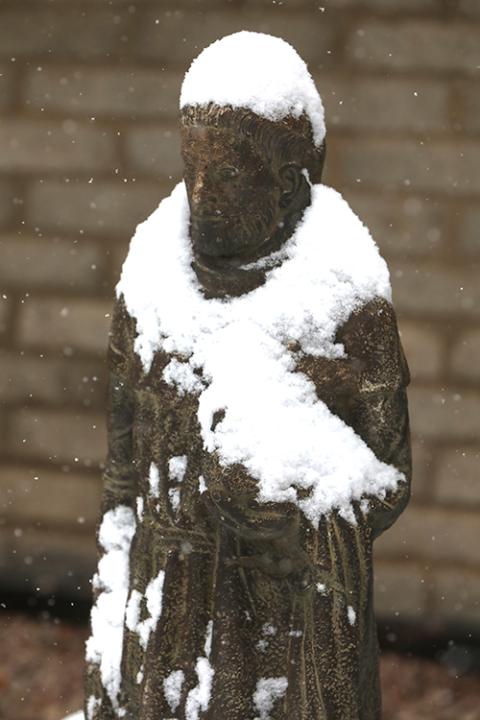
Snow covers a statue of St. Francis of Assisi outside Sacred Heart Church following a winter storm in Prescott, Arizona, Jan. 7, 2024. (OSV News/Bob Roller)
Much is rightly made of his addressing nonhuman creatures and elements with familial language, but less attention is paid to the way he acknowledges the individual and collective agency of the rest of creation. The "Canticle" is a celebration of the chorus of praise expressed by the whole cosmos. Each aspect of creation gives praise to God by being and doing what it was created to be and do. The sun gives praise to God by giving us light and the day. The wind gives praise to God by providing "every kind of weather." And earth gives praise to God by sustaining us, governing us and producing "various fruit with colored flowers and herbs."
These parts relate as family members in the cosmic kinship. If creation is a chorus composed of many voices praising God, then we humans are too often out of tune.
Some time after what he might have assumed to be the completion of the first part of the "Canticle," Francis heard about a political fight that had broken out in Assisi between the mayor (podesta) and the local bishop. The Assisi Compilation recounts that Francis, upon hearing about the dispute and power struggle, "was moved by pity for them, especially since there was no one, religious or secular, who was intervening for peace and harmony between them."
Advertisement
Compassion inspired Francis to compose additional verses that read:
Praised be You, my Lord, through those who give pardon for Your love, and bear infirmity and tribulation. Blessed are those who endure in peace, for by You, Most High, shall they be crowned.
Just as Francis conveyed that the sun gives praise to God by shining light and providing the day as God intended, so too humanity gives praise to God by being what God created us to be: peacemakers, reconcilers, lovers. When we are selfish, divisive, polarizing, unforgiving and the like, not only are we not praising God, but according to Francis, we are also not being fully human.
As we continue to celebrate the anniversary of this tremendous medieval text, may we be open to the ways the legacy of St. Francis of Assisi can continue to challenge and inspire us.