(Dreamstime/R. Gino Santa Maria)

by Kat Armas
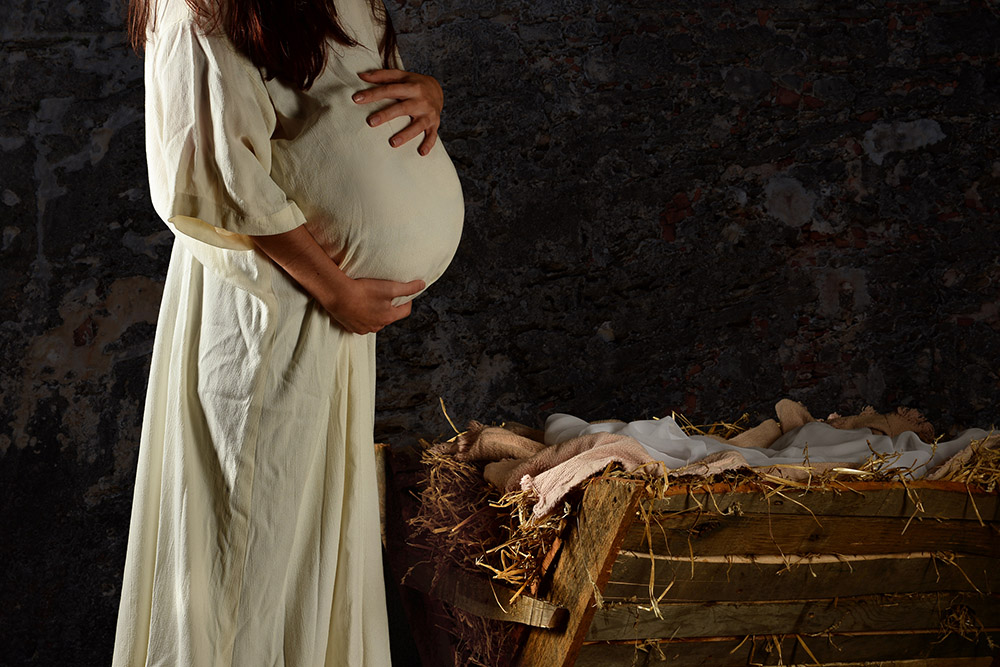
Each Advent, we're invited to look again at a scene we think we know: the Nativity. An angelic looking child wrapped in clean cloth, animals arranged as if on cue and Mary, fresh from labor, kneeling in serene composure. It's an image crafted to soothe us, an aesthetic of peace and holiness.
But after I gave birth to my first child just before Advent in 2021, that familiar tableau unsettled me. The dissonance was instant. After experiencing the blood, sweat, fear and sheer effort of childbirth, the polished Nativity felt dishonest; not maliciously, but because it floats above the real world — above the world into which Jesus was actually born.
Why does that matter? Because empire constructs images of the reality it wants us to believe. This sanitized Nativity communicates that holiness exists only where bodies don't sweat, bleed, ache or break, as if God's arrival had to be scrubbed clean of everything raw and real.
But the Incarnation is holy precisely because it is human.
Before angels announced good news and shepherds hurried from their fields, Mary carried the ordinary and extraordinary weight of pregnancy. Her skin stretched to make room for God. Her breath shortened as divinity pressed against her lungs. She likely wrestled with sleepless nights and the terrifying knowledge that childbirth could kill her, as it did so many women of her time. Mary held all of this risk in her young, vulnerable body.
The Gospel accounts don't dwell on these details, but they pulse beneath the story nonetheless: the census that displaced her, the long journey, the unstable shelter. Ancient writers rarely described the flesh-and-blood truth of labor — groaning, sweating, tearing, bleeding — perhaps because such realities were considered too ordinary, too earthy, too profane for holy stories. And so we inherited an Incarnation lifted off the ground, as though holiness and humanity cannot share the same space.
Advertisement
Yet Advent insists they are inseparable. God chooses a stretching, laboring body as the first sanctuary of the divine.
Empire, whether ancient Rome or the colonial powers that later carried Christian symbols across the world, has always tried to shape the story of God's coming. The same empire that controlled land, movement and bodies is the kind of power that later remade Mary in its own image; not as the brave, brown Jewish girl who said yes to God, but as an unattainable ideal used to discipline women into silence.
In much of Latin America, where Marian devotion blossomed under Spanish conquest, Mary was presented as the perfect daughter, virgin and mother — an image weaponized to enforce Western norms and reduce women's lives to narrow binaries. But the real Mary of the Gospels stands outside of empire's attempts to domesticate her. She is not a "quasi-woman" stripped of struggle. She is a young peasant woman whose yes to God was an act of agency, courage and resistance.
Mary's Magnificat makes this plain. Her song is not gentle sentiment. It is a proclamation of the downfall of the powerful and the lifting of the poor. Her body — her broken, refugee, brown, female, naked, stretched, hormonal, marginalized body — becomes the doorway through which divinity entered the world, and the place where imperial logic begins to unravel from the inside out.
The Incarnation is not antiseptic. It is not symbolic. It is not a Hallmark tableau. It is flesh and risk and effort and breath. And in Mary's case, it is the vulnerability of a young girl in an occupied land, giving birth far from home, without the care she might have needed, unsure of what would come next. Holiness was never meant to be sterile. Holiness is God choosing to be born into the very places we often avoid.
Christian imagination has often preferred a controlled, orderly God, a God untouched by bodily need, a God who enters clean rooms rather than messy lives. But the raw, unedited birth of Jesus tells a different story.
The Nativity scene, as we often see it, leaves out not only the bodily truth of birth but also the emotional truth. Not every pregnancy ends in joy. Not every cry in the night is one of celebration. Advent has always held grief and longing alongside hope. The birth of Jesus is no exception. The same chapter that gives us angels and shepherds also gives us Herod's violence, families displaced, children in danger, a holy family on the run. The shadow of empire hovers over the manger. And yet, it is precisely here — in the unstable, the dangerous, the unplanned — that God comes to dwell.
Christian imagination has often preferred a controlled, orderly God, a God untouched by bodily need, a God who enters clean rooms rather than messy lives. But the raw, unedited birth of Jesus tells a different story. It reveals both our discomfort with the body and the way we've been trained to value control, cleanliness and purity over physical or emotional vulnerability.
Empire insists that holiness belongs to the powerful, the polished, the protected. But the Incarnation reveals a God who refuses that narrative — who is not threatened by the realities of our humanity, who is not distant from our bodies, our fears or our longings. If the Incarnation reveals anything, it is that God meets us in the spaces empire devalues: in labor pains and long nights, in sweat and tears and unanswered questions. God does not enter the world through perfection but through the beautiful, complicated mess of being human — undermining every system that insists our worth depends on order or compliance.
This is good news. Because most of us live far from picture-perfect Nativity scenes. We know the ache of longing, the uncertainty of waiting, the tension of hope and fear held together. Advent names this tension. It tells the truth about a world longing for deliverance — and a God who does not wait for perfect conditions to draw near.
Advent peace is not the peace of sanitized images; it is the peace of God-with-us in our flesh, our struggle, our vulnerability. A peace born not in palaces, but in stables. A peace that does not hide from the world's pain but inhabits it. A peace strong enough to hold our sorrow and our joy together. As we dwell in this season, may we remember that the Incarnation is not clean, controlled, or comfortable. It is as real as blood and breath. As risky as childbirth. As tender as a mother's arms.