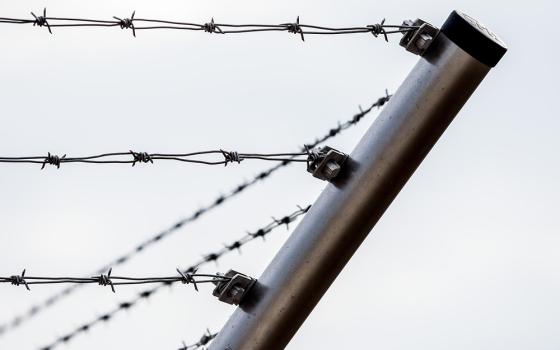

A lone person seats with their head in their arms, in an empty row of seats pictured in a black-and-white photo illustration. (Unsplash/Tymofii Tarasov)

by Virginia Mata
A profound shift is occurring in the human heart — a widening disconnection that is as much a spiritual wound as a social crisis. Beyond the public health warnings of loneliness lies a deeper question of what happens when we lose our tether to God, to others and to the world he entrusted to us. Over the past two years, I attended funerals for people who died by suicide — the first such funerals I have attended in my life. I share this not to alarm, but to acknowledge a truth that is quietly shaping our communities — people are suffering in ways our public conversations cannot fully name.
We are made for a multidimensional and mutual love between God, ourselves, our neighbors and our common home. As Pope Francis teaches in "Laudato Si', on Care for Our Common Home": "Human life is grounded in three fundamental and closely intertwined relationships: with God, with our neighbor, and with the earth itself." Healing must therefore be relational and holistic.
When people lose meaningful connection with God, with one another and with creation, despair quietly takes hold. Communities fracture, and purpose and belonging begin to fade. The church is uniquely equipped to heal the primary wound of disconnection because it holds the spiritual and relational tools required to build connection and purposeful communities that sustain all of creation.
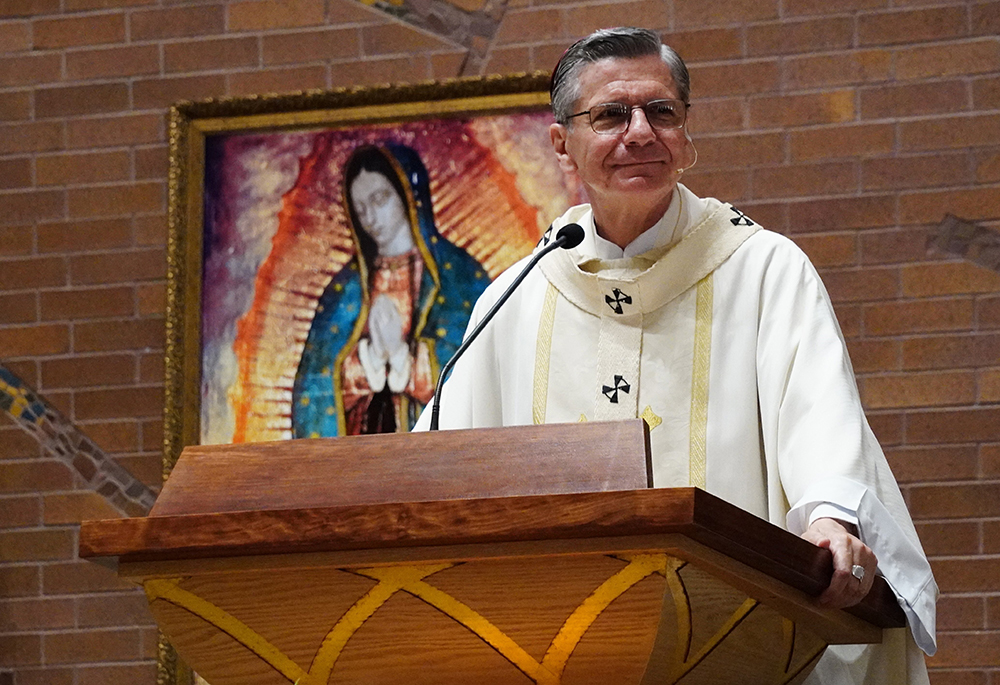
Archbishop Gustavo García-Siller of San Antonio, is pictured in a June 8, 2024, photo. (OSV News/Courtesy of Archdiocese of San Antonio/Veronica Markland)
In my social justice ministry with the Archdiocese of San Antonio and in my doctoral research on faith-based community organizing, I have seen something different, something hopeful. I have watched what happens when people reconnect with each other and with all of creation.
With the full support of Archbishop Gustavo García‑Siller, we committed to addressing disconnection not through programs alone, but through relationships — in simple, ordinary spaces like over coffee after Mass in parish halls where stories are shared. In this way, one‑on‑one conversations become sacred ground where walls fade, trust grows and heart-to-heart connections rekindle love.
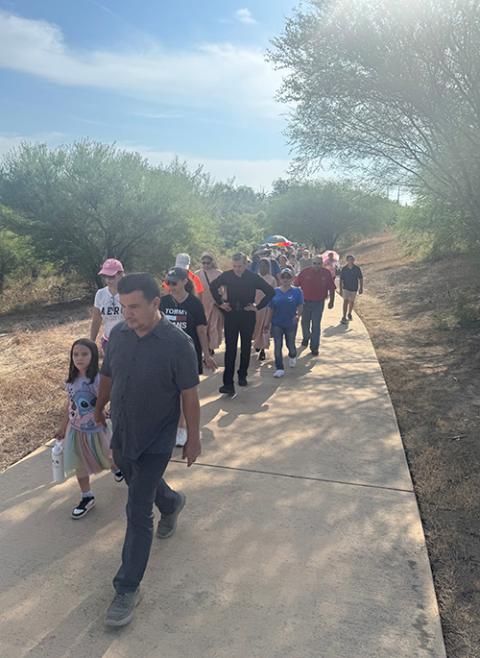
Participants in the Archdiocese of San Antonio's Pilgrimage for the Care of Creation walk trails at Mission Espada in San Antonio, Texas, Sept. 14, 2025. (Courtesy of Virginia Mata)
This is not sentimental love, but the love God has for each of us. What Pierre Teilhard de Chardin in The Human Phenomenon calls radial energy — the inward, unifying force that draws all creation toward greater communion with God. This energy — love — strengthens when human relationships deepen and diminishes when connection collapses.
In prioritizing these purposeful horizontal connections we lay the soil from which collective action can grow. In San Antonio, the fruit of this relational approach is already visible. More than 60 parishes are engaged in our Laudato Si' initiative, a process that started with an invitation from Archbishop Gustavo to clergy to join the global Laudato Si' Movement, followed by 1-1 conversations with clergy, and ministry leaders, and leveraging Zoom for wider participation. Through the 1-1 conversations, heart-to-heart connections are made that lead to action and connection. For example, with our Laudato Si initiative, parish leaders are leading efforts to develop and implement Laudato Si' goals in their parishes. A process that requires cultivating relationships with their parish community that simultaneously creates purpose and belonging.
Advertisement
Campus ministries invite students to sit down for coffee and conversation under a simple sign that reads, "I'm Catholic — Ask Me Anything," creating spaces where stories can be shared without pressure or judgment. Taking the time to listen and accompany youth tells them they matter and affirms their dignity.
Mental wellness ministries gather people to listen and be heard in their own parishes. In my own parish, Holy Family, parishioners started a mental wellness ministry after receiving a small grant from the archdiocese. To do this required the support of our pastor and parishioners willing to listen to each other.
This process allows us to create deep connections and a sense of belonging that nurtures the heart.
Criminal justice ministries accompany the incarcerated and their families, affirming dignity where society often withdraws it. Monthly pilgrimages through San Antonio's historic missions invite people to walk together, listen deeply, and reconnect with God, with the land and with one another.
The loneliness crisis will not be healed by better messaging or more programs. It will be healed through clergy support, deeper relationships — especially with marginalized communities — and collective action for the common good.
None of this happens by accident. It requires leadership support from clergy, sustained investment in relationships, and rotation of ministry leaders to invite wider participation. Through one‑on‑one conversations and training in relational practices, parish leaders are learning how to listen well, build trust and cultivate social friendships. This embodies the "culture of encounter" called for in Fratelli Tutti, where Pope Francis insists that "we, as a people, should be passionate about meeting others, seeking points of contact, building bridges, planning a project that includes everyone."
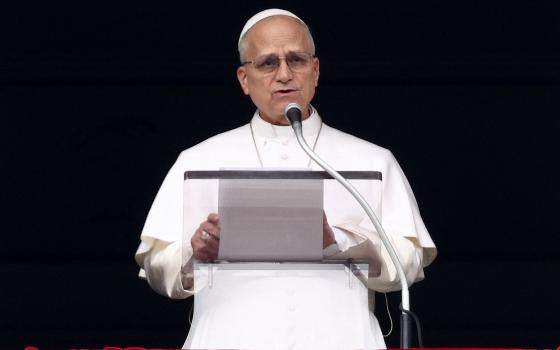
The loneliness crisis will not be healed by better messaging or more programs. It will be healed through clergy support, deeper relationships — especially with marginalized communities — and collective action for the common good. In Dilexi Te, Pope Leo XIV reminds us that God reveals himself not in isolation, but by coming down to deliver his people. This is how the church creates heaven on Earth — not someday, but now. If this moment of grace is met with courage rather than caution, the church can help heal the primary wound of disconnection. And in doing so, participate in God's work of restoring a little more of heaven on Earth, here and now.