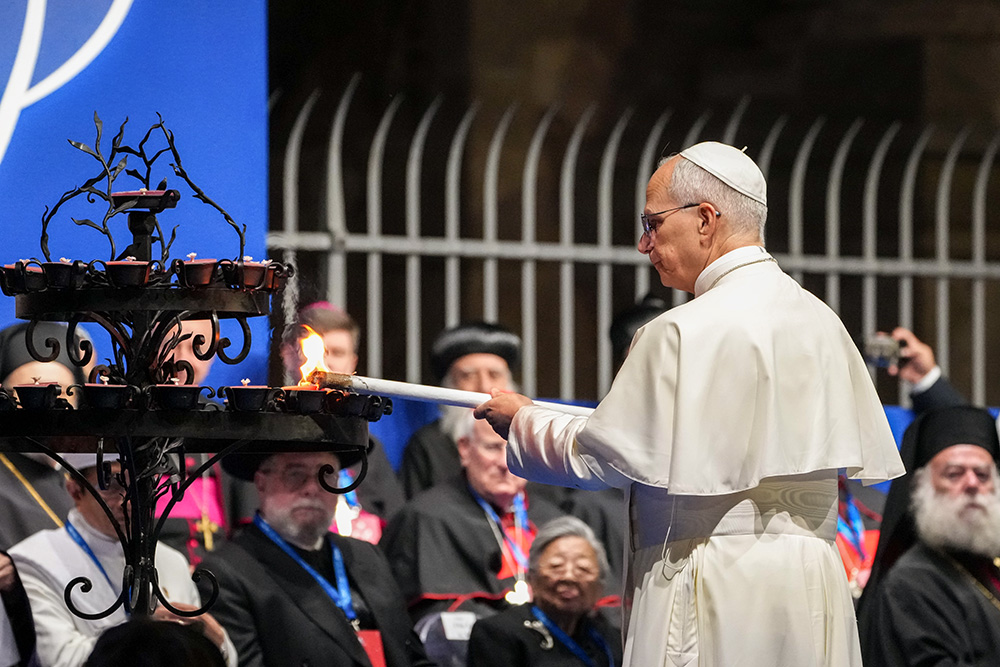
Pope Leo XIV lights a candle during an international gathering for peace attended by leaders of Christian communities and other world religions at the Colosseum in Rome Oct. 28, 2025. The annual International Meeting of Dialogue and Prayer for Peace was organized by the Rome-based Community of Sant'Egidio. (CNS/Lola Gomez)

by CJ Pine
In the face of widespread conflicts, peacemaking must be the first global priority. Pope Leo XIV has the unique potential to utilize his pastoral and political platform for tangible, lasting peace beyond the signing of deals. As pontiff, Leo bridges high-level and grassroots lines of effort — he relates to global leaders as peers, offers direction for the Catholic church toward peace, and inspires broader communities about long-term social change. His leadership and powerful embrace of perseverance and intercommunal reconciliation can achieve something greater than temporary pauses in fighting.
In his international travels to date, Leo has spoken against the devastations of war and modeled the importance of dialogue. His planned visits to Angola and Spain, including the Canary Islands, provide opportunities to further champion his holistic message for peace.
While world leaders are focused on negotiations to reach ceasefires, Leo's leadership fills a critical gap in the work of reorienting conflict parties toward lasting peace. To break cycles of violence, the sustainability of any agreement must be foregrounded.
The Vatican has already explored how the contributions of religious mediators complement those of secular ones. Religious and political tracks to peacebuilding are not mutually exclusive, and should both be measured by their ability to deliver concrete results.
Similarly, the pope's leadership for peace goes beyond simply expressing high-level principles or aspirations, but requires concrete political engagement that responds to current events. Leo demonstrated this when speaking about his engagement with Turkish President Recep Tayyip Erdogan, taking the opportunity to reiterate the Vatican's support for the two-state solution between Israel and Palestine.
Advertisement
In Lebanon, Leo spoke with youth about a vision of perseverance and described Christian-Muslim solidarity as one of his core messages. His meeting with families at the site of the Beirut port blast site was perceived as spotlighting the need for justice for victims — Muslim and Christian.
Point 18 of U.S. President Donald Trump's Gaza peace plan, which calls for an "interfaith dialogue" to "change mindsets and narratives," could serve as a recent example of that vision in practice. The pope's role is to utilize this type of opening, giving it weight and visibility, while empowering religious communities on the ground to carry out the difficult work of implementation.
Peter Mandaville powerfully described the potential of point 18, and the risk of such efforts being reduced to "peace theater" without concrete commitment. Leo has described his prioritization of peacebuilding as a vision for the full apparatus of the church working as a bridge-builder, far beyond a one-off event or press conference. It is critical for this vision to carry through at all levels, including in the pope's upcoming travels.
In Angola, Leo will build on legacies from his predecessor's last visit to the African continent in 2023. We should expect Leo, alongside Angolan President João Lourenço, to express a vision for sustained peacebuilding.
Pope Francis spoke of sowing seeds of peace ahead of his visit to the Democratic Republic of Congo and South Sudan. Leo can call for the nurturing of those seeds, alongside Lourenço, complementing the latter's concurrent position as president of the African Union and former mediator for eastern Congo.
In Leo's planned travel to Spain and the Canary Islands, he carries forward Francis' pastoral attention to migrants. Through this visit, Leo emphasizes the church's call for solidarity with those on the margins of society, as well as rebuke of global inequality, polarization and xenophobia.
Significantly, Leo's identity as the "first American pope" means he has responsibility to speak clearly against violence and conflict caused by the United States. Leo has shown that he will utilize religious tradition to advocate for the rights of migrants or for the U.S. to step back from conflict with Venezuela.
At a time when Trump often pushes transactional deal-making in response to conflicts, there is precisely the need for Leo to champion the work of long-term and lasting peace. There is not a clean dichotomy where the first approach is only cynical and the second idealistic. Both can be tools to deliver results. However, the first approach has been shown to be insufficient on its own.
One of the pillars of interreligious peacebuilding, according to Leo, is "to bring hope to a humanity that is often tempted by despair." In his travels to Turkey and Lebanon, he consistently raised the message of hope for peace precisely in the midst of tensions. Political tracks of peacebuilding are limited when devoid of narratives for, and belief in, the possibility of peace.
Leo's upcoming travels to Angola, Spain and the Canary Islands offer him significant opportunities to build on his leadership for sustained peace. His messages and dialogue substantiate the belief that global conflicts are not inevitable, carrying forward the rich traditions of peacebuilders who forge multitrack and resilient approaches.