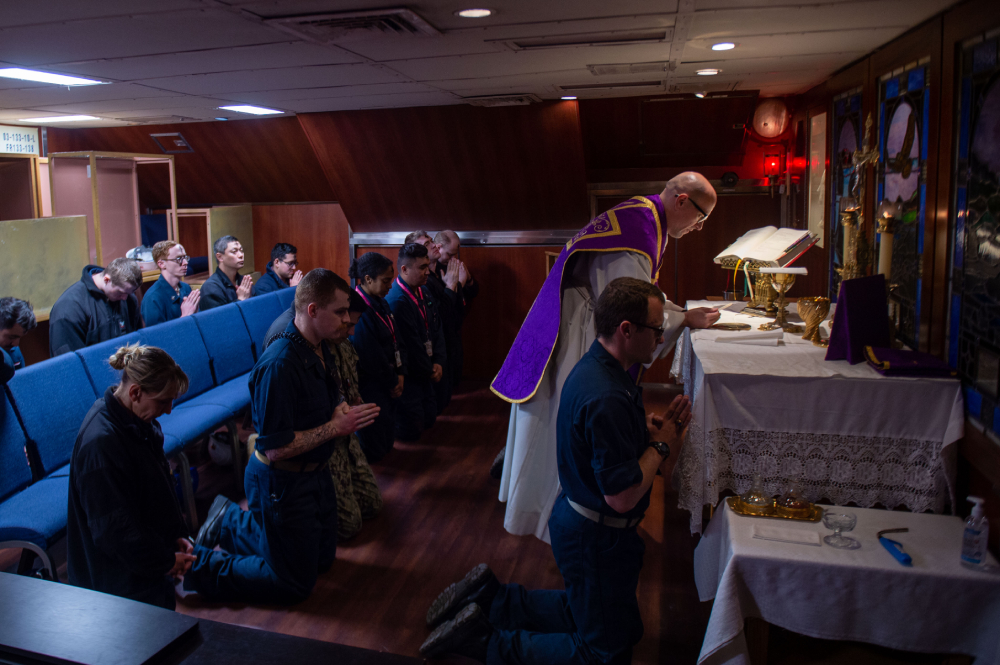
Lt. Jacob Meyer, center, a chaplain, reads from the Bible during a Catholic Ash Wednesday service in the chapel aboard the U.S. Navy's only forward-deployed aircraft carrier, USS Ronald Reagan (CVN 76), while in port at Fleet Activities Yokosuka, Feb. 14, 2024. (U.S. Navy/Mass Communication Specialist 3rd Class Kyree Rogers/240214-N-SO660-1039)

by Cynthia L. G. Kane
The carrier flight deck was just waking up. The air held the bite of salt and the tang of jet fuel. A young Sailor stopped me in the passageway and asked if we could talk somewhere private. We stepped into a corner behind stacks of cargo nets. The deck roared above us. He began to tell me something he had been carrying for weeks.
Moments like that do not appear in the Pentagon's vision for future conflicts. Planners track missiles, fuel and bandwidth. They map autonomous drones that select targets, artificial intelligence that coordinates attacks and encryption no rival can crack. The technology is impressive. But the souls of the people are harder to find.
A missing presence
I have served as a Navy chaplain for 26 years. Today I oversee religious ministry for more than 164,000 sailors, marines, coast guardsmen and families in Navy Region Southwest. In Southern California, I have arranged contracts with priests credentialed by the archdiocese for the military services. They serve roughly 33,000 Catholics in uniform. The region has two such contracts, in addition to one active-duty Catholic priest. Across the Navy, there are about 40 active-duty Catholic priests for 75,000 Catholics.
Numbers alone do not tell the story. Catholic teaching holds that every person is created in the image of God. The Gaudium et Spes constitution names the human being as "the only creature on earth that God willed for its own sake." That truth matters on the flight line, in the engine room and in the command center.
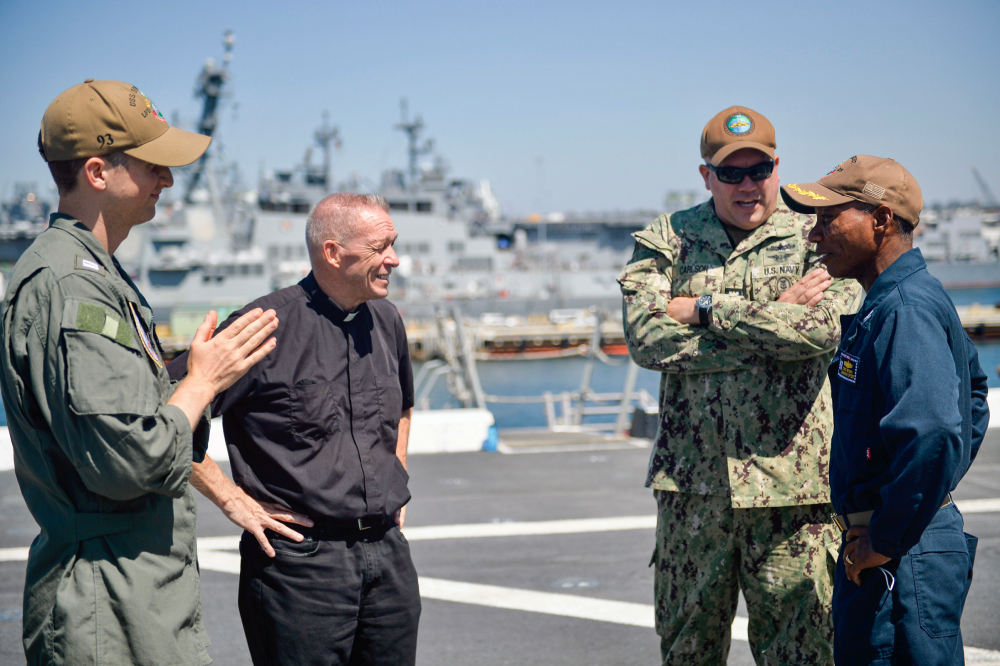
Fr. Shuley, Naval Base San Diego, aboard USS SOMERSET. (U.S. Navy Public Affairs/Defense Visual Information Distribution Service)
What I see on the ground
Navy SEALs ask for chaplains before they deploy. Marines seek the sacraments before they step into danger. Drone operators in Nevada live with the images they see on their screens. Cyber teams know that keystrokes can put lives at risk. The tools change. The weight on the conscience remains.
I have sat with Marines who expected to take a life before sundown. I have prayed with Coast Guard crews returning from missions where not everyone survived. These encounters do not fit into a readiness checklist. They depend on the presence of someone who will listen without judgment, pray without rushing and share the burden.
A single fighter aircraft runs into the hundreds of millions. A chaplain's presence costs far less, and it yields something no weapon can: warriors who can live with what they have done.
Conscience in an age of algorithms
The Vatican's 2025 document Antiqua et Nova teaches that moral responsibility belongs to human beings, not machines. Pope Leo XIV has warned that technology must serve human dignity. In war, this means keeping moral reflection at the center of operations.
Autonomous systems create distance between action and consequence, and that distance is physical, not moral. A pilotless aircraft may deliver the strike, yet a human being carries the decision. Without chaplains, that moral load often remains unspoken. Silence drives it deeper.
More than services
Chaplains do more than lead worship — they ask questions others may not. In planning rooms, when the discussion turns to what is possible, a chaplain may ask what is right. They remind leaders that lawful orders can still wound the spirit, and that the cost of war reaches far beyond the battlefield.
History gives proof of their place. In the Pacific during World War II, Catholic chaplains heard confessions in foxholes and celebrated Mass on ship decks. In Afghanistan, they walked with their units, carrying scripture and sacrament into the fight. Though these acts did not appear in mission briefings, they held the moral fabric of the force together.
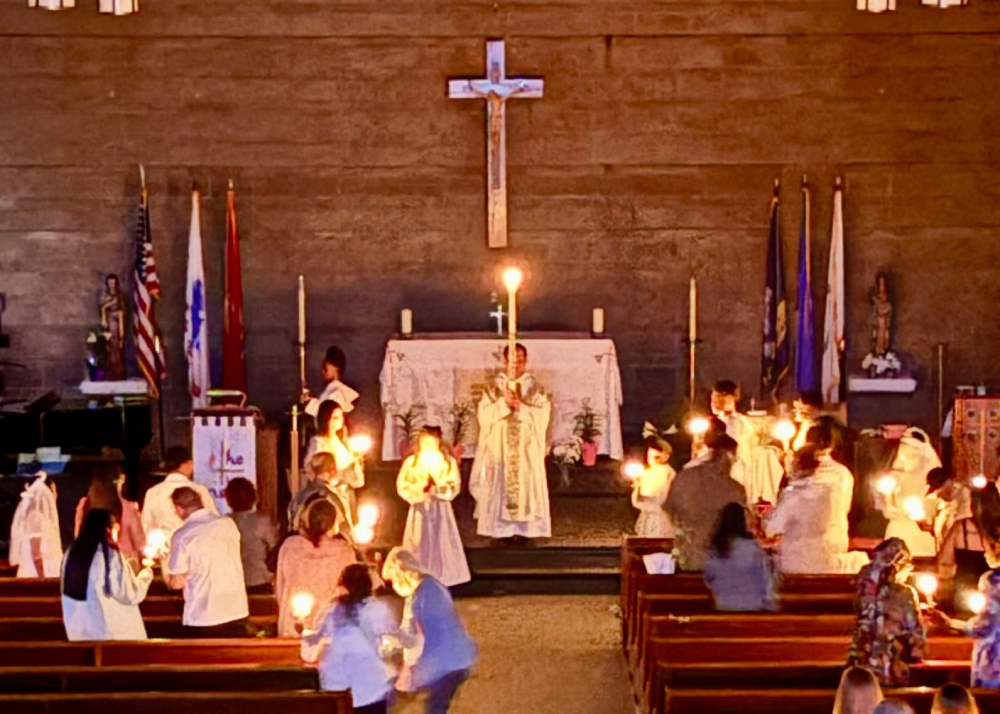
Fr. Britanico, Naval Air Station Lemoore, conducting Easter services. (Courtesy of RP2 Brian Wilson, NAS Lemoore)
Building true readiness
Recruiting more chaplains is one part of the answer. The deeper change is to treat spiritual care as core military infrastructure. Planning exercises should include chaplains from the start. Leaders should see the spiritual resilience of their people as bound up with physical training and tactical skill.
The cost is modest. A single fighter aircraft runs into the hundreds of millions, but a chaplain's presence costs far less, and it yields something no weapon can: warriors who can live with what they have done.
Technology can help chaplains reach more people through secure communication or virtual visits. It cannot, however, replace the sacramental presence or the bond formed when someone stands beside you during the hardest moments.
Advertisement
Why this matters now
The military already names some capabilities as "force multipliers" because they strengthen the whole. Chaplains multiply strength in ways that are less visible, yet just as real. Their work deepens trust, steadies morale and anchors conscience.
A future without chaplains is easy to imagine, but that future is not inevitable. We can choose to keep the priest on the flight deck, the rabbi in the field tent, the imam in the hospital ward. We can decide that conscience belongs in the room when lethal choices are made.
The human question
In the end, this is not about technology or tactics. It's about who we are when war comes. Will we field a force that moves faster than thought, with no one left to speak of the meaning? Or will we keep sight of the truth that every life matters beyond the mission?
I think back to that sailor on the flight deck, standing in the corner with me as the ship came alive. For him, the presence of a chaplain was the difference between facing the day alone and facing it with someone willing to carry the weight alongside him.
That is worth planning for.