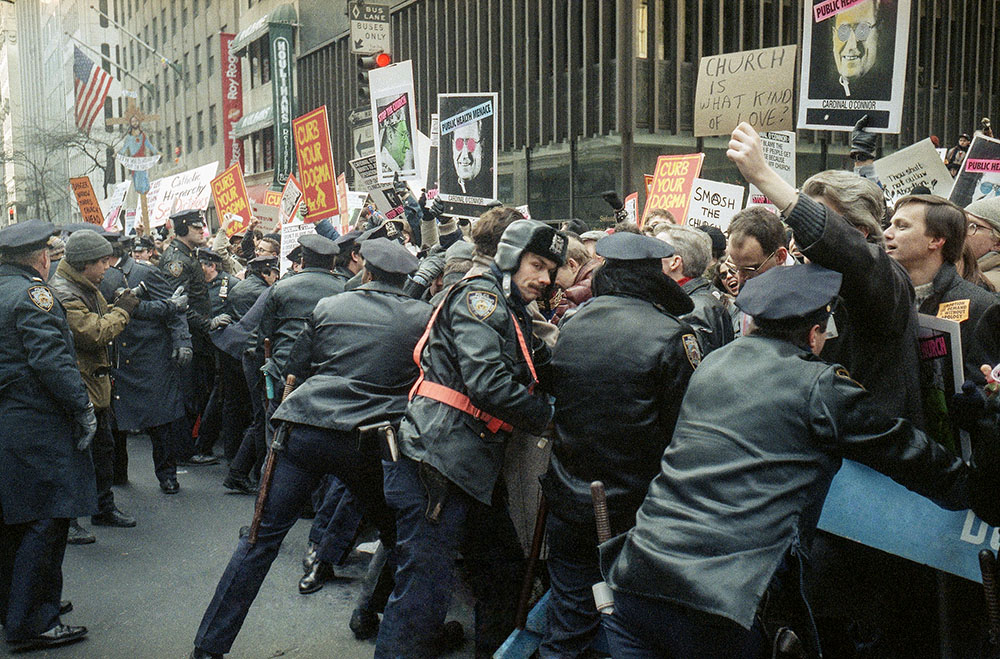
Police keep AIDS activists and pro-choice groups demonstrating outside of St. Patrick's Cathedral behind barriers, Dec. 10, 1989, in New York City. (AP/Frankie Ziths)
by Kevin Hershey
As pro-Palestinian and anti-ICE protests surge across the country, Gov. Kathy Hochul of New York has announced her support for a statewide bill that would effectively ban protesting on public property immediately outside of houses of worship. This bill is a response to a series of demonstrations that took place outside of New York synagogues that were hosting events to promote the sale of property in Israel, including in illegal settlements in the occupied West Bank.
Understandably, the proposed law was not written for Catholics, but to protect Jews, among other minority religious groups. Yet I am concerned that this bill will impact all faith communities, and will not address the root causes of danger. The scope of the bill will do more to limit protesters' rights than to address issues of safety for worshippers of any denomination.
One of the most well-known protests in New York City history took place at St. Patrick's Cathedral in 1989. Catholic and non-Catholic members of the group AIDS Coalition To Unleash Power (ACT UP) demonstrated outside the church, calling church leaders murderers for their efforts to stop the distribution of condoms and end safe sex education programs.
Inside the church, some protesters laid their bodies on the ground, screamed accusations at the congregation, and one even smashed the Blessed Sacrament on the floor. Fifty-three protesters inside the church were arrested for trespassing and removed from the church.
A later federal law, the Freedom of Access to Clinic Entrances Act of 1994, was passed, prohibiting the disruption of a religious service, and the obstruction of people from entering a place of worship or reproductive health clinic.
Advertisement
ACT UP members themselves had mixed feelings on the morality of indoor demonstrations. But all seemed to agree that protests outside the church were well within their rights, and that this demonstration forever changed the public perception of the church.
The church did not stop being the site of protest in 1989. In 2013, gay Catholics demonstrated outside of the same St. Patrick's Cathedral with dirt on their hands to respond to Cardinal Timothy Dolan's homophobic comments about LGBT Catholics. In 2025, Catholics rallied outside the cathedral in Rockville Centre, New York, to demand that Bishop John Barres take more action to stop President Donald Trump's mass deportation efforts. As recently as last week, protesters against Immigration and Customs Enforcement stormed a Minnesota Protestant church and the attorney general of that state has defended them.
All these actions have made some Catholics uncomfortable and angry. All of them have called vital attention to issues at the very core of Catholic and American lives. All of them would be illegal under the proposed law.
I worry about a Catholic Church that is protected from protest. I worry that such a law would make us further immune from responsibility for the harmful actions of our institution.
The truth is, houses of worship in our country are not safe. But unarmed protesters are not the problem. Armed white nationalists who have murdered congregants in synagogues and Black churches are not protesters. The ICE agents who wait outside churches in Chicago to intimidate and kidnap worshipping families, and those who arrested worshippers outside a mosque in Albany, New York, along with police departments that have infiltrated mosques in campaigns of mass surveillance — none of them are protesters.
Catholics know all too well that some of the people who make our parishes the least safe are clergy and staff. The hundreds of thousands of Catholic children sexually abused by priests, and Jewish children abused by rabbis, were not harmed by protesters.
If we care about the safety of our faith communities, we should not concentrate our efforts further removing our houses of worship from public critique. We should focus on stopping access to guns, protecting children from sexual violence, keeping ICE out of our cities, and ending racial profiling and police surveillance.
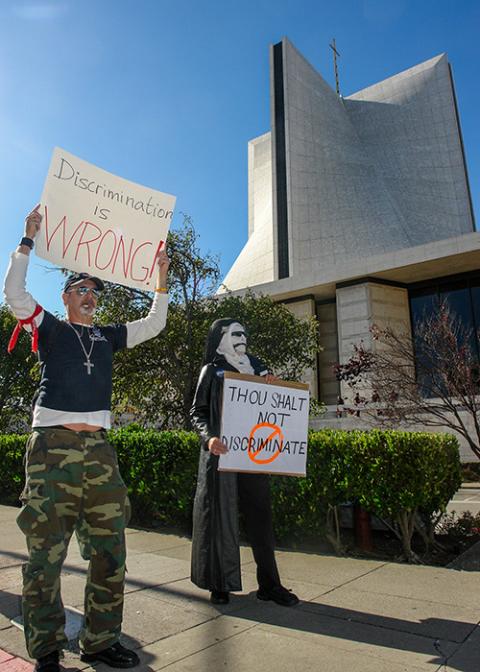
Supporters of same-sex marriage protest outside San Francisco's St. Mary's Cathedral Nov. 9, 2008. (CNS/Catholic San Francisco/Dan Morris-Young)
I worry about a Catholic Church that is protected from protest. I worry that such a law would make us further immune from responsibility for the harmful actions of our institution. I worry that it would further obscure the dishonorable aspects of our church from public view, after groups like ACT UP and DignityUSA have worked so hard to hold us accountable. These groups have demanded that our church respond to its members, and that we live up to our commitment to the marginalized. Through public demonstrations, they have not let our leaders forget their responsibilities to LGBTQ people, the sick and immigrants.
I share the concerns of some Jewish groups, who hold dear their right to protest their own religious institutions. The church is not a democracy, and protest is often the only way Catholics can make our voices heard.
In 1989, a group of ACT UP members stormed St. Vincent's Hospital in New York City to protest homophobia of hospital staff. They damaged property and put condoms all over a statue of Christ. Rather than press charges, the Sisters of Charity who ran the hospital met with ACT UP leaders and asked how they could respond to their demands. This is the type of faith community that I want to see in New York — one that is responsive to public need, one that engages with critics rather than silences them.
The proposed law to limit protests outside houses of worship is meant to give Jews and other groups the sense of safety we all deserve when we pray. But this proposal does not address the root causes of danger in faith communities, and its impacts will go beyond the safety of minority groups.
I know that the Catholic Church needs protest and dissent to stay alive. If the public wants to gather at our doors and address the multiple ways our church has harmed and failed our communities both past and present, let them.