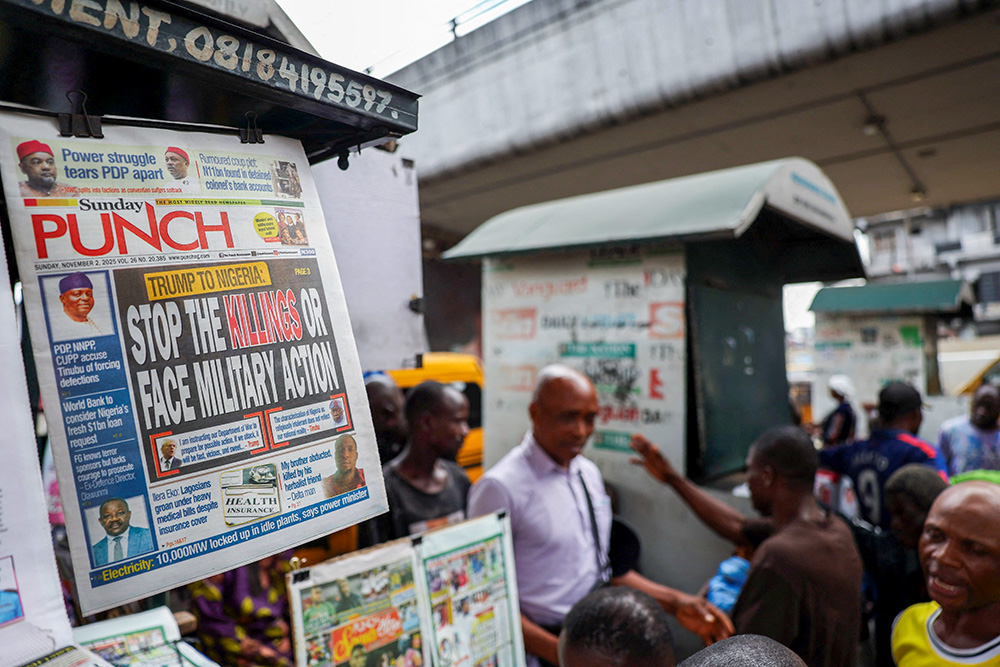
A newspaper with an article reporting U.S. President Donald Trump's message to Nigeria over the treatment of Christians hangs at a newspaper stand in Ojuelegba, Lagos, Nigeria. Nov. 2, 2025. (OSV News/Reuters/Sodiq Adelakun)

by Stan Chu Ilo
When President Donald Trump threatened to go into Nigeria " 'guns-a-blazing,' to completely wipe out the Islamic Terrorists who are committing these horrible atrocities," he reignited an old illusion — that America can save Africa from itself, or that the United States has the right to strike any nation without regard for international law or sovereignty.
In Nigeria, some welcomed Trump's warning as proof that someone powerful was finally paying attention — a savior who might rescue them from a captured state ruled by a few political elites whose extractive and manipulative leadership has brought a once-great nation to its knees. Others dismissed Trump's threat as grandstanding by a man deflecting from turmoil at home.
As a Nigerian priest, theologian and advocate for Gospel nonviolence and an inclusive community everywhere, my argument is simple: Trump and America cannot save Nigerian Christians or Nigeria because both nations are facing existential crises about the survival of democracy and the moral foundations of a just, inclusive and pluralistic society.
The United States, under Trump, bears deep wounds in its democracy, moral imagination, and sense of shared purpose. The Jan. 6, 2021, insurrection was not an anomaly; it was a revelation of how far a politics of grievance and racial entitlement can corrode the foundations of liberty. The national debt has soared beyond $38 trillion, job growth has slowed and polarization has hardened into tribal warfare.
These are not the marks of a nation capable of rescuing another. The U.S. cannot heal Nigeria because it has not yet healed itself. The loudest champions of freedom abroad have allowed fear and resentment to corrode freedom at home. Extremist groups, emboldened by hate and conspiracy, spread division in a society that, as the U.S. surgeon general noted in his 2023 report, is suffering from "an epidemic of loneliness" and a breakdown of social connection.
Advertisement
After 9/11, many Americans began to search for a savior — a leader who could restore their lost sense of greatness. Harvard social psychologist Robert Jay Lifton described this in 2003 as a "superpower syndrome": a national mindset that grants a nation a sense of omnipotence and entitlement — the right to hold sway over all others. It creates an illusion of invulnerability and a "cosmic ambition" to shape the world in its own image.
This mindset fuels a neuralgic reconstruction of national identity, seen in Trump's interventionist posturing and his belief that electoral victory vindicates an infallible vision of America. Those who reject it are branded as enemies or purveyors of "fake news." Such delusions of grandeur make truth a casualty and diplomacy an afterthought.
Superpower syndrome also breeds apocalyptic thinking — justifying aggression as moral duty. Under this logic, it becomes acceptable for an American president to threaten military attacks or engage in gunboat diplomacy, as Trump has done against nations like Venezuela.
Barack Obama's "Yes, we can" stirred hope but faltered against entrenched cynicism. Trump's "America first" took that yearning and weaponized it. His movement — built on nostalgia, nationalism and white grievance — transformed politics into a kind of civil religion. America once exported democracy; today, it exports its discontents.
The Public Religion Research Institute reports that nearly three in 10 Americans sympathize with Christian nationalism — the belief that America was and must remain a Christian nation. Alarmingly, 40% of them believe "true American patriots may have to resort to violence to save the country." When Christianity is reduced to a flag, a slogan or a weapon, it loses its soul.
Nigerian Christians should be cautious. Aligning with the American religious right as a counterweight to Islamist extremism would be a tragic mistake. It risks importing the same toxic brew of faith and fear that now threatens American democracy — a fusion of piety and paranoia that turns neighbors into enemies and politics into a crusade. This path could plunge Nigeria into a religious war.
Trump cannot fix America, and America cannot fix Nigeria. Both suffer from the same disease — the worship of power, eclipse of freedom and the constitutional order, and the loss of moral imagination.
America's record as a liberator of Black nations offers little reassurance. In Somalia, U.S. troops entered under Operation Restore Hope in 1992 but withdrew in 1994 humiliated after the 1993 Battle of Mogadishu, when soldiers' bodies were dragged through the streets.
In Haiti, repeated U.S. interventions — from 1915 to 1934, and again in 1994-95 — brought neither democracy nor prosperity. After billions in aid, Haiti remains the poorest country in the Western Hemisphere.
Across Africa, U.S. military operations under AFRICOM — from drone strikes in Somalia to training missions in Niger — have done little to stem jihadist violence, which, according to the monitoring organization Armed Conflict Location & Event Data, has more than doubled in Burkina Faso, Mali and Niger in West Africa since 2021. America's foreign crusades, cloaked in moral rhetoric, too often leave behind chaos, not freedom.
Meanwhile, U.S.-Nigeria relations have grown transactional and tepid. America once relied on Nigerian crude for about 10% of its oil imports; today, that figure is below 1%. Nigeria is no longer a strategic priority in Washington. No amount of presidential bluster will change that.
Malcolm X once warned Africans to look at how America treats its Black citizens before trusting its promises to other countries. The data remain damning. Black Americans live, on average, three to five years less than white Americans. Their median household wealth is one-sixth that of whites. They are imprisoned at five times the rate and remain disproportionately victims of police violence. And as Martin Luther King Jr. said, "Of all the forms of inequality, injustice in health care is the most shocking and inhuman."
If America cannot ensure justice for its own Black citizens, it cannot credibly claim to deliver justice for Nigerians.
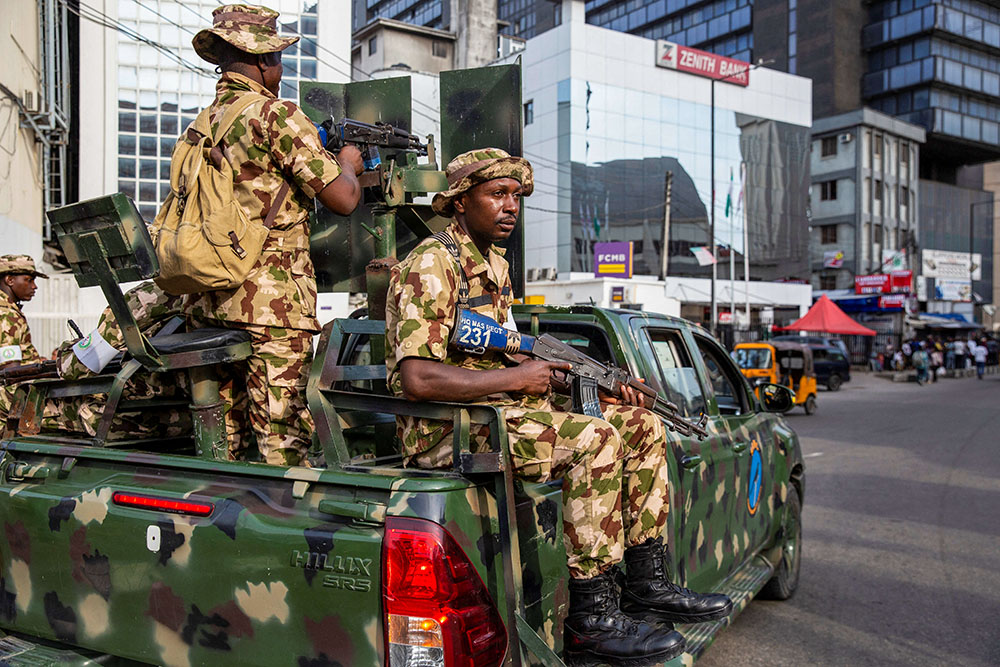
Nigerian soldiers patrol near a market to prevent violence in Lagos Island Feb. 27, 2023. (OSV News/Reuters/James Oatway)
Nigeria, too, is searching for saviors — from the political cabal surrounding President Bola Tinubu to the messianic hopes vested in opposition figures like Peter Obi. The nation has placed too much faith in personalities and too little in institutions or the agency of its citizens. When citizens surrender their agency to strongmen, democracy decays into rituals and hero worship.
Nigeria's crisis is not only political; it is moral and spiritual — a collapse of civic trust and collective purpose. More than 129 million Nigerians live below the poverty line, according to the World Bank. Unemployment for 25- to 34-year-olds hovers near 37%. Transparency International reports that 44% of public service users in Nigeria paid a bribe to access those services. These numbers tell the story of a people trapped between fear and fatigue, ruled by elites who privatize hope and weaponize poverty.
Trump's threats will not change that. The salvation of Nigeria will not come from Washington, London or Beijing. It will not come from weapons, sanctions or well-meaning speeches about freedom. It will come from Nigerians themselves — from rebuilding institutions, reviving public ethics, and rediscovering a shared vision of the common good and the true values of African ubuntu spirit of inclusion and pluralism.
The task before the church and civil society is not to anoint the next savior but to awaken the conscience of the nation. Pope Francis, in Fratelli Tutti, warns against populists who "seek popularity by appealing to the basest and most selfish inclinations of certain sectors of the population." Such politics replaces love of the people with manipulation of the people. Nigeria knows this story too well. The same demagogues who steal elections now pose as defenders of faith and nation.
Trump cannot fix America, and America cannot fix Nigeria. Both suffer from the same disease — the worship of power, eclipse of freedom and the constitutional order, and the loss of moral imagination. A cross draped with any flag ceases to be a symbol of salvation; it becomes a religious ideology of naked power.
Nigeria's freedom will be born not of foreign intervention but of national conversion — a reawakening of justice, courage and truth. Until then, no American president, no populist prophet, and no strongman will save us from ourselves.