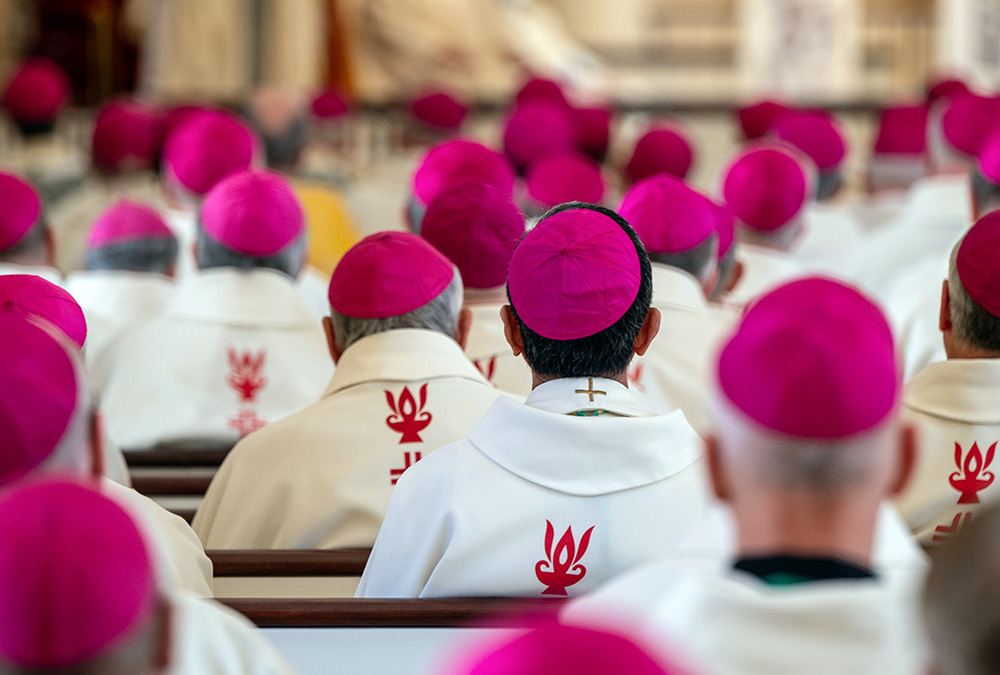
U.S. bishops gather for Mass at the Basilica of the National Shrine of the Assumption of the Blessed Virgin Mary in Baltimore in a November 2024 file photo. (OSV News/Catholic Review/Kevin J. Parks)

by Stephanie J. Peddicord
Recently, a reel came across my social media feed: a Catholic cleric emblazoned in amaranth red, seen shouting down Immigration and Customs Enforcement agents and defending the steps of his sanctuary. In it, he boldly declares, "I don't know what God you worship — maybe an orange one — but my God is love! Now go, and don't come back."
The violent shooting deaths of Renee Good and Alex Pretti were still raw; the continued unrest in Minneapolis was visceral, scary and deeply unsettling. Doomscrolling had become a bleak part of my morning routine, as ritualized as getting my kids off to school and playing Wordle.
But this reel was different. Finally, one of our shepherds was standing up — literally and figuratively — to ICE. This bishop was unapologetic — brazen, even — in defense of our immigrant brothers and sisters. He looked in the eyes of those agents and spoke with conviction and clarity.
It felt like he was speaking on behalf of me and all Catholics of goodwill — saying to ICE what we might, if given the opportunity.
Not long after, I hopped on Zoom, where I shared about the reel with younger colleagues, eagerly emphasizing, "I need to go back and find that video. I couldn't immediately place which bishop it was, but I'm super curious. He needs to be celebrated!"
Advertisement
One of them — at once chagrined and sympathetic — delivered the blow: "That video is a fake. AI. I know — it would be awesome if it were true. But sadly, not."
I had been duped.
Not only had I just revealed myself as a rube to my staff (and my Gen X embarrassment was palpable), but I was bereft with disillusionment. I had really — really — wanted that reel to be real.
I wasn't the only one. The now-debunked video had been shared hundreds of thousands of times across various platforms, with comments like "Preach!" and "Amen" and "Enough is enough for clergy too."
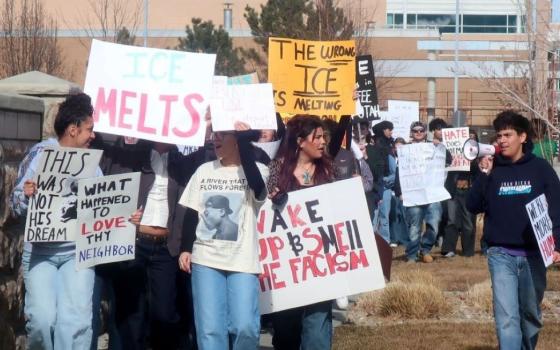
For weeks, we had seen the resistance rising in Minneapolis and elsewhere, with religious leaders at the center of the action. On Jan. 23, an ecumenical protest at the Minneapolis-St. Paul International Airport drew clergy from across the country to stand in solidarity against unjust deportations, resulting in more than 100 arrests. On Jan. 29, some 80 clerical and community leaders gathered at the Hart Senate Building in Washington, D.C., to engage in prayer and civil disobedience, resulting in at least 54 arrests.
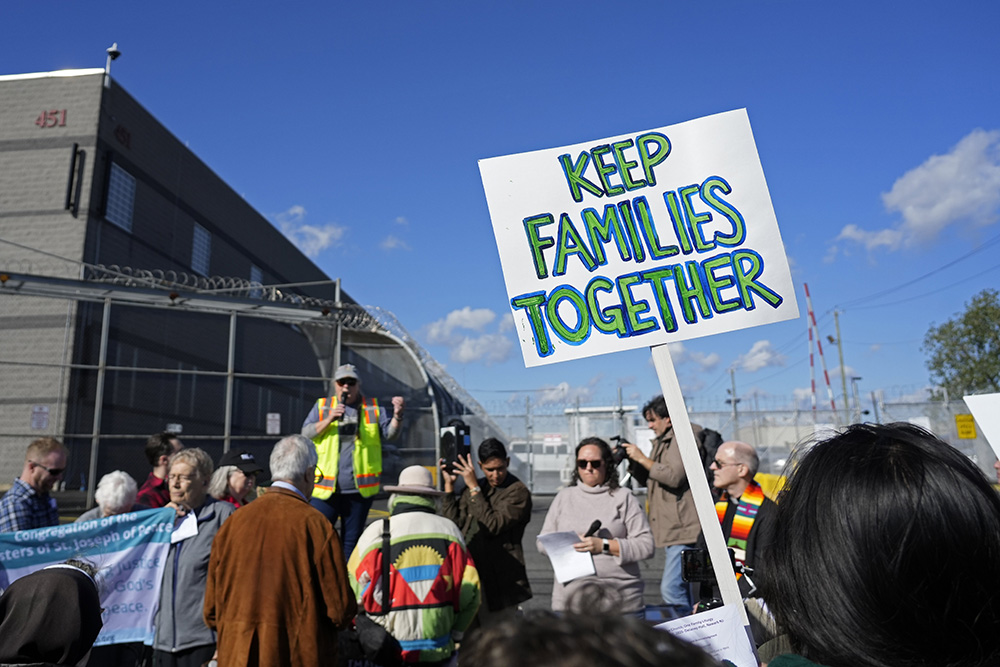
People gather for a pro-immigrant prayer vigil outside Delaney Hall, a migrant detention center in Newark, N.J., Oct. 22, 2025. The event was affiliated with the nationwide "One Church, One Family: Catholic Public Witness for Immigrants" initiative. (OSV News/Gregory A. Shemitz)
The visuals have been reminiscent of the height of the Civil Rights Movement. Martin Luther King Jr., marching from Selma to Montgomery, Alabama, flanked by thousands from diverse backgrounds and faith traditions. Historical record has shown that there were many Catholics present that day, including clergy, women religious, and laypeople. A 1965 story in Extension magazine said, "Selma was a call for a moral revolution of Christian witness and love in the hearts and minds of Americans."
I want to acknowledge that Catholics have been leading, too, in today's evolving movement of immigrant solidarity. This fall, "One Church, One Family" brought together Catholics from across the country in moments of collective action and response. A Jan. 27 webinar called "Taken, Broken, Shared: Catholic Witness Today" drew more than 2,000 participants, including four bishops, and quickly exceeded stream capacity. This national gathering spawned an effort for regional convenings calling for a "Season of Faithful Witness" to begin on Ash Wednesday, encouraging and inspiring local responses.
We often take for granted that women religious are at the forefront of these movements. It was not surprising to see several sisters from the U.S. Federation of the Sisters of St. Joseph and the Sisters of Mercy of the Americas among those protesting at the Hart Senate Building.
Speaking out is not acting out, and the faithful seem to be hungry for embodied, prophetic leadership.
But the response from the U.S. bishops has been, at best, episodic. To their credit, the U.S. Conference of Catholic Bishops has been more vocal than in the past. After the conference's November 2025 annual meeting, the bishops released a "special pastoral message on immigration," appealing to human dignity and compassion. Individually, select bishops have begun to speak out as well, praying for and asking for understanding, mutuality and peace in their own contexts.
But speaking out is not acting out, and the faithful seem to be hungry for embodied, prophetic leadership.
Bishop Rob Hirschfeld of the Episcopal Diocese of New Hampshire, called upon his pastorate to "get their affairs in order, to make sure they have their wills written. Because it may be that now is no longer the time for statements but for us with our bodies to stand between the powers of this world and the most vulnerable."
Perhaps this is what is needed at this moment in the Catholic Church. A Selma response for this — our Selma moment. Not only carefully worded press releases, but also bishops in collars showing up in really public ways on the front lines of our communities.
Again, there have been glimpses of this, however brief: Bishop Michael Pham of San Diego attending immigration hearings; Archbishop Thomas Wenski of Miami doing prayer vigils outside of Alligator Alcatraz; Bishop Mark Seitz of El Paso, Texas, holding a protest vigil and march.
The closest I have come to the now infamous AI reel was during a Jan. 26 webinar hosted by Faith in Action. Logging in that Sunday night, I was disappointed — but not surprised — to see that no Catholic clergy were scheduled among the speakers.
And then, at the end of the program, Cardinal Joseph Tobin of Newark, New Jersey, appeared on screen like a celebrity surprise guest.
In his quiet and characteristically unassuming way, he introduced himself as "Joe Tobin — servant of the Archdiocese of Newark," and went on to speak boldly and unapologetically about the militarization of our communities. He likened ICE to a "machinery of death" and implored participants to contact their representatives about a forthcoming vote on funding.
My husband eyed me quizzically as I pulled my chin from the floor and proclaimed, "It's Cardinal Tobin! Cardinal Tobin! This is huge!"
It was real. It was prophetic. And, by the following morning, it was everywhere.
If only this had happened on the steps of the U.S. Capitol or any one of our majestic cathedrals. I do have hope that those moments are on the horizon. When they do, I will proudly be there to link arms with my fellow Catholics — clergy and laity alike.