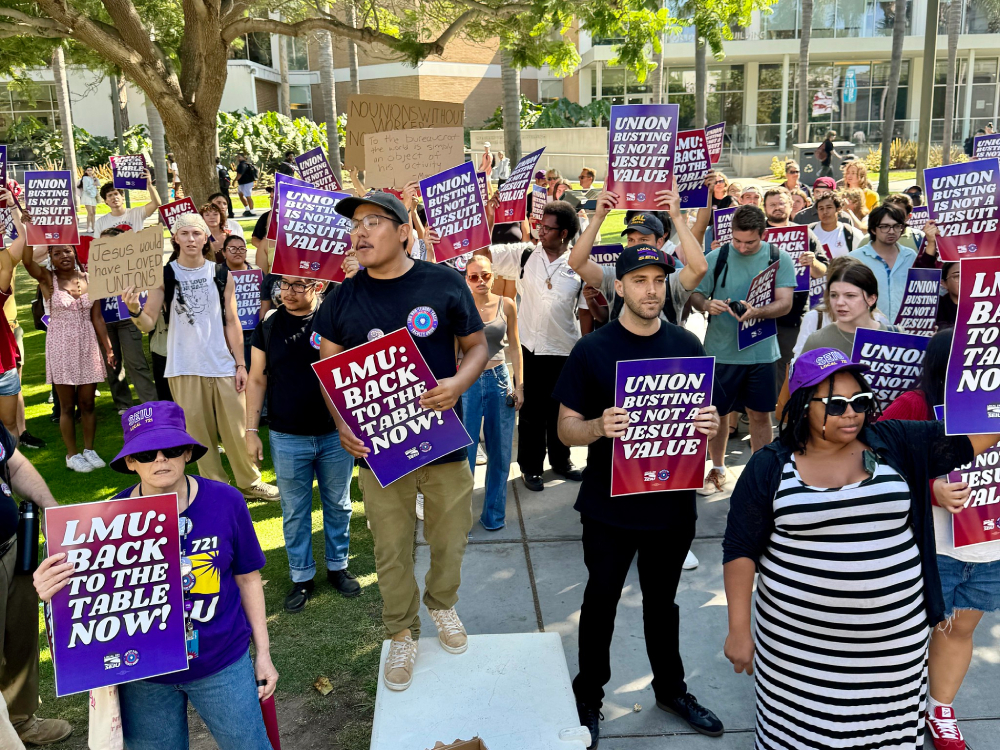
Protesters gathered Sept. 16 on the campus of Loyola Marymount University in Los Angeles, urging school officials not to dissolve the employee union. (Courtesy of SEIU Local 721/Emily Dorrel)

by David Kovacs
At 2 p.m. Friday, Sept. 12, the students, staff and faculty of Loyola Marymount University in Los Angeles received an email unlike any they had ever read. The Jesuit school's board of trustees had unanimously decided that they would no longer recognize the part-time and non-tenured faculty's labor union, or any other union among its employees. The official legal justification was "religious exemption."
LMU is not the first Catholic school to claim that religion precluded them from having a legally recognized union. That is not what made the email so unusual. Thanks to a rule change by Donald Trump's National Labor Relations Board (NLRB) in 2020, it is now considerably easier for Catholic schools to betray church teachings when their employees seek to unionize. What makes the LMU incident unusual is that 14 months earlier, they had recognized the union after the nontenured faculty overwhelmingly voted 227-29 to unionize. Before that vote was held, LMU never raised the religious exemption issue.
I have taught philosophy (with emphasis on philosophy of religion and the theology of Thomas Aquinas) at the school since 2018. As one of the union organizers, my specific focus has been on helping full-time faculty secure better long-term contracts. And I am pleased to say that I was able to work with LMU's administrators and bargaining team to improve the job security of a number of faculty members who had suffered from problematic practices in the past. While LMU and the union's leadership still had many issues to discuss, including the compensation issue (even full-time faculty make less than the local median income), I believed we were on a positive track. No one expected the board of trustees to direct administrators to change their position regarding the religious exemption.
To be clear: LMU recognized the union and began negotiations without ever suggesting a conflict existed between unionization and the school's Catholic, Jesuit mission. School officials only changed their mind over a year later after bargaining was taking place. By way of metaphor: You have every right to refuse to open a credit card if you believe such banking is against your religion; you do not get to take out debt, make a few payments, then suddenly remember that the pope told you not to open the credit card.
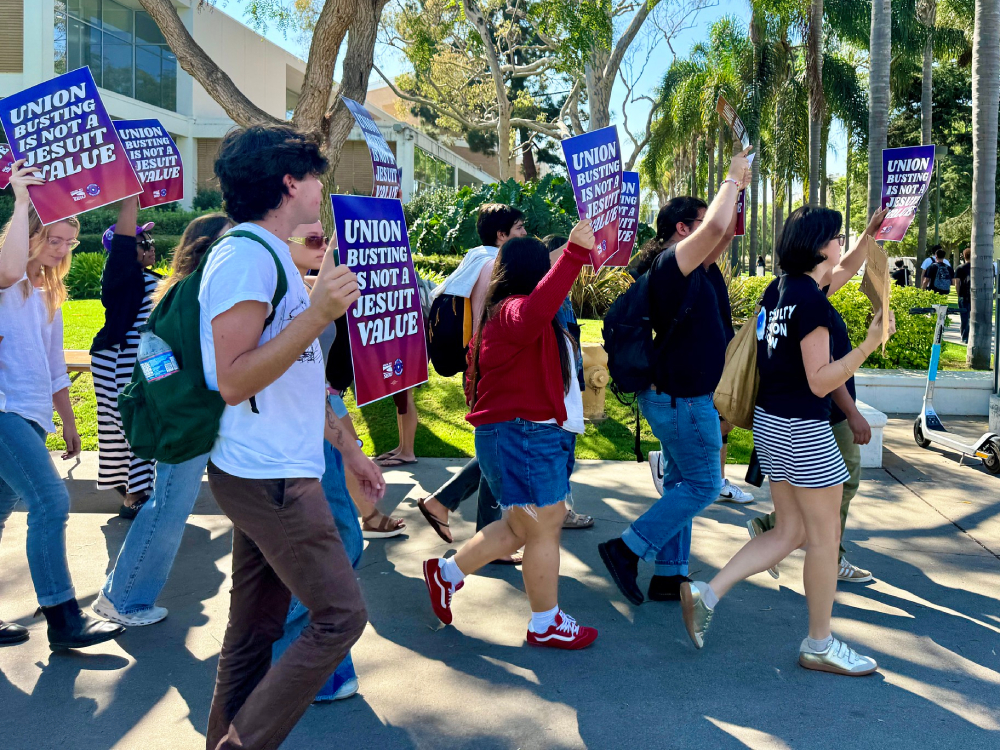
Protesters gathered Sept. 16 on the campus of Loyola Marymount University in Los Angeles, urging school officials not to dissolve the employee union. (Courtesy of SEIU Local 721/Emily Dorrel)
What is especially disappointing is that the board voted unanimously. The board of trustees at LMU includes at least seven Jesuits and two religious sisters, plus lots of business people. So much for the myth of the "liberal Jesuit school in Los Angeles."
For readers who may not know, the church has recognized the rights of workers to unionize in most circumstances since Pope Leo XIII'x 1891 encyclical Rerum Novarum. This position has only been strengthened by subsequent popes, including John Paul II, whose Laborem Exercens specified that unions were not purely the interest of industrial workers, but of all workers. None of that seems to matter to LMU's board of trustees.
Perhaps you are thinking I must be leaving something out of this story. You can't be blamed for hoping I will say that this happened because negotiations broke down or because the union's presence on campus raised problems. Yet nothing like that is true. In fact, the union presented a number of proposals, including one on compensation. The school's administration then declared via press releases that the compensation proposal would be unaffordable.
Advertisement
So far, this is all normal and acceptable: Initial compensation proposals in union negotiations can be rejected as unfeasible. The way for an employer to reject such a proposal is to offer a counter-proposal. This is what I would consider "bargaining in good faith." LMU never offered a counter-proposal on compensation. They merely announced in a Friday afternoon email that, at the insistence of the trustees, they would no longer negotiate with the union. The board of trustees emphasized that their decision was final: Not even the school's administrators would be able to change their minds.
This is a moment for all Catholic schools — and their powerful boards — to ask themselves whether they take seriously the Catholic Church's commitment to labor, including its repeated affirmation of the right to collective bargaining. If LMU wins its long-term goal of crushing unions on campus, it will set a precedent that allows other institutions, secular and religious, to further erode labor rights. It will be very sad if it is such an obviously Catholic name — Loyola Marymount University — that names the case which lawyers and activists will study for a generation.