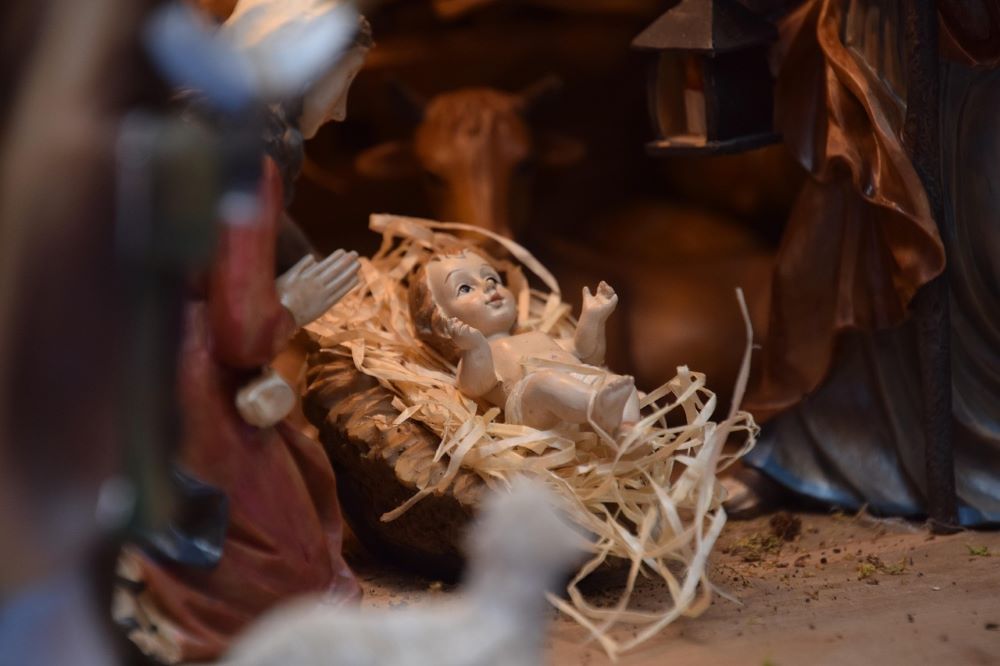
(Pixabay/giampaolo555)

by Cecilia González-Andrieu
Editor's note: This Advent and Christmas, Catholic Women Preach — now in its ninth year — continues sharing the voices of Catholic women by centering Latina voices.
What follows is the written text of a homily originally published on Youtube by Cecilia González-Andrieu, Ph.D., for Christmas Day. You can view the recording here.
What does it mean to have Christian faith? This may seem like an odd question on this Christmas day, but I think it might be the question today (Christmas day) is meant to answer.
The sad truth is that I often hear "I was raised Catholic but no longer identify as Catholic." It is a painful disclosure, an admission of the pain of losing home, and also of outrage because, as they see it, in contemporary Christianity, judgment and exclusion have overtaken love and compassion. Stepping away seems like the only solution.
What surprises people is that I encourage them to say more. "This you are saying right now, this is a sign of caring." The discovery that asking questions is encouraged by our faith, that their sense of feeling betrayed is often justifiable, and that this was frequently the very thing that the prophets and Jesus were doing, comes as a mystifying surprise.
Of course, being a Latina complicates matters even more. As a woman, I am often asked how I can stay in a church that sometimes acts in ways contrary to women's dignity. "This question you are asking right now — many of us are working hard on this."
What does it mean to have Christian faith? If anyone can tell us, it is the most vulnerable who see God's hand sustaining them and trust in the unconditionality of God's love.
Even more, living in the United States in an age of mass deportations and racial profiling, I am often asked how I can remain a Christian. Have I considered how many who call themselves Christians support the open assault on the dignity of immigrants? How many look the other way as we witness the destruction of families and the victimization of the hungry, the sick and the poor? "This question you are asking right now — this is what we all need to ask."
What does it mean to have Christian faith? What if I told you to look at Christmas for the answer?
The Catholic Church begins preparing for Christmas on the first Sunday of Advent, not by imagining a celebratory feast, but from the vantage point of a world that has repeatedly failed to "stay awake" and recognize God at work in history. The start of Advent sets up what seem like two irreconcilable truths: On the one hand is the stark realism that sees the human community as full of contradictions and prone to making horrible mistakes; and on the other, is the belief that these very same, inconsistent, broken and oh-so-flawed human beings are God's beloved creatures.
What does it mean to have Christian faith?
In the wisdom of our ancestors, the church gives several possible Christmas liturgies to help us probe this question, and if we examine the texts, we can discern a pattern.
First, the prophet Isaiah exposes the suffering of the community. I think of my sisters and brothers hunted down because they are brown, they work at service jobs, they live in poor neighborhoods and they are inherently vulnerable. They are justified to feel with Isaiah what it is to be "forsaken" and "desolate," to live in "a land of gloom" and under the "rod of … taskmasters." When I am given the gift of a conversation with the most vulnerable, those who wait tables and care for other people's homes and gardens and children, I hear Isaiah's cry of being "forsaken" and "desolate," and then … then I hear faith. Because just as Isaiah announces, they still find the courage to persist and believe that God "restores," "comforts" and "redeems."
What does it mean to have Christian faith? If anyone can tell us, it is the most vulnerable who see God's hand sustaining them and trust in the unconditionality of God's love.
Advertisement
The second thing the Christmas liturgies disclose is that Jesus — born on the margins, who dared to see and speak with the powerless in ways that returned them to personhood, is the "light of the human race." This child Jesus, whose entry into history we proclaim today is "the Word become flesh," bears "the imprint" of God, reveals God, is the glory of God!
What does it mean to have Christian faith? It means that our God made God's-self powerless to know us more intimately, and that as God's Word entered history, for one breathtaking moment all of Creation sang out with rejoicing. God is with us. God is with us always, and God dwells with us most perfectly in the ones who need us. Where are our mangers? Let us search for them because that is where Creation joins our song. To go to them, protect them, accompany them is to give our Christian faith meaning and to make our God present. Welcome home, Merry Christmas, let us sing!