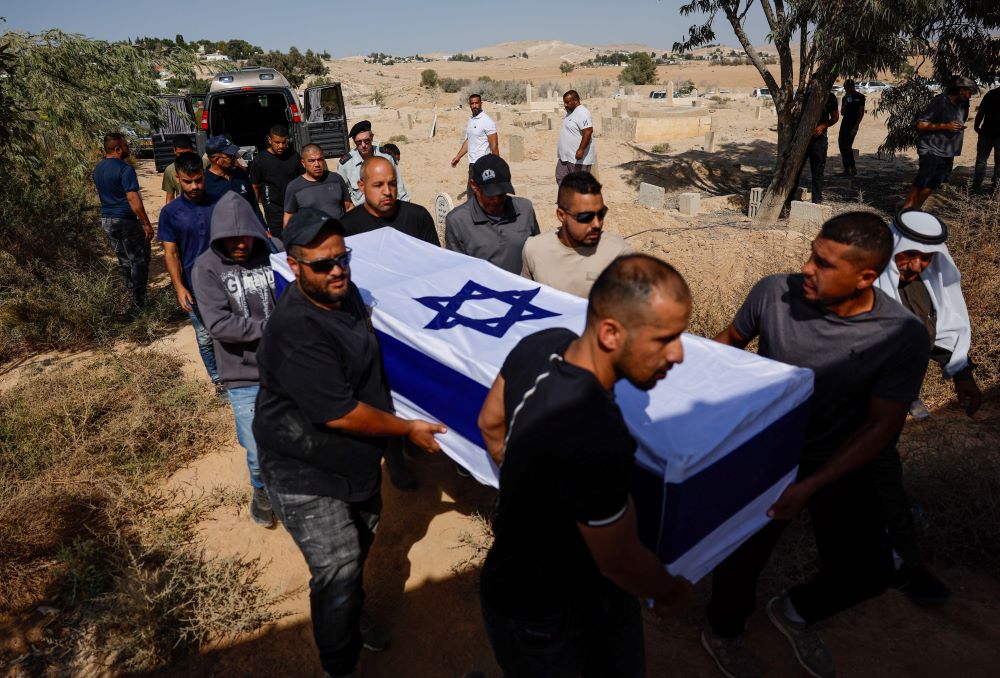
Pallbearers carry the coffin of Sgt. Major Muhammad al-Atarash during his funeral Oct. 16, 2025, in Sawe in southern Israel. According to the Israeli army, al-Atarash fell in combat during the Oct. 7, 2023, attack by Hamas on Israel. His body was taken by Hamas to Gaza and returned to Israel as part of a ceasefire and hostage-prisoner swap deal between Israel and Hamas. (OSV News/Reuters/Ammar Awad)
Judaism and the Jewish people have no better friend in the Christian world than the Catholic Church. As His Eminence, the late Cardinal Francis George said, for the Catholic Church, friendship with the Jewish people is doctrinal. The Jewish people pay close attention to what the church writes and says about Judaism, the Jewish people and the state of Israel.
It is equally important to note what is not said about us in a variety of Christian writings and statements. Much has been written about Israel's war with Hamas. Much has not.
The Israeli-Palestinian conflict is a tragic, this-worldly conflict. It is a clash of two just goods, two peoples establishing a home in the same land, at the same time. Its resolution will come, someday, through painful compromise, with both sides accepting fairly equal amounts of injustice.
A fragile Gaza ceasefire is now in place. Lasting peace is many steps away. These steps must be implemented with a mix of realism and hope. These virtues require clear thinking about the conflict by those committed to ending it.
The conflict imposed on Israel by Hamas, Hezbollah and Iran is not the same as the fight for a Palestinian state. It is a theological attack. From that perspective, Israel, a secular Western democratic state, a decidedly real-world enterprise like all nation states, is under assault by three eschatologies, three distinct theologies about the ultimate fate of the human soul and the approach of the end-times. It makes compromise in the search of peace uniquely difficult.
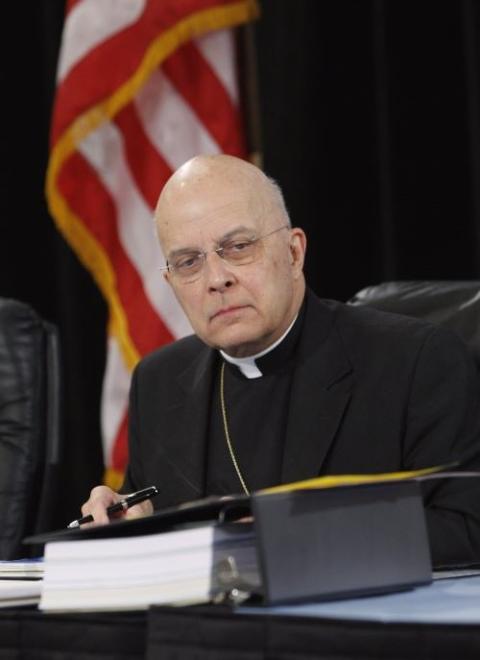
Cardinal Francis George of Chicago, then president of the U.S. Conference of Catholic Bishop, is pictured in a 2008 photo during the bishops' November meeting in Baltimore. (CNS photo/Nancy Wiechec)
Jewish eschatological messianism is held by a small percent of the Israeli Jewish population. This belief holds that the Jewish people are living in the messianic era, as evidenced by their return to the Land. Since the end of prophecy, the direct speech of God, it is forbidden for a Jew to assert knowledge of God's will and purpose in a natural or historical event, which is what these messianists do when they claim Jewish return to the land is a divine act.
Rather, Jewish responses to such events must be determined by the commandments of the Torah. False messianism is, according to Halacha-Jewish law, blasphemous. But this is the price the Jewish people pay for waiting, with firm belief, for the coming of the Messiah of the House of David. Some of us occasionally get impatient.
The second eschatology is Christian. This Christian messianism has two expressions. The first is presented by some Palestinian Protestant Christians such as Munther Isaac and Mitri Raheb. They believe that, since the Christian messiah has come, the Jewish people have no place in the Promised Land because they have rejected the messiah. The promises made to the Jewish people in the Torah are now erased, nullified or universalized.
These promises are inherited by the New Israel, those who have come to Christ. New Israel supersedes and replaces Old Israel. They extend the classic teaching of contempt for Judaism and the Jewish people to Zionism and the state of Israel. Supersessionism, which argues Christians have replaced Jews as the people of God, is not just the foundation of the Christian teaching of contempt for Judaism and the Jewish people. It is also the basis for Christian nationalism and white supremacy.
The other Christian messianism is premillennial dispensationalism. This messianism holds that God has two distinct covenants: one for Christians, the other for the Jewish people — who have returned to rule their ancient homeland in order to herald the Second Coming. These two messianisms share one thing in common: the belief that the Jewish people, with either the First or Second Coming, have no role in God's economy.
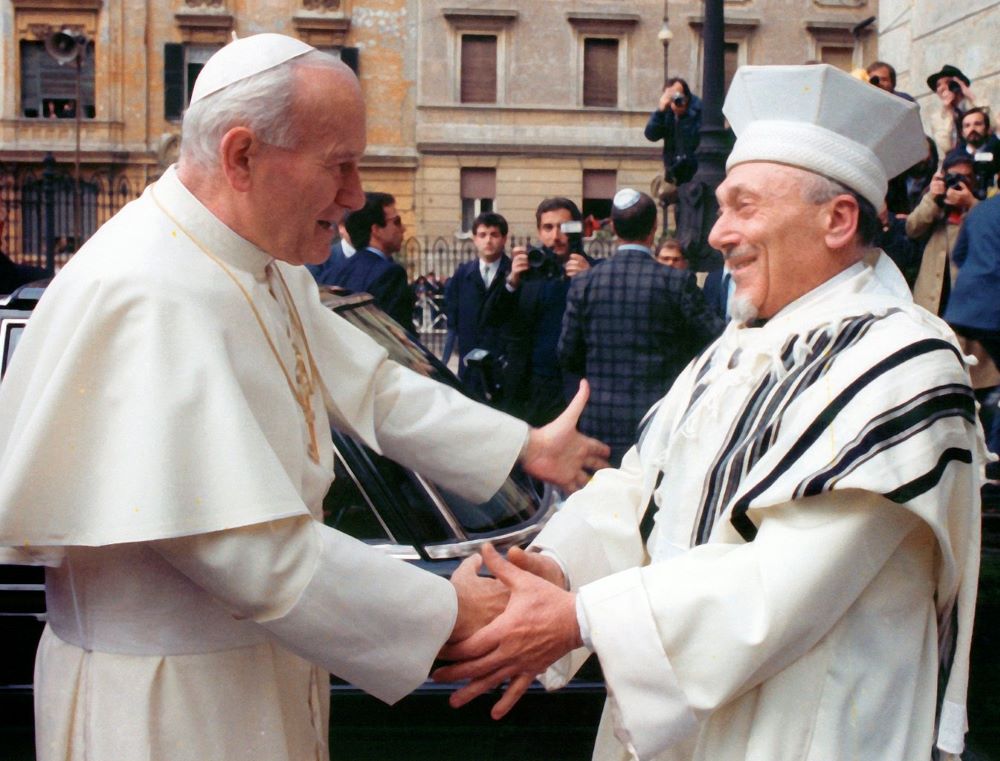
Pope John Paul II greets Rabbi Elio Toaff in 1986 at Rome's main synagogue, believed to be the oldest Jewish community in the West. (CNS file photo/Arturo Mari, L'Osservatore Romano)
Hamas, Hezbollah and Iran are engaged in a religious war rooted in another theology, one that demands Israel's annihilation. In their view, Jewish sovereignty blocks the fulfillment of history. Again, conflict centered on theology does not lend itself to compromise. It ends by the utter triumph of one side over the other.
As is written in the 1988 Hamas Covenant, Article 7:
The Prophet, Allah bless him and grant him salvation has said: "The Day of Judgement will not come about until Moslems fight the Jews (killing the Jews), when the Jew will hide behind stones and trees. The stones and trees will say O Moslems, O Abdulla, there is a Jew behind me, come and kill him."
Hamas issued a new charter in 2017 removing the Article 7 language, but not disowning it. Christians must not ignore the true nature of this eschatological assault, where there can only be winners and losers, right and wrong.
More recently, Iran acted on this religious belief by building a ring of annihilation against Israel, with Hezbollah on the northern border and Hamas on the southern border. And the world was silent.
For the past four decades, Iran placed the approximately 2.25 million Christians in Lebanon under the jackboot of Hezbollah. Israel liberated the Lebanese Christians. Israel has no offensive goals in Lebanon, other than defending against Hezbollah's genocidal aims — and Jewish people are not the only victims of Iranian terrorism. Yet, there has been no groundswell of Christian acknowledgement for this remarkable change.
Iran also actively enabled Bashar Assad in his murder of 600,000 Syrians and exile of 5 million Syrians, one-third of the population. Jewish people are not the only victims of Iranian terrorism. Once again, few Christians have spoken about Israel's role in the downfall of Assad and the possibility of a free Syria.
Israel, a few months ago, significantly limited the capacity of Iran, the world's foremost exporter of terrorism, to continue spreading its violence and bloodshed. In the past 40 years thousands of Jewish people throughout the world have been murdered by a terrorism whose return address is Iran.
Advertisement
The 15.7 million Jewish people in the world today are 0.7% of the 2.3 billion Christian population. The Jewish people are a community of the few. The Christian people are the community of the many. In the 20th century, the community of the few experienced two unimaginable events after which nothing again was ever the same: the destruction of European Jewry in the heart of Christendom and the return to sovereignty in the ancient Jewish homeland of Israel.
These two events are of monumental significance to the Christian people. The destruction of European Jewry in the very bosom of Christianity shook the foundation and efficacy of Christian faith. The Jewish return to sovereignty refuted the traditional Christian view of the Jewish people wandering homeless for rejecting Christianity. But this launched extreme end-times eschatologies, where the Jewish people are merely supporting players to a final Christian destiny, or obstacles to radical fundamentalist goals like those of Hamas.
The Jewish people and the Christian church now live after these two events — and a two-year war in Gaza. In this decisive moment, what do the churches have to say to the Jewish people about their standing in our future?