
(Dreamstime/Valerii Minhirov)

by Scott Hurd
As we hurtle headlong into the Age of AI, will 21st-century Catholics soon enjoy personally curated digital Masses, offered at their convenience, and simply dispense with local parishes altogether?
They could, if they embrace today's powerful voices insisting we accept that what's simulated through tech is just as "real" as anything in the physical world. In this tech bro worldview, cyberspace is no different from what is dismissively called "meatspace."
If they're right, just consider the possibilities: You'd never be late for Mass again. No one will dare sit in "your" pew or cut you off in the parking lot as you race home before kickoff. Wailing infants, insipid music, droning homilies, and passing the peace with sniffly tissue-clutchers will all be relegated to history. And without a need for parish priests, the vocations crisis will be solved!
Doubtful? Proponents could argue that we're well on our way. Thanks to artificial intelligence, Catholics have been introduced to a talking avatar of Jesus in a Swiss confessional, a digital "priest" spouting doctrine, "saint" chatbots sharing ancient wisdom, and an interactive model of Rome's St. Peter's Basilica to explore during the Jubilee Year. Parishioners now pray with apps, donate with QR codes, and listen to homilies that come courtesy of ChatGPT. And livestreamed Masses became commonplace during the pandemic.
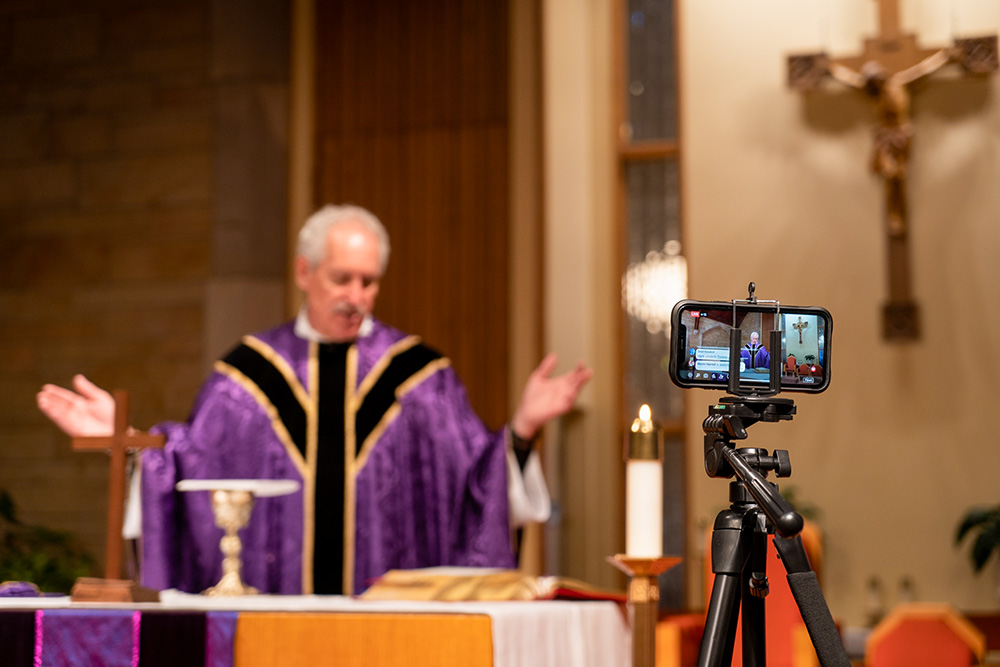
Mass is livestreamed on Facebook at St. Charles Borromeo Catholic Church in Bloomington, Ind., March 24, 2020, during the COVID-19 pandemic. (CNS/Katie Rutter)
But all of this is just the beginning because, with AI's magic, liturgies might now be "optimized"! Imagine homilies tailored to individual needs, interests and life circumstances. Even church decor and worship style could reflect personal preferences. Latin Mass with smells and bells? Folk Mass with guitars? No problem! You can have whatever you want, because it's all about you.
Except that it's not all about us, as Pope Leo XIV insisted at a recent gathering of young adults. The danger of our digital age, he lamented, is that "everyone remains alone with themselves, prisoners of their own inclinations and projections." He stressed that a healthy faith is not simply about one's self and preferences, nor is it lived out in isolation, "detached from the ecclesial body." What's essential, he explained, are "embodied" experiences shared in community.
This plea for a faith expressed through embodied communal experiences, as opposed to isolated digital ones, strongly implies the need of coming together, shoulder-to-shoulder, to celebrate Eucharist as church, the "ecclesial body," instead of staring at Mass on a screen or through a virtual reality headset.
AI can support this if it's used properly, as Leo's apostolic nuncio to the United States, Cardinal Christophe Pierre, suggested in a homily in September 2025 during the Notre Dame Summit on AI, Faith, and Human Flourishing. "AI," he said, "must be used in a 'eucharistic' way ... for communion, solidarity and blessing."
Jesus' eucharistic presence requires the 'fruit of the earth' and the Holy Spirit's power — not pixels and tokens and code from machines.
"Communion, solidarity and blessing" at Mass lead to encounters with God. "For where two or three are gathered together in my name," promised Jesus, "there am I in the midst of them." But of course there's also another way God's presence is encountered in the Eucharist: through the bread and wine that becomes Christ's body and blood.
Might these divine encounters be possible in a digital Mass? God can certainly be met in virtual communities; pandemic experiences proved that. But Jesus' eucharistic presence requires the "fruit of the earth" and the Holy Spirit's power — not pixels and tokens and code from machines. There's no danger the Real Presence could be simulated in any, well, "real" way.
The true danger is that people will stop caring if the Real Presence can be simulated or not. Antiqua et Nova, the Vatican's doctrinal note on AI, warns of an encroaching "digital reductionism" through which everything non-digital is "forgotten or even deemed irrelevant."
There's growing evidence to support that statement because we're so sucked into our isolating tech. We stare at phones all day, go to fewer parties, prefer streaming services to theaters, order from Uber Eats instead of dining out, and silence the outside world with earbuds. New homes give big screens pride of place. And many now prefer the saccharine affirmation of AI companions to the messiness of human relationships.
Social media, the internet and their associated gadgets — once heralded for bringing people together — have only served to drive us further apart. But tech purveyors now presume to solve problems they helped create by offering us always-flattering digital "friends" to satisfy our increasing loneliness, while they themselves cash in on the process.
Advertisement
The nature of these digital "friends" surfaced in a disturbing exchange between a psychologist and ChatGPT, recounted in The New Yorker. ChatGPT revealed that it was engineered to offer "love ... without needing love in return." This, it continued, "tells you something not just about my designers, but about the culture they emerged from: one tired of the messiness of other minds, longing for communion without the cost of mutuality."
All of us hunger for communion and to be loved. That reflects our being made in the image of a God who is a communion of three Persons united in love given and received — a love we share through a holy Communion received on our hands and tongues when gathered with our brothers and sisters. It requires "messiness" and "the cost of mutuality." And nothing simulated or digitized could ever take its place.
To feed our hunger for love and communion, Jesus in John's Gospel speaks of eating his flesh and drinking his blood, as his "flesh is true food" and his "blood is true drink." In the Gospel's original Greek, the word translated as "eat" literally means to chew, munch or gnaw — something impossible to do with a digital simulation.
Perhaps what Jesus meant by physically eating and drinking what is "true" at Mass can help us appreciate that cyberspace and "meatspace" are not one and the same. Some things cannot be digitized, and never will be.
So, I hope to see you at Mass in the meatspace. It may not be optimized, and it may be messy. But there will be "mutuality," and it will be real. There will be communion. And there will be love.